

104
Y. S. Dzyazko et al.
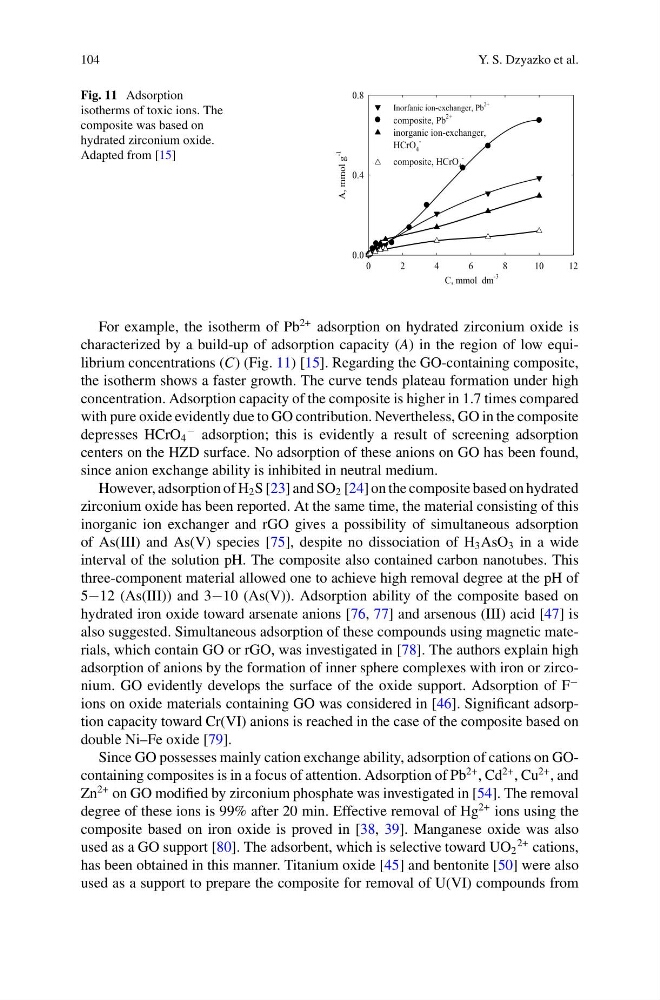
Fig. 11 Adsorption
isotherms of toxic ions. The
composite was based on
hydrated zirconium oxide.
Adapted from [15]
C, mmol dm
-3
0
2
4
6
8
1 0
1 2
A, mmol g
-1
0.0
0.4
0.8
Inorfanic ion-exchanger, Pb
2+
composite, Pb
2+
inorganic ion-exchanger,
HCrO 4
-
composite, HCrO 4
-
For example, the isotherm of Pb
2+ adsorption on hydrated zirconium oxide is
characterized by a build-up of adsorption capacity (A) in the region of low equilibrium concentrations (C) (Fig. 11) [15]. Regarding the GO-containing composite,
the isotherm shows a faster growth. The curve tends plateau formation under high
concentration. Adsorption capacity of the composite is higher in 1.7 times compared
with pure oxide evidently due to GO contribution. Nevertheless, GO in the composite
depresses HCrO 4
− adsorption; this is evidently a result of screening adsorption
centers on the HZD surface. No adsorption of these anions on GO has been found,
since anion exchange ability is inhibited in neutral medium.
However, adsorption of H 2 S [23] and SO 2 [24] on the composite based on hydrated
zirconium oxide has been reported. At the same time, the material consisting of this
inorganic ion exchanger and rGO gives a possibility of simultaneous adsorption
of As(III) and As(V) species [75], despite no dissociation of H 3 AsO 3 in a wide
interval of the solution pH. The composite also contained carbon nanotubes. This
three-component material allowed one to achieve high removal degree at the pH of
5−12 (As(III)) and 3−10 (As(V)). Adsorption ability of the composite based on
hydrated iron oxide toward arsenate anions [76, 77] and arsenous (III) acid [47] is
also suggested. Simultaneous adsorption of these compounds using magnetic materials, which contain GO or rGO, was investigated in [78]. The authors explain high
adsorption of anions by the formation of inner sphere complexes with iron or zirconium. GO evidently develops the surface of the oxide support. Adsorption of F
−
ions on oxide materials containing GO was considered in [46]. Significant adsorption capacity toward Cr(VI) anions is reached in the case of the composite based on
double Ni–Fe oxide [79].
Since GO possesses mainly cation exchange ability, adsorption of cations on GOcontaining composites is in a focus of attention. Adsorption of Pb
2+ , Cd
2+ , Cu
2+ , and
Zn
2+ on GO modified by zirconium phosphate was investigated in [54]. The removal
degree of these ions is 99% after 20 min. Effective removal of Hg
2+ ions using the
composite based on iron oxide is proved in [38, 39]. Manganese oxide was also
used as a GO support [80]. The adsorbent, which is selective toward UO 2
2+ cations,
has been obtained in this manner. Titanium oxide [45] and bentonite [50] were also
used as a support to prepare the composite for removal of U(VI) compounds from
Y. S. Dzyazko et al.
Fig. 11 Adsorption
isotherms of toxic ions. The
composite was based on
hydrated zirconium oxide.
Adapted from [15]
C, mmol dm
-3
0
2
4
6
8
1 0
1 2
A, mmol g
-1
0.0
0.4
0.8
Inorfanic ion-exchanger, Pb
2+
composite, Pb
2+
inorganic ion-exchanger,
HCrO 4
-
composite, HCrO 4
-
For example, the isotherm of Pb
2+ adsorption on hydrated zirconium oxide is
characterized by a build-up of adsorption capacity (A) in the region of low equilibrium concentrations (C) (Fig. 11) [15]. Regarding the GO-containing composite,
the isotherm shows a faster growth. The curve tends plateau formation under high
concentration. Adsorption capacity of the composite is higher in 1.7 times compared
with pure oxide evidently due to GO contribution. Nevertheless, GO in the composite
depresses HCrO 4
− adsorption; this is evidently a result of screening adsorption
centers on the HZD surface. No adsorption of these anions on GO has been found,
since anion exchange ability is inhibited in neutral medium.
However, adsorption of H 2 S [23] and SO 2 [24] on the composite based on hydrated
zirconium oxide has been reported. At the same time, the material consisting of this
inorganic ion exchanger and rGO gives a possibility of simultaneous adsorption
of As(III) and As(V) species [75], despite no dissociation of H 3 AsO 3 in a wide
interval of the solution pH. The composite also contained carbon nanotubes. This
three-component material allowed one to achieve high removal degree at the pH of
5−12 (As(III)) and 3−10 (As(V)). Adsorption ability of the composite based on
hydrated iron oxide toward arsenate anions [76, 77] and arsenous (III) acid [47] is
also suggested. Simultaneous adsorption of these compounds using magnetic materials, which contain GO or rGO, was investigated in [78]. The authors explain high
adsorption of anions by the formation of inner sphere complexes with iron or zirconium. GO evidently develops the surface of the oxide support. Adsorption of F
−
ions on oxide materials containing GO was considered in [46]. Significant adsorption capacity toward Cr(VI) anions is reached in the case of the composite based on
double Ni–Fe oxide [79].
Since GO possesses mainly cation exchange ability, adsorption of cations on GOcontaining composites is in a focus of attention. Adsorption of Pb
2+ , Cd
2+ , Cu
2+ , and
Zn
2+ on GO modified by zirconium phosphate was investigated in [54]. The removal
degree of these ions is 99% after 20 min. Effective removal of Hg
2+ ions using the
composite based on iron oxide is proved in [38, 39]. Manganese oxide was also
used as a GO support [80]. The adsorbent, which is selective toward UO 2
2+ cations,
has been obtained in this manner. Titanium oxide [45] and bentonite [50] were also
used as a support to prepare the composite for removal of U(VI) compounds from