

102
Y. S. Dzyazko et al.
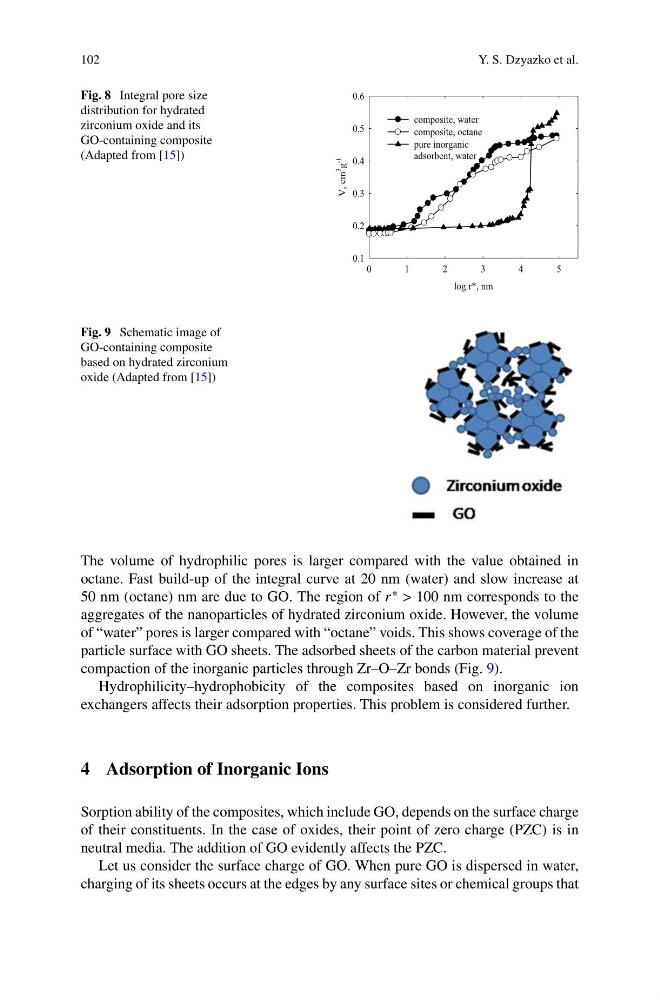
Fig. 8 Integral pore size
distribution for hydrated
zirconium oxide and its
GO-containing composite
(Adapted from [15])
log r*, nm
0
1
2
3
4
5
V, cm
3
g
-1
0.1
0.2
0.3
0.4
0.5
0.6
composite, water
composite, octane
pure inorganic
adsorbent, water
Fig. 9 Schematic image of
GO-containing composite
based on hydrated zirconium
oxide (Adapted from [15])
The volume of hydrophilic pores is larger compared with the value obtained in
octane. Fast build-up of the integral curve at 20 nm (water) and slow increase at
50 nm (octane) nm are due to GO. The region of r
∗ > 100 nm corresponds to the
aggregates of the nanoparticles of hydrated zirconium oxide. However, the volume
of “water” pores is larger compared with “octane” voids. This shows coverage of the
particle surface with GO sheets. The adsorbed sheets of the carbon material prevent
compaction of the inorganic particles through Zr–O–Zr bonds (Fig. 9).
Hydrophilicity–hydrophobicity of the composites based on inorganic ion
exchangers affects their adsorption properties. This problem is considered further.
4 Adsorption of Inorganic Ions
Sorption ability of the composites, which include GO, depends on the surface charge
of their constituents. In the case of oxides, their point of zero charge (PZC) is in
neutral media. The addition of GO evidently affects the PZC.
Let us consider the surface charge of GO. When pure GO is dispersed in water,
charging of its sheets occurs at the edges by any surface sites or chemical groups that
Y. S. Dzyazko et al.
Fig. 8 Integral pore size
distribution for hydrated
zirconium oxide and its
GO-containing composite
(Adapted from [15])
log r*, nm
0
1
2
3
4
5
V, cm
3
g
-1
0.1
0.2
0.3
0.4
0.5
0.6
composite, water
composite, octane
pure inorganic
adsorbent, water
Fig. 9 Schematic image of
GO-containing composite
based on hydrated zirconium
oxide (Adapted from [15])
The volume of hydrophilic pores is larger compared with the value obtained in
octane. Fast build-up of the integral curve at 20 nm (water) and slow increase at
50 nm (octane) nm are due to GO. The region of r
∗ > 100 nm corresponds to the
aggregates of the nanoparticles of hydrated zirconium oxide. However, the volume
of “water” pores is larger compared with “octane” voids. This shows coverage of the
particle surface with GO sheets. The adsorbed sheets of the carbon material prevent
compaction of the inorganic particles through Zr–O–Zr bonds (Fig. 9).
Hydrophilicity–hydrophobicity of the composites based on inorganic ion
exchangers affects their adsorption properties. This problem is considered further.
4 Adsorption of Inorganic Ions
Sorption ability of the composites, which include GO, depends on the surface charge
of their constituents. In the case of oxides, their point of zero charge (PZC) is in
neutral media. The addition of GO evidently affects the PZC.
Let us consider the surface charge of GO. When pure GO is dispersed in water,
charging of its sheets occurs at the edges by any surface sites or chemical groups that