

Composites Containing Inorganic Ion Exchangers …
101
r
∗
=
r
cos θ
,
(1)
where θ is the wetting angle. Both hydrophilic and hydrophobic pores are determined
with ideally wetting octane (cos θ = 1, r
∗
= r , where r is the true pore radius). Water
is used for the recognition of hydrophilic pores. For completely hydrophilic materials,
r
∗
= r . In the case of hydrophilic–hydrophobic solid, the V − r
∗ distribution is shifted
toward larger r
∗ values relatively to the curve obtained in octane. Indeed, this shift
is observed for rGO. This is typical for most materials.
As opposed to rGO, higher porosity in water medium has been found for GO. This
“superhydrophilicity” is caused for the hydration of its functional groups. From the
formal point of view, cos θ < 0. It is similar for polymer ion exchange membranes
[67] or carbon paper for gas diffusion layer of fuel cells [68]. The same results were
obtained in [15] for GO obtained according to modified Hummer’s method. The
volume of hydrophilic pores (determined with water) is larger compared with voids,
which are recognized with octane, only in the region of log r* = 0−3.5 (nm). Aerogel
of rGO, which was obtained by reduction of GO using a mixture of H 3 PO 2 and I 2 ,
possesses higher hydrophilic porosity at log r* = 0−2 (nm) [69]. It means incomplete
reduction of oxygen-containing functional groups of GO, when the chemical method
is applied. Microwave processing allows one to reach more complete reduction (see
Fig. 6b).
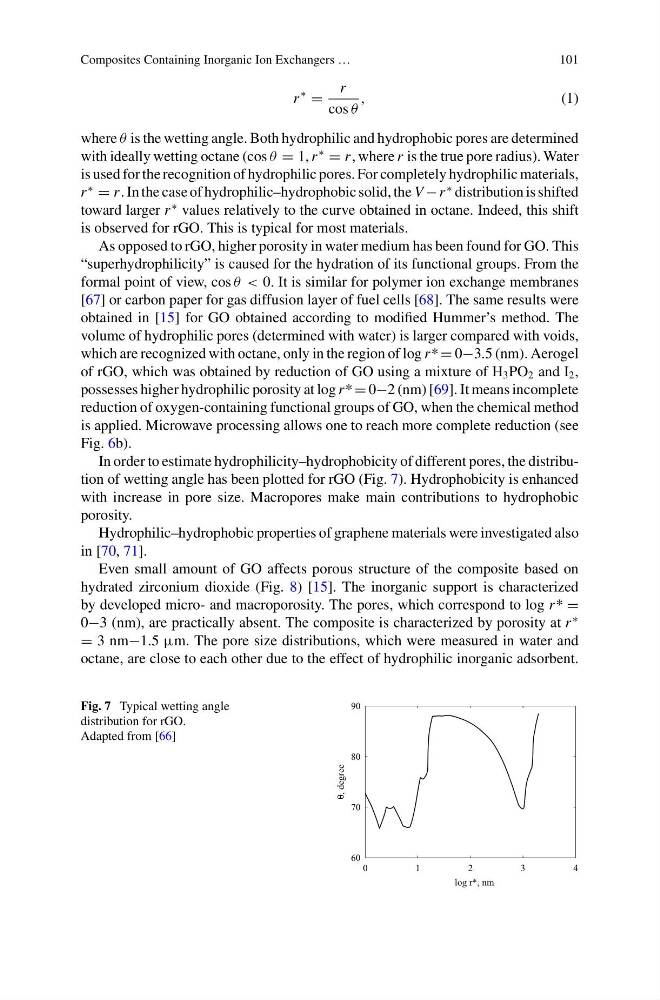
In order to estimate hydrophilicity–hydrophobicity of different pores, the distribution of wetting angle has been plotted for rGO (Fig. 7). Hydrophobicity is enhanced
with increase in pore size. Macropores make main contributions to hydrophobic
porosity.
Hydrophilic–hydrophobic properties of graphene materials were investigated also
in [70, 71].
Even small amount of GO affects porous structure of the composite based on
hydrated zirconium dioxide (Fig. 8) [15]. The inorganic support is characterized
by developed micro- and macroporosity. The pores, which correspond to log r* =
0−3 (nm), are practically absent. The composite is characterized by porosity at r
∗
= 3 nm−1.5 μm. The pore size distributions, which were measured in water and
octane, are close to each other due to the effect of hydrophilic inorganic adsorbent.
Fig. 7 Typical wetting angle
distribution for rGO.
Adapted from [66]
0
1
2
3
4
θ, degree
60
70
80
90
log r*, nm
101
r
∗
=
r
cos θ
,
(1)
where θ is the wetting angle. Both hydrophilic and hydrophobic pores are determined
with ideally wetting octane (cos θ = 1, r
∗
= r , where r is the true pore radius). Water
is used for the recognition of hydrophilic pores. For completely hydrophilic materials,
r
∗
= r . In the case of hydrophilic–hydrophobic solid, the V − r
∗ distribution is shifted
toward larger r
∗ values relatively to the curve obtained in octane. Indeed, this shift
is observed for rGO. This is typical for most materials.
As opposed to rGO, higher porosity in water medium has been found for GO. This
“superhydrophilicity” is caused for the hydration of its functional groups. From the
formal point of view, cos θ < 0. It is similar for polymer ion exchange membranes
[67] or carbon paper for gas diffusion layer of fuel cells [68]. The same results were
obtained in [15] for GO obtained according to modified Hummer’s method. The
volume of hydrophilic pores (determined with water) is larger compared with voids,
which are recognized with octane, only in the region of log r* = 0−3.5 (nm). Aerogel
of rGO, which was obtained by reduction of GO using a mixture of H 3 PO 2 and I 2 ,
possesses higher hydrophilic porosity at log r* = 0−2 (nm) [69]. It means incomplete
reduction of oxygen-containing functional groups of GO, when the chemical method
is applied. Microwave processing allows one to reach more complete reduction (see
Fig. 6b).
In order to estimate hydrophilicity–hydrophobicity of different pores, the distribution of wetting angle has been plotted for rGO (Fig. 7). Hydrophobicity is enhanced
with increase in pore size. Macropores make main contributions to hydrophobic
porosity.
Hydrophilic–hydrophobic properties of graphene materials were investigated also
in [70, 71].
Even small amount of GO affects porous structure of the composite based on
hydrated zirconium dioxide (Fig. 8) [15]. The inorganic support is characterized
by developed micro- and macroporosity. The pores, which correspond to log r* =
0−3 (nm), are practically absent. The composite is characterized by porosity at r
∗
= 3 nm−1.5 μm. The pore size distributions, which were measured in water and
octane, are close to each other due to the effect of hydrophilic inorganic adsorbent.
Fig. 7 Typical wetting angle
distribution for rGO.
Adapted from [66]
0
1
2
3
4
θ, degree
60
70
80
90
log r*, nm