

4.4 Time Domain Analysis: Proportional Damping
89
4.4.5 Earthquake Engineering
We present two applications dealing with MDOF systems subjected to support
motion, e.g., structural systems subjected to seismic shaking. The first application develops the equations of motions and solutions for this input. The second
introduces the concept of design spectrum that is used extensively in Earthquake
Engineering. These applications relate to Sect. 4.4.1 on damped systems in forced
vibration.
4.4.5.1 Seismic Ground Acceleration
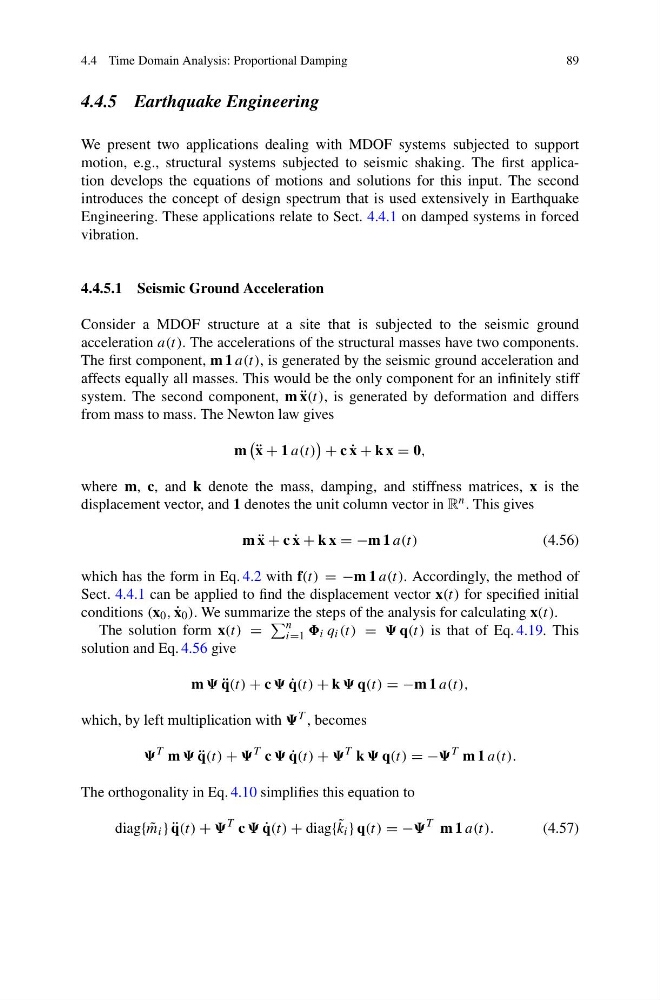
Consider a MDOF structure at a site that is subjected to the seismic ground
acceleration a(t). The accelerations of the structural masses have two components.
The first component, m 1 a(t), is generated by the seismic ground acceleration and
affects equally all masses. This would be the only component for an infinitely stiff
system. The second component, m ¨
x(t), is generated by deformation and differs
from mass to mass. The Newton law gives
m
¨
x + 1 a(t)
+ c ˙
x + k x = 0,
where m, c, and k denote the mass, damping, and stiffness matrices, x is the
displacement vector, and 1 denotes the unit column vector in R n . This gives
m ¨
x + c ˙
x + k x = −m 1 a(t)
(4.56)
which has the form in Eq. 4.2 with f(t) = −m 1 a(t). Accordingly, the method of
Sect. 4.4.1 can be applied to find the displacement vector x(t) for specified initial
conditions (x 0 , ˙
x 0 ). We summarize the steps of the analysis for calculating x(t).
The solution form x(t) =
n
i=1 i q i (t) = q(t) is that of Eq. 4.19. This
solution and Eq. 4.56 give
m ¨
q(t) + c ˙
q(t) + k q(t) = −m 1 a(t),
which, by left multiplication with T , becomes
T m ¨
q(t) +
T c ˙
q(t) +
T k q(t) = −
T m 1 a(t).
The orthogonality in Eq. 4.10 simplifies this equation to
diag{ ˜
m i } ¨
q(t) +
T c ˙
q(t) + diag{ ˜
k i } q(t) = −
T m 1 a(t).
(4.57)
89
4.4.5 Earthquake Engineering
We present two applications dealing with MDOF systems subjected to support
motion, e.g., structural systems subjected to seismic shaking. The first application develops the equations of motions and solutions for this input. The second
introduces the concept of design spectrum that is used extensively in Earthquake
Engineering. These applications relate to Sect. 4.4.1 on damped systems in forced
vibration.
4.4.5.1 Seismic Ground Acceleration
Consider a MDOF structure at a site that is subjected to the seismic ground
acceleration a(t). The accelerations of the structural masses have two components.
The first component, m 1 a(t), is generated by the seismic ground acceleration and
affects equally all masses. This would be the only component for an infinitely stiff
system. The second component, m ¨
x(t), is generated by deformation and differs
from mass to mass. The Newton law gives
m
¨
x + 1 a(t)
+ c ˙
x + k x = 0,
where m, c, and k denote the mass, damping, and stiffness matrices, x is the
displacement vector, and 1 denotes the unit column vector in R n . This gives
m ¨
x + c ˙
x + k x = −m 1 a(t)
(4.56)
which has the form in Eq. 4.2 with f(t) = −m 1 a(t). Accordingly, the method of
Sect. 4.4.1 can be applied to find the displacement vector x(t) for specified initial
conditions (x 0 , ˙
x 0 ). We summarize the steps of the analysis for calculating x(t).
The solution form x(t) =
n
i=1 i q i (t) = q(t) is that of Eq. 4.19. This
solution and Eq. 4.56 give
m ¨
q(t) + c ˙
q(t) + k q(t) = −m 1 a(t),
which, by left multiplication with T , becomes
T m ¨
q(t) +
T c ˙
q(t) +
T k q(t) = −
T m 1 a(t).
The orthogonality in Eq. 4.10 simplifies this equation to
diag{ ˜
m i } ¨
q(t) +
T c ˙
q(t) + diag{ ˜
k i } q(t) = −
T m 1 a(t).
(4.57)