

76
4 Multi-Degree of Freedom (MDOF) Systems
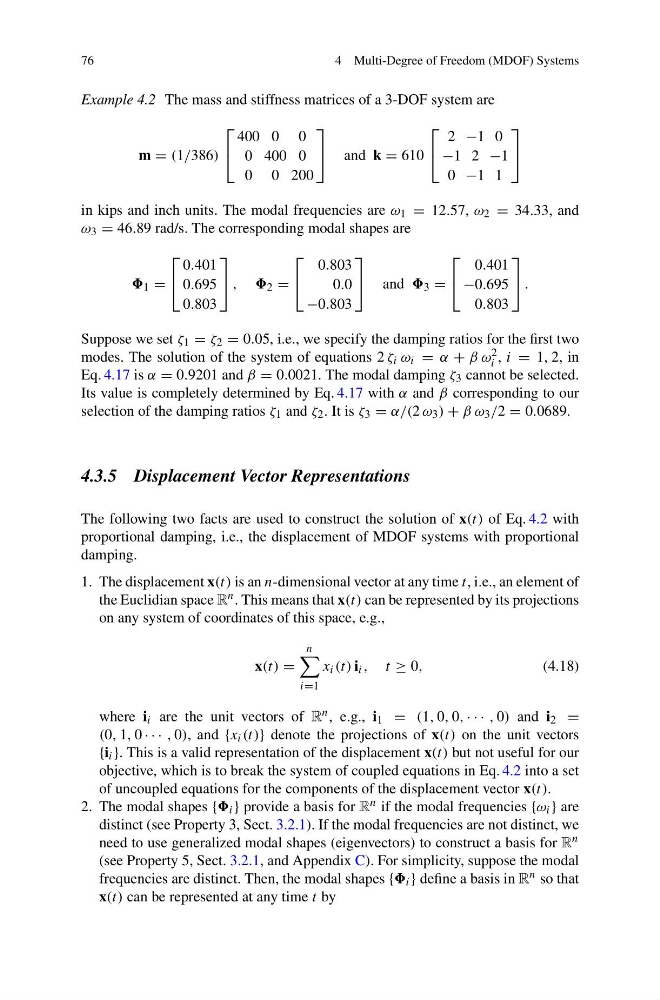
Example 4.2 The mass and stiffness matrices of a 3-DOF system are
m = (1/386)
⎡
⎣
400 0 0
0 400 0
0 0 200
⎤
⎦ and k = 610
⎡
⎣
2 −1 0
−1 2 −1
0 −1 1
⎤
⎦
in kips and inch units. The modal frequencies are ω 1 = 12.57, ω 2 = 34.33, and
ω 3 = 46.89 rad/s. The corresponding modal shapes are
1 =
⎡
⎣
0.401
0.695
0.803
⎤
⎦ , 2 =
⎡
⎣
0.803
0.0
−0.803
⎤
⎦ and 3 =
⎡
⎣
0.401
−0.695
0.803
⎤
⎦ .
Suppose we set ζ 1 = ζ 2 = 0.05, i.e., we specify the damping ratios for the first two
modes. The solution of the system of equations 2 ζ i ω i = α + β ω 2
i , i = 1, 2, in
Eq. 4.17 is α = 0.9201 and β = 0.0021. The modal damping ζ 3 cannot be selected.
Its value is completely determined by Eq. 4.17 with α and β corresponding to our
selection of the damping ratios ζ 1 and ζ 2 . It is ζ 3 = α/(2 ω 3 ) + β ω 3 /2 = 0.0689.
4.3.5 Displacement Vector Representations
The following two facts are used to construct the solution of x(t) of Eq. 4.2 with
proportional damping, i.e., the displacement of MDOF systems with proportional
damping.
1. The displacement x(t) is an n-dimensional vector at any time t, i.e., an element of
the Euclidian space R n . This means that x(t) can be represented by its projections
on any system of coordinates of this space, e.g.,
x(t) =
n
i=1
x i (t) i i , t ≥ 0,
(4.18)
where i i are the unit vectors of R n , e.g., i 1 = (1, 0, 0, · · · , 0) and i 2 =
(0, 1, 0 · · · , 0), and {x i (t)} denote the projections of x(t) on the unit vectors
{i i }. This is a valid representation of the displacement x(t) but not useful for our
objective, which is to break the system of coupled equations in Eq. 4.2 into a set
of uncoupled equations for the components of the displacement vector x(t).
2. The modal shapes { i } provide a basis for R n if the modal frequencies {ω i } are
distinct (see Property 3, Sect. 3.2.1). If the modal frequencies are not distinct, we
need to use generalized modal shapes (eigenvectors) to construct a basis for R n
(see Property 5, Sect. 3.2.1, and Appendix C). For simplicity, suppose the modal
frequencies are distinct. Then, the modal shapes { i } define a basis in R n so that
x(t) can be represented at any time t by
4 Multi-Degree of Freedom (MDOF) Systems
Example 4.2 The mass and stiffness matrices of a 3-DOF system are
m = (1/386)
⎡
⎣
400 0 0
0 400 0
0 0 200
⎤
⎦ and k = 610
⎡
⎣
2 −1 0
−1 2 −1
0 −1 1
⎤
⎦
in kips and inch units. The modal frequencies are ω 1 = 12.57, ω 2 = 34.33, and
ω 3 = 46.89 rad/s. The corresponding modal shapes are
1 =
⎡
⎣
0.401
0.695
0.803
⎤
⎦ , 2 =
⎡
⎣
0.803
0.0
−0.803
⎤
⎦ and 3 =
⎡
⎣
0.401
−0.695
0.803
⎤
⎦ .
Suppose we set ζ 1 = ζ 2 = 0.05, i.e., we specify the damping ratios for the first two
modes. The solution of the system of equations 2 ζ i ω i = α + β ω 2
i , i = 1, 2, in
Eq. 4.17 is α = 0.9201 and β = 0.0021. The modal damping ζ 3 cannot be selected.
Its value is completely determined by Eq. 4.17 with α and β corresponding to our
selection of the damping ratios ζ 1 and ζ 2 . It is ζ 3 = α/(2 ω 3 ) + β ω 3 /2 = 0.0689.
4.3.5 Displacement Vector Representations
The following two facts are used to construct the solution of x(t) of Eq. 4.2 with
proportional damping, i.e., the displacement of MDOF systems with proportional
damping.
1. The displacement x(t) is an n-dimensional vector at any time t, i.e., an element of
the Euclidian space R n . This means that x(t) can be represented by its projections
on any system of coordinates of this space, e.g.,
x(t) =
n
i=1
x i (t) i i , t ≥ 0,
(4.18)
where i i are the unit vectors of R n , e.g., i 1 = (1, 0, 0, · · · , 0) and i 2 =
(0, 1, 0 · · · , 0), and {x i (t)} denote the projections of x(t) on the unit vectors
{i i }. This is a valid representation of the displacement x(t) but not useful for our
objective, which is to break the system of coupled equations in Eq. 4.2 into a set
of uncoupled equations for the components of the displacement vector x(t).
2. The modal shapes { i } provide a basis for R n if the modal frequencies {ω i } are
distinct (see Property 3, Sect. 3.2.1). If the modal frequencies are not distinct, we
need to use generalized modal shapes (eigenvectors) to construct a basis for R n
(see Property 5, Sect. 3.2.1, and Appendix C). For simplicity, suppose the modal
frequencies are distinct. Then, the modal shapes { i } define a basis in R n so that
x(t) can be represented at any time t by