

4.4 Time Domain Analysis: Proportional Damping
77
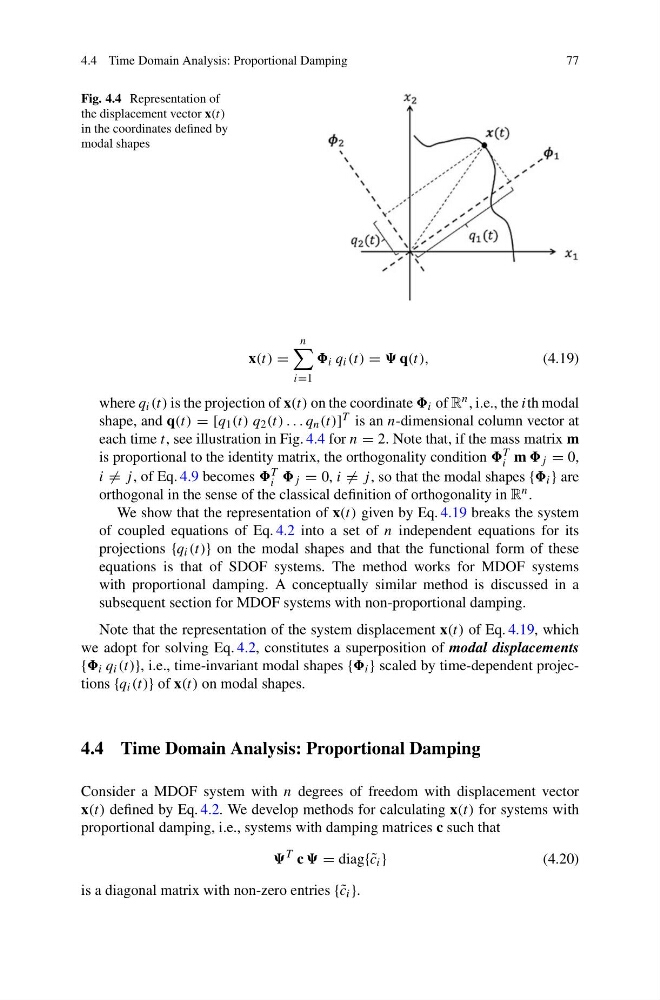
Fig. 4.4 Representation of
the displacement vector x(t)
in the coordinates defined by
modal shapes
x(t) =
n
i=1
i q i (t) = q(t),
(4.19)
where q i (t) is the projection of x(t) on the coordinate i of R n , i.e., the ith modal
shape, and q(t) = [q 1 (t) q 2 (t) . . . q n (t)] T is an n-dimensional column vector at
each time t, see illustration in Fig. 4.4 for n = 2. Note that, if the mass matrix m
is proportional to the identity matrix, the orthogonality condition T
i m j = 0,
i = j , of Eq. 4.9 becomes T
i j = 0, i = j , so that the modal shapes { i } are
orthogonal in the sense of the classical definition of orthogonality in R n .
We show that the representation of x(t) given by Eq. 4.19 breaks the system
of coupled equations of Eq. 4.2 into a set of n independent equations for its
projections {q i (t)} on the modal shapes and that the functional form of these
equations is that of SDOF systems. The method works for MDOF systems
with proportional damping. A conceptually similar method is discussed in a
subsequent section for MDOF systems with non-proportional damping.
Note that the representation of the system displacement x(t) of Eq. 4.19, which
we adopt for solving Eq. 4.2, constitutes a superposition of modal displacements
{ i q i (t)}, i.e., time-invariant modal shapes { i } scaled by time-dependent projections {q i (t)} of x(t) on modal shapes.
4.4 Time Domain Analysis: Proportional Damping
Consider a MDOF system with n degrees of freedom with displacement vector
x(t) defined by Eq. 4.2. We develop methods for calculating x(t) for systems with
proportional damping, i.e., systems with damping matrices c such that
T c = diag{ ˜
c i }
(4.20)
is a diagonal matrix with non-zero entries { ˜
c i }.
77
Fig. 4.4 Representation of
the displacement vector x(t)
in the coordinates defined by
modal shapes
x(t) =
n
i=1
i q i (t) = q(t),
(4.19)
where q i (t) is the projection of x(t) on the coordinate i of R n , i.e., the ith modal
shape, and q(t) = [q 1 (t) q 2 (t) . . . q n (t)] T is an n-dimensional column vector at
each time t, see illustration in Fig. 4.4 for n = 2. Note that, if the mass matrix m
is proportional to the identity matrix, the orthogonality condition T
i m j = 0,
i = j , of Eq. 4.9 becomes T
i j = 0, i = j , so that the modal shapes { i } are
orthogonal in the sense of the classical definition of orthogonality in R n .
We show that the representation of x(t) given by Eq. 4.19 breaks the system
of coupled equations of Eq. 4.2 into a set of n independent equations for its
projections {q i (t)} on the modal shapes and that the functional form of these
equations is that of SDOF systems. The method works for MDOF systems
with proportional damping. A conceptually similar method is discussed in a
subsequent section for MDOF systems with non-proportional damping.
Note that the representation of the system displacement x(t) of Eq. 4.19, which
we adopt for solving Eq. 4.2, constitutes a superposition of modal displacements
{ i q i (t)}, i.e., time-invariant modal shapes { i } scaled by time-dependent projections {q i (t)} of x(t) on modal shapes.
4.4 Time Domain Analysis: Proportional Damping
Consider a MDOF system with n degrees of freedom with displacement vector
x(t) defined by Eq. 4.2. We develop methods for calculating x(t) for systems with
proportional damping, i.e., systems with damping matrices c such that
T c = diag{ ˜
c i }
(4.20)
is a diagonal matrix with non-zero entries { ˜
c i }.