

4.3 Classical Modal Analysis
75
Note that the approximations overestimate ω 1 and improve as the trial deformation
u is closer to the first mode of vibration 1 . That our approximations overestimate
ω 1 is expected since, for u to be the actual deformation, we need to add geometrical
constraints that would make the structure stiffer.
4.3.4 Proportional Damping
Generally, the (n, n)-matrix T c is not diagonal, where c is the (n, n)-damping
matrix in Eq. 4.2. There is no reason to expect that the matrix T c is diagonal
since the modal shapes do not depend on c. If T c is diagonal, the damping
matrix c is said to be proportional. Otherwise, c is said to be a non-proportional
damping matrix.
To simplify the analysis, it is common to assume that the damping matrix c is
proportional. A broad range of damping matrix models have been proposed, but
perhaps the most popular is the Rayleigh model that has been introduced many
years ago [3]. The model assumes that the damping matrix is a weighted sum of the
mass and stiffness matrices, i.e.,
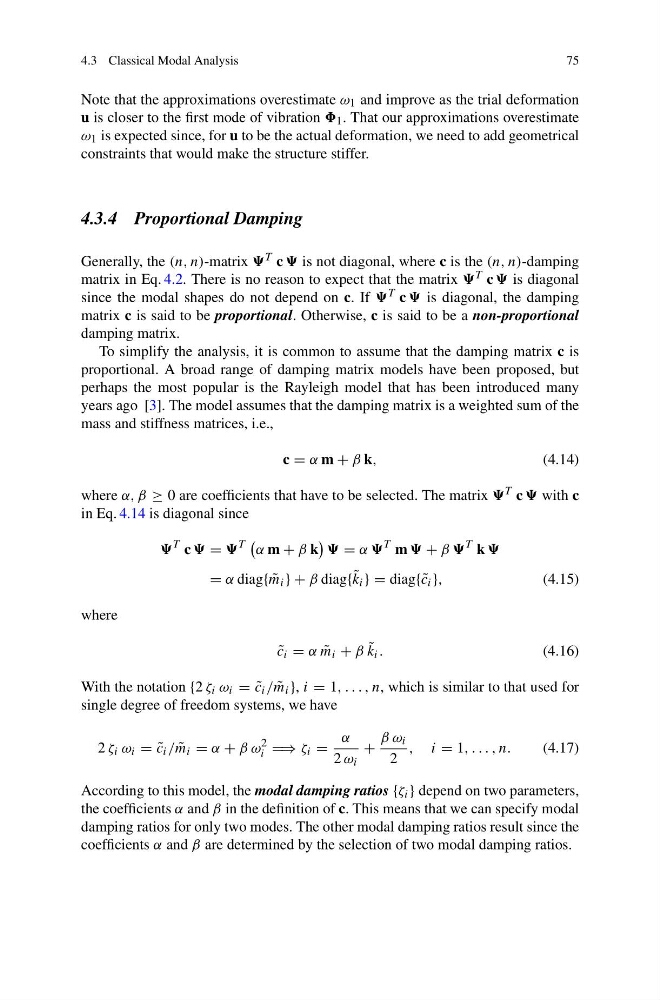
c = α m + β k,
(4.14)
where α, β ≥ 0 are coefficients that have to be selected. The matrix T c with c
in Eq. 4.14 is diagonal since
T c =
T
α m + β k
= α
T m + β
T k
= α diag{ ˜
m i } + β diag{ ˜
k i } = diag{ ˜
c i },
(4.15)
where
˜
c i = α ˜
m i + β ˜
k i .
(4.16)
With the notation {2 ζ i ω i = ˜
c i / ˜
m i }, i = 1, . . . , n, which is similar to that used for
single degree of freedom systems, we have
2 ζ i ω i = ˜
c i / ˜
m i = α + β ω
2
i ⇒ ζ i =
α
2 ω i
+
β ω i
2
, i = 1, . . . , n.
(4.17)
According to this model, the modal damping ratios {ζ i } depend on two parameters,
the coefficients α and β in the definition of c. This means that we can specify modal
damping ratios for only two modes. The other modal damping ratios result since the
coefficients α and β are determined by the selection of two modal damping ratios.
75
Note that the approximations overestimate ω 1 and improve as the trial deformation
u is closer to the first mode of vibration 1 . That our approximations overestimate
ω 1 is expected since, for u to be the actual deformation, we need to add geometrical
constraints that would make the structure stiffer.
4.3.4 Proportional Damping
Generally, the (n, n)-matrix T c is not diagonal, where c is the (n, n)-damping
matrix in Eq. 4.2. There is no reason to expect that the matrix T c is diagonal
since the modal shapes do not depend on c. If T c is diagonal, the damping
matrix c is said to be proportional. Otherwise, c is said to be a non-proportional
damping matrix.
To simplify the analysis, it is common to assume that the damping matrix c is
proportional. A broad range of damping matrix models have been proposed, but
perhaps the most popular is the Rayleigh model that has been introduced many
years ago [3]. The model assumes that the damping matrix is a weighted sum of the
mass and stiffness matrices, i.e.,
c = α m + β k,
(4.14)
where α, β ≥ 0 are coefficients that have to be selected. The matrix T c with c
in Eq. 4.14 is diagonal since
T c =
T
α m + β k
= α
T m + β
T k
= α diag{ ˜
m i } + β diag{ ˜
k i } = diag{ ˜
c i },
(4.15)
where
˜
c i = α ˜
m i + β ˜
k i .
(4.16)
With the notation {2 ζ i ω i = ˜
c i / ˜
m i }, i = 1, . . . , n, which is similar to that used for
single degree of freedom systems, we have
2 ζ i ω i = ˜
c i / ˜
m i = α + β ω
2
i ⇒ ζ i =
α
2 ω i
+
β ω i
2
, i = 1, . . . , n.
(4.17)
According to this model, the modal damping ratios {ζ i } depend on two parameters,
the coefficients α and β in the definition of c. This means that we can specify modal
damping ratios for only two modes. The other modal damping ratios result since the
coefficients α and β are determined by the selection of two modal damping ratios.