

4.3 Classical Modal Analysis
69
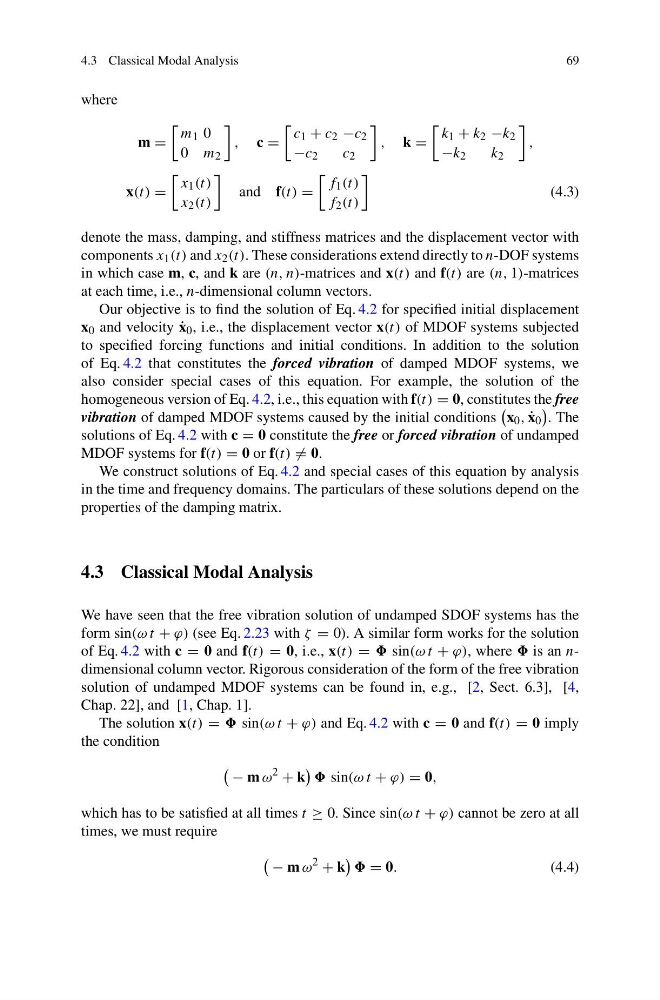
where
m =
m 1 0
0 m 2
, c =
c 1 + c 2 −c 2
−c 2
c 2
, k =
k 1 + k 2 −k 2
−k 2
k 2
,
x(t) =
x 1 (t)
x 2 (t)
and f(t) =
f 1 (t)
f 2 (t)
(4.3)
denote the mass, damping, and stiffness matrices and the displacement vector with
components x 1 (t) and x 2 (t). These considerations extend directly to n-DOF systems
in which case m, c, and k are (n, n)-matrices and x(t) and f(t) are (n, 1)-matrices
at each time, i.e., n-dimensional column vectors.
Our objective is to find the solution of Eq. 4.2 for specified initial displacement
x 0 and velocity ˙
x 0 , i.e., the displacement vector x(t) of MDOF systems subjected
to specified forcing functions and initial conditions. In addition to the solution
of Eq. 4.2 that constitutes the forced vibration of damped MDOF systems, we
also consider special cases of this equation. For example, the solution of the
homogeneous version of Eq. 4.2, i.e., this equation with f(t) = 0, constitutes the free
vibration of damped MDOF systems caused by the initial conditions
x 0 , ˙
x 0
. The
solutions of Eq. 4.2 with c = 0 constitute the free or forced vibration of undamped
MDOF systems for f(t) = 0 or f(t) = 0.
We construct solutions of Eq. 4.2 and special cases of this equation by analysis
in the time and frequency domains. The particulars of these solutions depend on the
properties of the damping matrix.
4.3 Classical Modal Analysis
We have seen that the free vibration solution of undamped SDOF systems has the
form sin(ω t + ϕ) (see Eq. 2.23 with ζ = 0). A similar form works for the solution
of Eq. 4.2 with c = 0 and f(t) = 0, i.e., x(t) = sin(ω t + ϕ), where is an ndimensional column vector. Rigorous consideration of the form of the free vibration
solution of undamped MDOF systems can be found in, e.g., [2, Sect. 6.3], [4,
Chap. 22], and [1, Chap. 1].
The solution x(t) = sin(ω t + ϕ) and Eq. 4.2 with c = 0 and f(t) = 0 imply
the condition
− m ω
2
+ k
sin(ω t + ϕ) = 0,
which has to be satisfied at all times t ≥ 0. Since sin(ω t + ϕ) cannot be zero at all
times, we must require
− m ω
2
+ k
= 0.
(4.4)
69
where
m =
m 1 0
0 m 2
, c =
c 1 + c 2 −c 2
−c 2
c 2
, k =
k 1 + k 2 −k 2
−k 2
k 2
,
x(t) =
x 1 (t)
x 2 (t)
and f(t) =
f 1 (t)
f 2 (t)
(4.3)
denote the mass, damping, and stiffness matrices and the displacement vector with
components x 1 (t) and x 2 (t). These considerations extend directly to n-DOF systems
in which case m, c, and k are (n, n)-matrices and x(t) and f(t) are (n, 1)-matrices
at each time, i.e., n-dimensional column vectors.
Our objective is to find the solution of Eq. 4.2 for specified initial displacement
x 0 and velocity ˙
x 0 , i.e., the displacement vector x(t) of MDOF systems subjected
to specified forcing functions and initial conditions. In addition to the solution
of Eq. 4.2 that constitutes the forced vibration of damped MDOF systems, we
also consider special cases of this equation. For example, the solution of the
homogeneous version of Eq. 4.2, i.e., this equation with f(t) = 0, constitutes the free
vibration of damped MDOF systems caused by the initial conditions
x 0 , ˙
x 0
. The
solutions of Eq. 4.2 with c = 0 constitute the free or forced vibration of undamped
MDOF systems for f(t) = 0 or f(t) = 0.
We construct solutions of Eq. 4.2 and special cases of this equation by analysis
in the time and frequency domains. The particulars of these solutions depend on the
properties of the damping matrix.
4.3 Classical Modal Analysis
We have seen that the free vibration solution of undamped SDOF systems has the
form sin(ω t + ϕ) (see Eq. 2.23 with ζ = 0). A similar form works for the solution
of Eq. 4.2 with c = 0 and f(t) = 0, i.e., x(t) = sin(ω t + ϕ), where is an ndimensional column vector. Rigorous consideration of the form of the free vibration
solution of undamped MDOF systems can be found in, e.g., [2, Sect. 6.3], [4,
Chap. 22], and [1, Chap. 1].
The solution x(t) = sin(ω t + ϕ) and Eq. 4.2 with c = 0 and f(t) = 0 imply
the condition
− m ω
2
+ k
sin(ω t + ϕ) = 0,
which has to be satisfied at all times t ≥ 0. Since sin(ω t + ϕ) cannot be zero at all
times, we must require
− m ω
2
+ k
= 0.
(4.4)