

60
3 Eigenvalue Problem
implies λ k x ∗T
k x k = λ ∗
k x ∗T
k x k or
λ k − λ ∗
k
x ∗T
k x k = 0. Since x ∗T
k x k = 0 (x k
is eigenvector!), we have λ k = λ ∗
k so that λ k is real. Example 3.2 illustrates this
property.
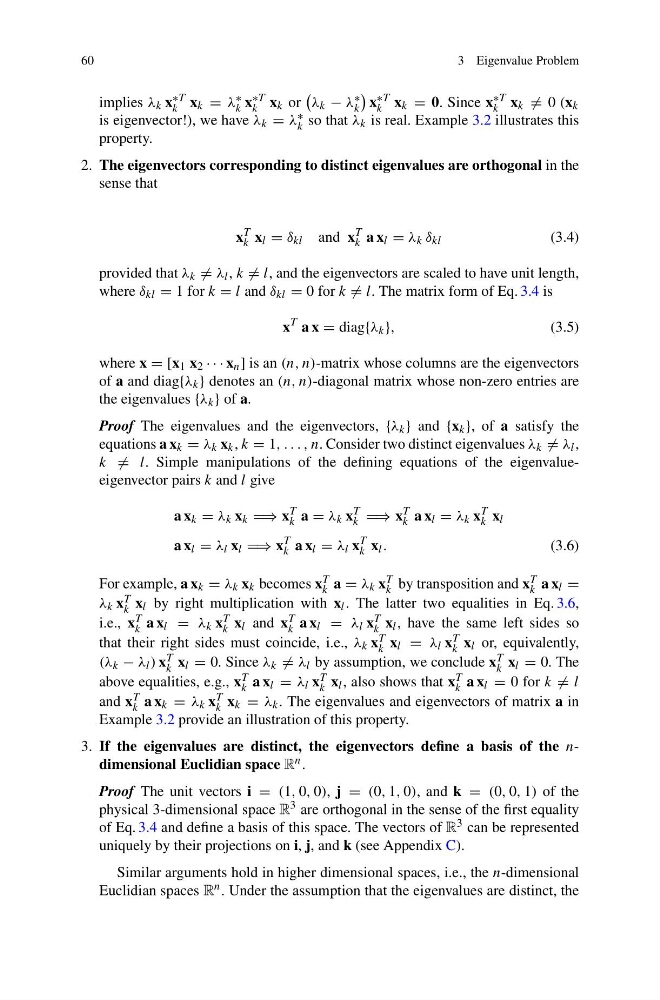
2. The eigenvectors corresponding to distinct eigenvalues are orthogonal in the
sense that
x
T
k x l = δ kl and x
T
k a x l = λ k δ kl
(3.4)
provided that λ k = λ l , k = l, and the eigenvectors are scaled to have unit length,
where δ kl = 1 for k = l and δ kl = 0 for k = l. The matrix form of Eq. 3.4 is
x
T a x = diag{λ k },
(3.5)
where x = [x 1 x 2 · · · x n ] is an (n, n)-matrix whose columns are the eigenvectors
of a and diag{λ k } denotes an (n, n)-diagonal matrix whose non-zero entries are
the eigenvalues {λ k } of a.
Proof The eigenvalues and the eigenvectors, {λ k } and {x k }, of a satisfy the
equations a x k = λ k x k , k = 1, . . . , n. Consider two distinct eigenvalues λ k = λ l ,
k = l. Simple manipulations of the defining equations of the eigenvalueeigenvector pairs k and l give
a x k = λ k x k ⇒ x
T
k a = λ k x
T
k ⇒ x
T
k a x l = λ k x
T
k x l
a x l = λ l x l ⇒ x
T
k a x l = λ l x
T
k x l .
(3.6)
For example, a x k = λ k x k becomes x T
k a = λ k x T
k by transposition and x T
k a x l =
λ k x T
k x l by right multiplication with x l . The latter two equalities in Eq. 3.6,
i.e., x T
k a x l = λ k x T
k x l and x T
k a x l = λ l x T
k x l , have the same left sides so
that their right sides must coincide, i.e., λ k x T
k x l = λ l x T
k x l or, equivalently,
(λ k − λ l ) x T
k x l = 0. Since λ k = λ l by assumption, we conclude x T
k x l = 0. The
above equalities, e.g., x T
k a x l = λ l x T
k x l , also shows that x T
k a x l = 0 for k = l
and x T
k a x k = λ k x T
k x k = λ k . The eigenvalues and eigenvectors of matrix a in
Example 3.2 provide an illustration of this property.
3. If the eigenvalues are distinct, the eigenvectors define a basis of the ndimensional Euclidian space R n .
Proof The unit vectors i = (1, 0, 0), j = (0, 1, 0), and k = (0, 0, 1) of the
physical 3-dimensional space R 3 are orthogonal in the sense of the first equality
of Eq. 3.4 and define a basis of this space. The vectors of R 3 can be represented
uniquely by their projections on i, j, and k (see Appendix C).
Similar arguments hold in higher dimensional spaces, i.e., the n-dimensional
Euclidian spaces R n . Under the assumption that the eigenvalues are distinct, the
3 Eigenvalue Problem
implies λ k x ∗T
k x k = λ ∗
k x ∗T
k x k or
λ k − λ ∗
k
x ∗T
k x k = 0. Since x ∗T
k x k = 0 (x k
is eigenvector!), we have λ k = λ ∗
k so that λ k is real. Example 3.2 illustrates this
property.
2. The eigenvectors corresponding to distinct eigenvalues are orthogonal in the
sense that
x
T
k x l = δ kl and x
T
k a x l = λ k δ kl
(3.4)
provided that λ k = λ l , k = l, and the eigenvectors are scaled to have unit length,
where δ kl = 1 for k = l and δ kl = 0 for k = l. The matrix form of Eq. 3.4 is
x
T a x = diag{λ k },
(3.5)
where x = [x 1 x 2 · · · x n ] is an (n, n)-matrix whose columns are the eigenvectors
of a and diag{λ k } denotes an (n, n)-diagonal matrix whose non-zero entries are
the eigenvalues {λ k } of a.
Proof The eigenvalues and the eigenvectors, {λ k } and {x k }, of a satisfy the
equations a x k = λ k x k , k = 1, . . . , n. Consider two distinct eigenvalues λ k = λ l ,
k = l. Simple manipulations of the defining equations of the eigenvalueeigenvector pairs k and l give
a x k = λ k x k ⇒ x
T
k a = λ k x
T
k ⇒ x
T
k a x l = λ k x
T
k x l
a x l = λ l x l ⇒ x
T
k a x l = λ l x
T
k x l .
(3.6)
For example, a x k = λ k x k becomes x T
k a = λ k x T
k by transposition and x T
k a x l =
λ k x T
k x l by right multiplication with x l . The latter two equalities in Eq. 3.6,
i.e., x T
k a x l = λ k x T
k x l and x T
k a x l = λ l x T
k x l , have the same left sides so
that their right sides must coincide, i.e., λ k x T
k x l = λ l x T
k x l or, equivalently,
(λ k − λ l ) x T
k x l = 0. Since λ k = λ l by assumption, we conclude x T
k x l = 0. The
above equalities, e.g., x T
k a x l = λ l x T
k x l , also shows that x T
k a x l = 0 for k = l
and x T
k a x k = λ k x T
k x k = λ k . The eigenvalues and eigenvectors of matrix a in
Example 3.2 provide an illustration of this property.
3. If the eigenvalues are distinct, the eigenvectors define a basis of the ndimensional Euclidian space R n .
Proof The unit vectors i = (1, 0, 0), j = (0, 1, 0), and k = (0, 0, 1) of the
physical 3-dimensional space R 3 are orthogonal in the sense of the first equality
of Eq. 3.4 and define a basis of this space. The vectors of R 3 can be represented
uniquely by their projections on i, j, and k (see Appendix C).
Similar arguments hold in higher dimensional spaces, i.e., the n-dimensional
Euclidian spaces R n . Under the assumption that the eigenvalues are distinct, the