

3.2 Eigenvalue Problem
61
orthogonality conditions x T
k x l = δ kl hold for all pairs of eigenvectors so that the
eigenvectors are linearly independent and define a basis for R n . Any element of
this space, i.e., any n-dimensional vector, can be represented by its projections
on the eigenvectors of matrix a (see Appendix C).
4. A matrix a is positive definite if and only if its eigenvalues are positive and
distinct.
Proof Recall that a is positive definite if x T a x > 0 for any n-dimensional nonzero vector x, i.e., x = 0, and that the eigenvalues of a are real since this matrix
is assumed to be symmetric with real entries.
Suppose first that a is positive definite. Then x T
k a x k > 0, k = 1, . . . , n, since
x k is an n-dimensional vector. We conclude that λ k > 0 since x T
k a x k = λ k , see
the second equality on Eq. 3.4 with k = l.
Suppose now that λ k > 0 and consider an arbitrary n-dimensional vector.
This vector admits the representation x =
n
k=1 α k x k , where {α k } denote the
projections of x on the system of coordinates defined by the eigenvectors {x k }.
This representation is valid by the previous property (see also Appendix C).
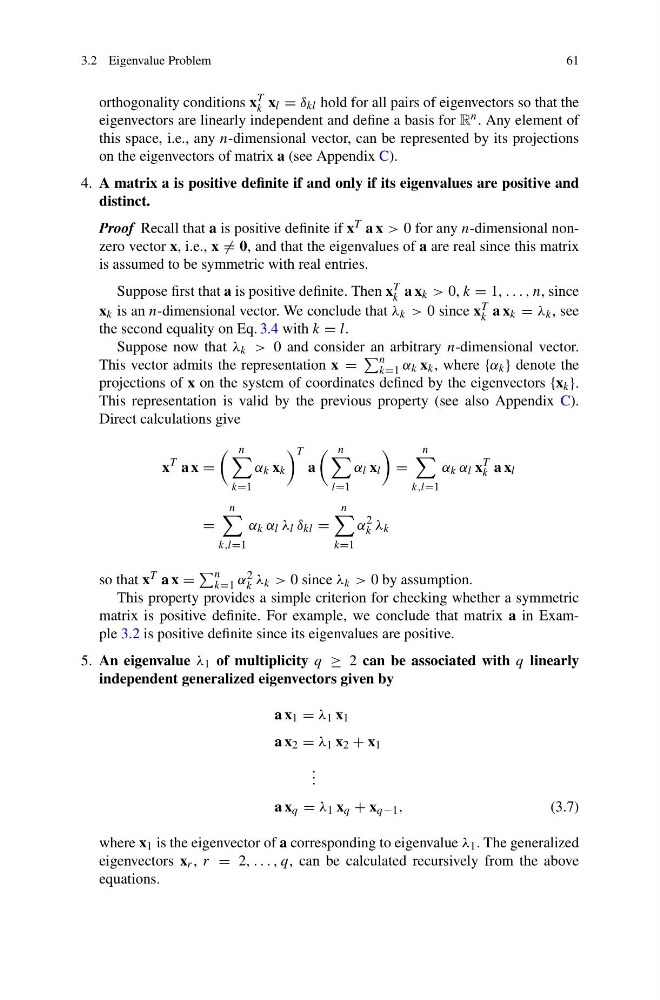
Direct calculations give
x
T a x =
n
k=1
α k x k
T
a
n
l=1
α l x l
=
n
k,l=1
α k α l x
T
k a x l
=
n
k,l=1
α k α l λ l δ kl =
n
k=1
α
2
k λ k
so that x T a x =
n
k=1 α 2
k λ k > 0 since λ k > 0 by assumption.
This property provides a simple criterion for checking whether a symmetric
matrix is positive definite. For example, we conclude that matrix a in Example 3.2 is positive definite since its eigenvalues are positive.
5. An eigenvalue λ 1 of multiplicity q ≥ 2 can be associated with q linearly
independent generalized eigenvectors given by
a x 1 = λ 1 x 1
a x 2 = λ 1 x 2 + x 1
. . .
a x q = λ 1 x q + x q−1 ,
(3.7)
where x 1 is the eigenvector of a corresponding to eigenvalue λ 1 . The generalized
eigenvectors x r , r = 2, . . . , q, can be calculated recursively from the above
equations.
61
orthogonality conditions x T
k x l = δ kl hold for all pairs of eigenvectors so that the
eigenvectors are linearly independent and define a basis for R n . Any element of
this space, i.e., any n-dimensional vector, can be represented by its projections
on the eigenvectors of matrix a (see Appendix C).
4. A matrix a is positive definite if and only if its eigenvalues are positive and
distinct.
Proof Recall that a is positive definite if x T a x > 0 for any n-dimensional nonzero vector x, i.e., x = 0, and that the eigenvalues of a are real since this matrix
is assumed to be symmetric with real entries.
Suppose first that a is positive definite. Then x T
k a x k > 0, k = 1, . . . , n, since
x k is an n-dimensional vector. We conclude that λ k > 0 since x T
k a x k = λ k , see
the second equality on Eq. 3.4 with k = l.
Suppose now that λ k > 0 and consider an arbitrary n-dimensional vector.
This vector admits the representation x =
n
k=1 α k x k , where {α k } denote the
projections of x on the system of coordinates defined by the eigenvectors {x k }.
This representation is valid by the previous property (see also Appendix C).
Direct calculations give
x
T a x =
n
k=1
α k x k
T
a
n
l=1
α l x l
=
n
k,l=1
α k α l x
T
k a x l
=
n
k,l=1
α k α l λ l δ kl =
n
k=1
α
2
k λ k
so that x T a x =
n
k=1 α 2
k λ k > 0 since λ k > 0 by assumption.
This property provides a simple criterion for checking whether a symmetric
matrix is positive definite. For example, we conclude that matrix a in Example 3.2 is positive definite since its eigenvalues are positive.
5. An eigenvalue λ 1 of multiplicity q ≥ 2 can be associated with q linearly
independent generalized eigenvectors given by
a x 1 = λ 1 x 1
a x 2 = λ 1 x 2 + x 1
. . .
a x q = λ 1 x q + x q−1 ,
(3.7)
where x 1 is the eigenvector of a corresponding to eigenvalue λ 1 . The generalized
eigenvectors x r , r = 2, . . . , q, can be calculated recursively from the above
equations.