

Appendix B
Linear Differential Equations
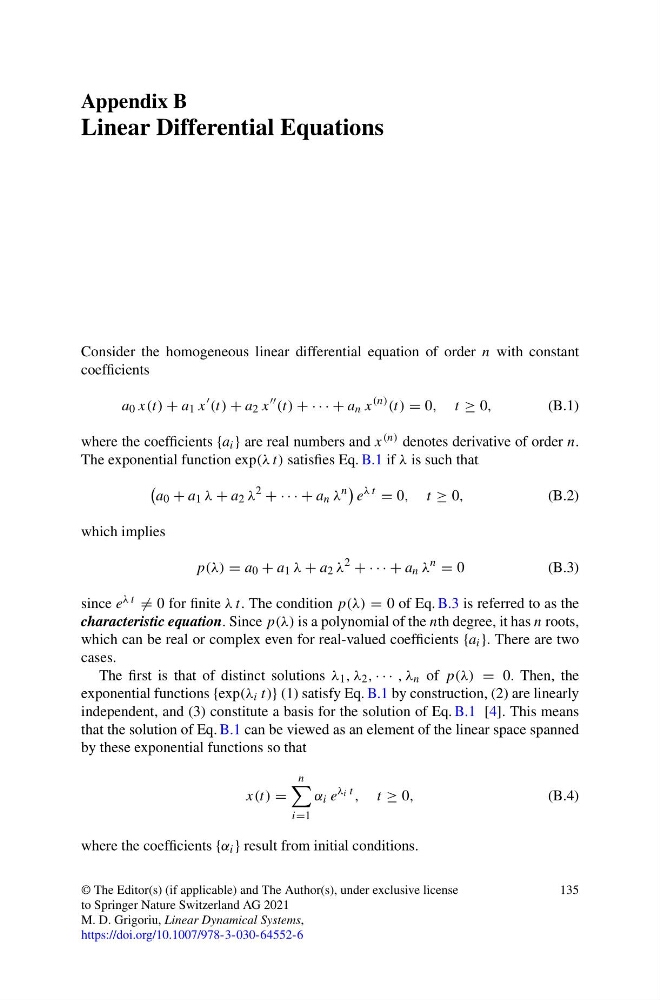
Consider the homogeneous linear differential equation of order n with constant
coefficients
a 0 x(t) + a 1 x
(t) + a 2 x
(t) + · · · + a n x
(n) (t) = 0, t ≥ 0,
(B.1)
where the coefficients {a i } are real numbers and x (n) denotes derivative of order n.
The exponential function exp(λ t) satisfies Eq. B.1 if λ is such that
a 0 + a 1 λ + a 2 λ
2
+ · · · + a n λ
n
e
λ t
= 0, t ≥ 0,
(B.2)
which implies
p(λ) = a 0 + a 1 λ + a 2 λ
2
+ · · · + a n λ
n
= 0
( B . 3 )
since e λ t = 0 for finite λ t. The condition p(λ) = 0 of Eq. B.3 is referred to as the
characteristic equation. Since p(λ) is a polynomial of the nth degree, it has n roots,
which can be real or complex even for real-valued coefficients {a i }. There are two
cases.
The first is that of distinct solutions λ 1 , λ 2 , · · · , λ n of p(λ) = 0. Then, the
exponential functions {exp(λ i t)} (1) satisfy Eq. B.1 by construction, (2) are linearly
independent, and (3) constitute a basis for the solution of Eq. B.1 [4]. This means
that the solution of Eq. B.1 can be viewed as an element of the linear space spanned
by these exponential functions so that
x(t) =
n
i=1
α i e
λ i t , t ≥ 0,
(B.4)
where the coefficients {α i } result from initial conditions.
© The Editor(s) (if applicable) and The Author(s), under exclusive license
to Springer Nature Switzerland AG 2021
M. D. Grigoriu, Linear Dynamical Systems,
https://doi.org/10.1007/978-3-030-64552-6
135
Linear Differential Equations
Consider the homogeneous linear differential equation of order n with constant
coefficients
a 0 x(t) + a 1 x
(t) + a 2 x
(t) + · · · + a n x
(n) (t) = 0, t ≥ 0,
(B.1)
where the coefficients {a i } are real numbers and x (n) denotes derivative of order n.
The exponential function exp(λ t) satisfies Eq. B.1 if λ is such that
a 0 + a 1 λ + a 2 λ
2
+ · · · + a n λ
n
e
λ t
= 0, t ≥ 0,
(B.2)
which implies
p(λ) = a 0 + a 1 λ + a 2 λ
2
+ · · · + a n λ
n
= 0
( B . 3 )
since e λ t = 0 for finite λ t. The condition p(λ) = 0 of Eq. B.3 is referred to as the
characteristic equation. Since p(λ) is a polynomial of the nth degree, it has n roots,
which can be real or complex even for real-valued coefficients {a i }. There are two
cases.
The first is that of distinct solutions λ 1 , λ 2 , · · · , λ n of p(λ) = 0. Then, the
exponential functions {exp(λ i t)} (1) satisfy Eq. B.1 by construction, (2) are linearly
independent, and (3) constitute a basis for the solution of Eq. B.1 [4]. This means
that the solution of Eq. B.1 can be viewed as an element of the linear space spanned
by these exponential functions so that
x(t) =
n
i=1
α i e
λ i t , t ≥ 0,
(B.4)
where the coefficients {α i } result from initial conditions.
© The Editor(s) (if applicable) and The Author(s), under exclusive license
to Springer Nature Switzerland AG 2021
M. D. Grigoriu, Linear Dynamical Systems,
https://doi.org/10.1007/978-3-030-64552-6
135