

134
A Taylor Series
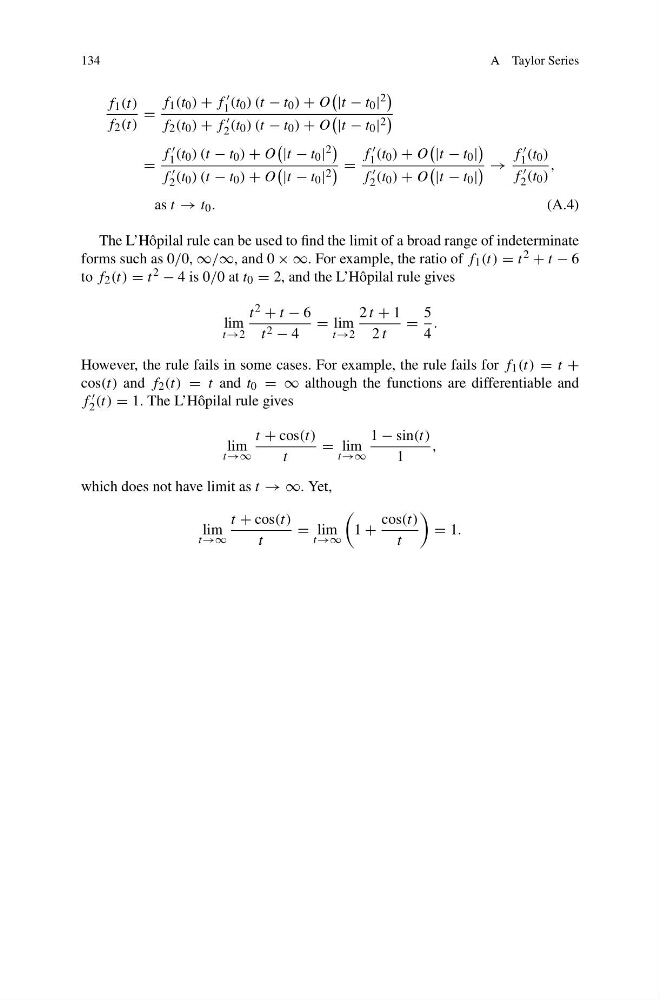
f 1 (t)
f 2 (t)
=
f 1 (t 0 ) + f
1 (t 0 ) (t − t 0 ) + O
|t − t 0 | 2
f 2 (t 0 ) + f
2 (t 0 ) (t − t 0 ) + O
|t − t 0 | 2
=
f
1 (t 0 ) (t − t 0 ) + O
|t − t 0 | 2
f
2 (t 0 ) (t − t 0 ) + O
|t − t 0 | 2
=
f
1 (t 0 ) + O
|t − t 0 |
f
2 (t 0 ) + O
|t − t 0 |
→
f
1 (t 0 )
f
2 (t 0 )
,
as t → t 0 .
(A.4)
The L’Hôpilal rule can be used to find the limit of a broad range of indeterminate
forms such as 0/0, ∞/∞, and 0 × ∞. For example, the ratio of f 1 (t) = t 2 + t − 6
to f 2 (t) = t 2 − 4 is 0/0 at t 0 = 2, and the L’Hôpilal rule gives
lim
t→2
t 2 + t − 6
t 2 − 4
= lim
t→2
2 t + 1
2 t
=
5
4
.
However, the rule fails in some cases. For example, the rule fails for f 1 (t) = t +
cos(t) and f 2 (t) = t and t 0 = ∞ although the functions are differentiable and
f
2 (t) = 1. The L’Hôpilal rule gives
lim
t→∞
t + cos(t)
t
= lim
t→∞
1 − sin(t)
1
,
which does not have limit as t → ∞. Yet,
lim
t→∞
t + cos(t)
t
= lim
t→∞
1 +
cos(t)
t
= 1.
A Taylor Series
f 1 (t)
f 2 (t)
=
f 1 (t 0 ) + f
1 (t 0 ) (t − t 0 ) + O
|t − t 0 | 2
f 2 (t 0 ) + f
2 (t 0 ) (t − t 0 ) + O
|t − t 0 | 2
=
f
1 (t 0 ) (t − t 0 ) + O
|t − t 0 | 2
f
2 (t 0 ) (t − t 0 ) + O
|t − t 0 | 2
=
f
1 (t 0 ) + O
|t − t 0 |
f
2 (t 0 ) + O
|t − t 0 |
→
f
1 (t 0 )
f
2 (t 0 )
,
as t → t 0 .
(A.4)
The L’Hôpilal rule can be used to find the limit of a broad range of indeterminate
forms such as 0/0, ∞/∞, and 0 × ∞. For example, the ratio of f 1 (t) = t 2 + t − 6
to f 2 (t) = t 2 − 4 is 0/0 at t 0 = 2, and the L’Hôpilal rule gives
lim
t→2
t 2 + t − 6
t 2 − 4
= lim
t→2
2 t + 1
2 t
=
5
4
.
However, the rule fails in some cases. For example, the rule fails for f 1 (t) = t +
cos(t) and f 2 (t) = t and t 0 = ∞ although the functions are differentiable and
f
2 (t) = 1. The L’Hôpilal rule gives
lim
t→∞
t + cos(t)
t
= lim
t→∞
1 − sin(t)
1
,
which does not have limit as t → ∞. Yet,
lim
t→∞
t + cos(t)
t
= lim
t→∞
1 +
cos(t)
t
= 1.