

124
5 Continuous Systems
5.2 Shear Beams
Shear beams provide simple models for the propagation of seismic waves from
ruptures along faults through soil. Their displacement functions satisfy onedimensional wave equations that are solved by following the approach of the
previous section.
5.2.1 Physical System and Equations of Motion
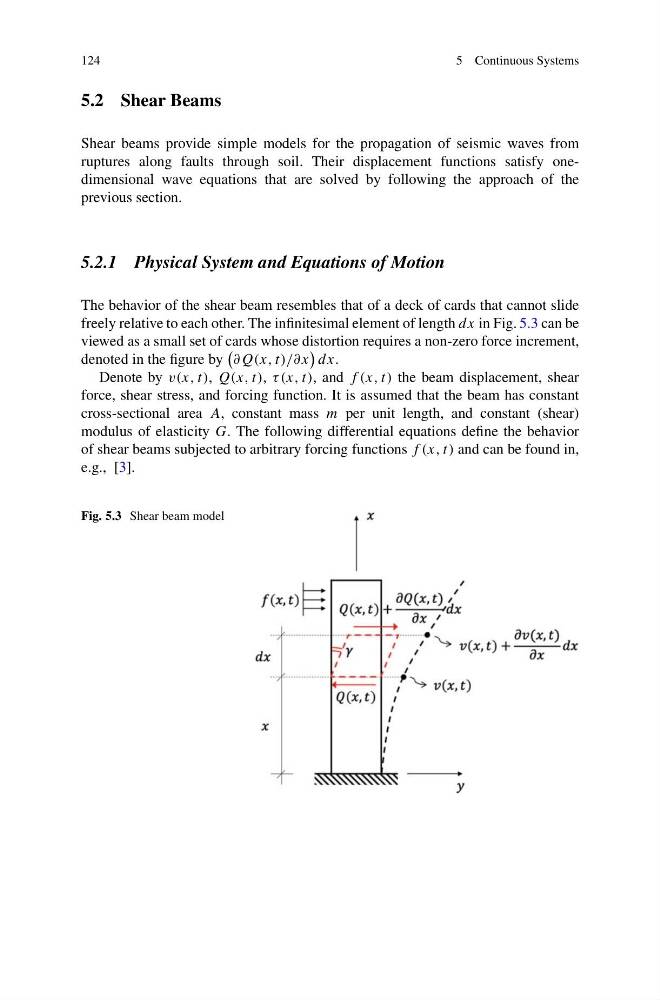
The behavior of the shear beam resembles that of a deck of cards that cannot slide
freely relative to each other. The infinitesimal element of length dx in Fig. 5.3 can be
viewed as a small set of cards whose distortion requires a non-zero force increment,
denoted in the figure by
∂Q(x, t)/∂x
dx.
Denote by v(x, t), Q(x, t), τ (x, t), and f (x, t) the beam displacement, shear
force, shear stress, and forcing function. It is assumed that the beam has constant
cross-sectional area A, constant mass m per unit length, and constant (shear)
modulus of elasticity G. The following differential equations define the behavior
of shear beams subjected to arbitrary forcing functions f (x, t) and can be found in,
e.g., [3].
Fig. 5.3 Shear beam model
5 Continuous Systems
5.2 Shear Beams
Shear beams provide simple models for the propagation of seismic waves from
ruptures along faults through soil. Their displacement functions satisfy onedimensional wave equations that are solved by following the approach of the
previous section.
5.2.1 Physical System and Equations of Motion
The behavior of the shear beam resembles that of a deck of cards that cannot slide
freely relative to each other. The infinitesimal element of length dx in Fig. 5.3 can be
viewed as a small set of cards whose distortion requires a non-zero force increment,
denoted in the figure by
∂Q(x, t)/∂x
dx.
Denote by v(x, t), Q(x, t), τ (x, t), and f (x, t) the beam displacement, shear
force, shear stress, and forcing function. It is assumed that the beam has constant
cross-sectional area A, constant mass m per unit length, and constant (shear)
modulus of elasticity G. The following differential equations define the behavior
of shear beams subjected to arbitrary forcing functions f (x, t) and can be found in,
e.g., [3].
Fig. 5.3 Shear beam model