

5.1 Flexural Beams
123
l
0
v 0 (x) ϕ r (x) dx =
∞
n=1
l
0
ϕ n (x) ϕ r (x) dx
q n,0 =
l
2
q r,0 and
l
0
˙
v 0 (x) ϕ r (x) dx =
∞
n=1
l
0
ϕ n (x) ϕ r (x) dx
˙
q n,0 =
l
2
˙
q r,0 , r = 1, 2, . . . ,
(5.18)
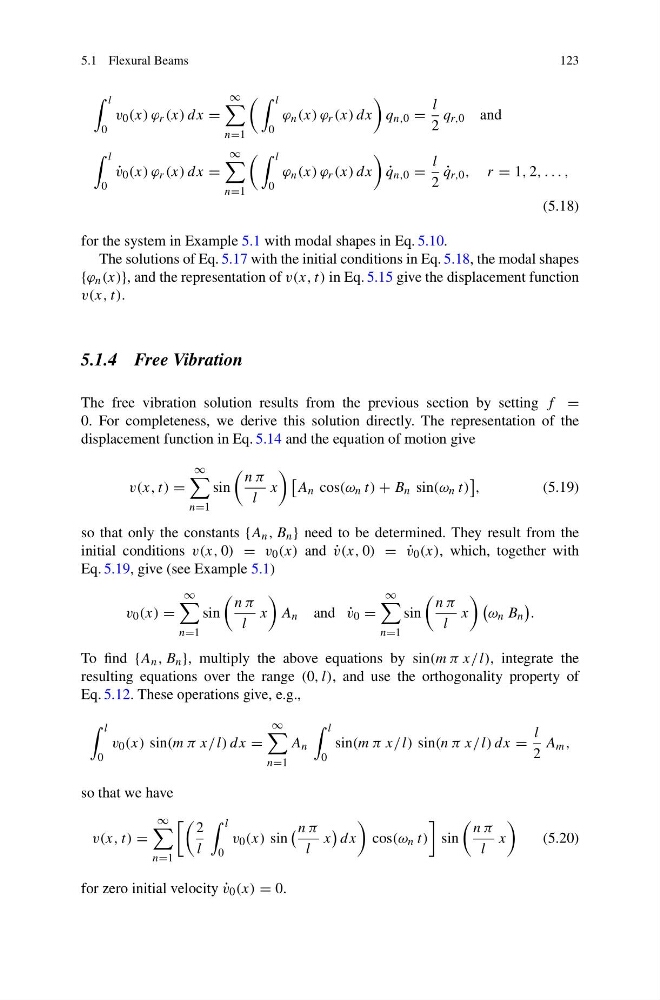
for the system in Example 5.1 with modal shapes in Eq. 5.10.
The solutions of Eq. 5.17 with the initial conditions in Eq. 5.18, the modal shapes
{ϕ n (x)}, and the representation of v(x, t) in Eq. 5.15 give the displacement function
v(x, t).
5.1.4 Free Vibration
The free vibration solution results from the previous section by setting f =
0. For completeness, we derive this solution directly. The representation of the
displacement function in Eq. 5.14 and the equation of motion give
v(x, t) =
∞
n=1
sin
n π
l
x
A n cos(ω n t) + B n sin(ω n t)
,
(5.19)
so that only the constants {A n , B n } need to be determined. They result from the
initial conditions v(x, 0) = v 0 (x) and ˙
v(x, 0) = ˙
v 0 (x), which, together with
Eq. 5.19, give (see Example 5.1)
v 0 (x) =
∞
n=1
sin
n π
l
x
A n and ˙
v 0 =
∞
n=1
sin
n π
l
x
ω n B n
.
To find {A n , B n }, multiply the above equations by sin(m π x/ l), integrate the
resulting equations over the range (0, l), and use the orthogonality property of
Eq. 5.12. These operations give, e.g.,
l
0
v 0 (x) sin(m π x/ l) dx =
∞
n=1
A n
l
0
sin(m π x/ l) sin(n π x/ l) dx =
l
2
A m ,
so that we have
v(x, t) =
∞
n=1
2
l
l
0
v 0 (x) sin
n π
l
x
dx
cos(ω n t)
sin
n π
l
x
(5.20)
for zero initial velocity ˙
v 0 (x) = 0.
123
l
0
v 0 (x) ϕ r (x) dx =
∞
n=1
l
0
ϕ n (x) ϕ r (x) dx
q n,0 =
l
2
q r,0 and
l
0
˙
v 0 (x) ϕ r (x) dx =
∞
n=1
l
0
ϕ n (x) ϕ r (x) dx
˙
q n,0 =
l
2
˙
q r,0 , r = 1, 2, . . . ,
(5.18)
for the system in Example 5.1 with modal shapes in Eq. 5.10.
The solutions of Eq. 5.17 with the initial conditions in Eq. 5.18, the modal shapes
{ϕ n (x)}, and the representation of v(x, t) in Eq. 5.15 give the displacement function
v(x, t).
5.1.4 Free Vibration
The free vibration solution results from the previous section by setting f =
0. For completeness, we derive this solution directly. The representation of the
displacement function in Eq. 5.14 and the equation of motion give
v(x, t) =
∞
n=1
sin
n π
l
x
A n cos(ω n t) + B n sin(ω n t)
,
(5.19)
so that only the constants {A n , B n } need to be determined. They result from the
initial conditions v(x, 0) = v 0 (x) and ˙
v(x, 0) = ˙
v 0 (x), which, together with
Eq. 5.19, give (see Example 5.1)
v 0 (x) =
∞
n=1
sin
n π
l
x
A n and ˙
v 0 =
∞
n=1
sin
n π
l
x
ω n B n
.
To find {A n , B n }, multiply the above equations by sin(m π x/ l), integrate the
resulting equations over the range (0, l), and use the orthogonality property of
Eq. 5.12. These operations give, e.g.,
l
0
v 0 (x) sin(m π x/ l) dx =
∞
n=1
A n
l
0
sin(m π x/ l) sin(n π x/ l) dx =
l
2
A m ,
so that we have
v(x, t) =
∞
n=1
2
l
l
0
v 0 (x) sin
n π
l
x
dx
cos(ω n t)
sin
n π
l
x
(5.20)
for zero initial velocity ˙
v 0 (x) = 0.