

122
5 Continuous Systems
5.1.3 Forced Vibration
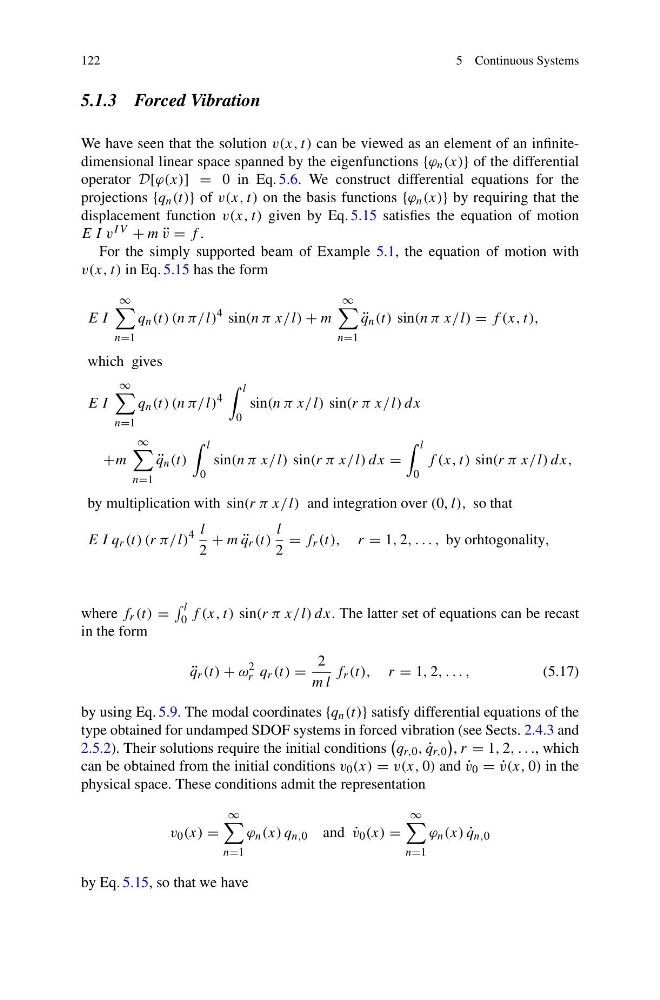
We have seen that the solution v(x, t) can be viewed as an element of an infinitedimensional linear space spanned by the eigenfunctions {ϕ n (x)} of the differential
operator D[ϕ(x)] = 0 in Eq. 5.6. We construct differential equations for the
projections {q n (t)} of v(x, t) on the basis functions {ϕ n (x)} by requiring that the
displacement function v(x, t) given by Eq. 5.15 satisfies the equation of motion
E I v I V + m ¨
v = f .
For the simply supported beam of Example 5.1, the equation of motion with
v(x, t) in Eq. 5.15 has the form
E I
∞
n=1
q n (t) (n π/ l)
4 sin(n π x/ l) + m
∞
n=1
¨
q n (t) sin(n π x/ l) = f (x, t),
which gives
E I
∞
n=1
q n (t) (n π/ l)
4
l
0
sin(n π x/ l) sin(r π x/ l) dx
+m
∞
n=1
¨
q n (t)
l
0
sin(n π x/ l) sin(r π x/ l) dx =
l
0
f (x, t) sin(r π x/ l) dx,
by multiplication with sin(r π x/ l) and integration over (0, l), so that
E I q r (t) (r π/ l)
4 l
2
+ m ¨
q r (t)
l
2
= f r (t), r = 1, 2, . . . , by orhtogonality,
where f r (t) =
l
0 f (x, t) sin(r π x/ l) dx. The latter set of equations can be recast
in the form
¨
q r (t) + ω
2
r q r (t) =
2
m l
f r (t), r = 1, 2, . . . ,
(5.17)
by using Eq. 5.9. The modal coordinates {q n (t)} satisfy differential equations of the
type obtained for undamped SDOF systems in forced vibration (see Sects. 2.4.3 and
2.5.2). Their solutions require the initial conditions
q r,0 , ˙
q r,0
, r = 1, 2, . . ., which
can be obtained from the initial conditions v 0 (x) = v(x, 0) and ˙
v 0 = ˙
v(x, 0) in the
physical space. These conditions admit the representation
v 0 (x) =
∞
n=1
ϕ n (x) q n,0 and ˙
v 0 (x) =
∞
n=1
ϕ n (x) ˙
q n,0
by Eq. 5.15, so that we have
5 Continuous Systems
5.1.3 Forced Vibration
We have seen that the solution v(x, t) can be viewed as an element of an infinitedimensional linear space spanned by the eigenfunctions {ϕ n (x)} of the differential
operator D[ϕ(x)] = 0 in Eq. 5.6. We construct differential equations for the
projections {q n (t)} of v(x, t) on the basis functions {ϕ n (x)} by requiring that the
displacement function v(x, t) given by Eq. 5.15 satisfies the equation of motion
E I v I V + m ¨
v = f .
For the simply supported beam of Example 5.1, the equation of motion with
v(x, t) in Eq. 5.15 has the form
E I
∞
n=1
q n (t) (n π/ l)
4 sin(n π x/ l) + m
∞
n=1
¨
q n (t) sin(n π x/ l) = f (x, t),
which gives
E I
∞
n=1
q n (t) (n π/ l)
4
l
0
sin(n π x/ l) sin(r π x/ l) dx
+m
∞
n=1
¨
q n (t)
l
0
sin(n π x/ l) sin(r π x/ l) dx =
l
0
f (x, t) sin(r π x/ l) dx,
by multiplication with sin(r π x/ l) and integration over (0, l), so that
E I q r (t) (r π/ l)
4 l
2
+ m ¨
q r (t)
l
2
= f r (t), r = 1, 2, . . . , by orhtogonality,
where f r (t) =
l
0 f (x, t) sin(r π x/ l) dx. The latter set of equations can be recast
in the form
¨
q r (t) + ω
2
r q r (t) =
2
m l
f r (t), r = 1, 2, . . . ,
(5.17)
by using Eq. 5.9. The modal coordinates {q n (t)} satisfy differential equations of the
type obtained for undamped SDOF systems in forced vibration (see Sects. 2.4.3 and
2.5.2). Their solutions require the initial conditions
q r,0 , ˙
q r,0
, r = 1, 2, . . ., which
can be obtained from the initial conditions v 0 (x) = v(x, 0) and ˙
v 0 = ˙
v(x, 0) in the
physical space. These conditions admit the representation
v 0 (x) =
∞
n=1
ϕ n (x) q n,0 and ˙
v 0 (x) =
∞
n=1
ϕ n (x) ˙
q n,0
by Eq. 5.15, so that we have