

4.6 Frequency Domain Analysis
107
4.6 Frequency Domain Analysis
We extend developments for SDOF systems related to the Fourier series representations to MDOF systems with proportional and non-proportional damping. First, we
construct Fourier series for vector-valued forcing functions.
4.6.1 Fourier Series Representation of Vector-Valued Forcing
Functions
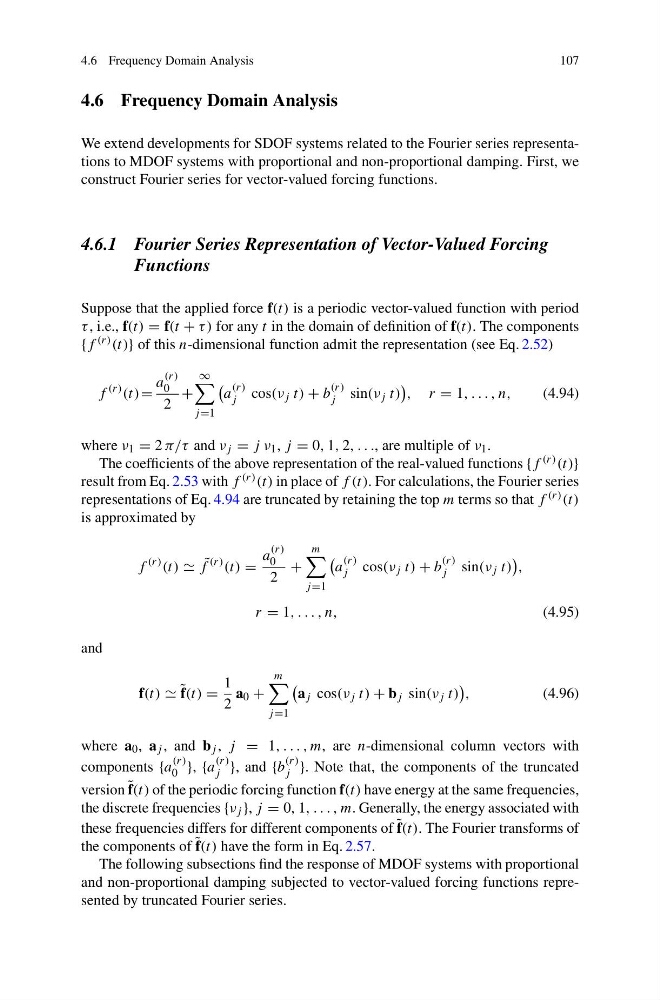
Suppose that the applied force f(t) is a periodic vector-valued function with period
τ , i.e., f(t) = f(t + τ ) for any t in the domain of definition of f(t). The components
{f (r) (t)} of this n-dimensional function admit the representation (see Eq. 2.52)
f
(r) (t) =
a
(r)
0
2
+
∞
j =1
a
(r)
j cos(ν j t) + b
(r)
j sin(ν j t)
, r = 1, . . . , n,
(4.94)
where ν 1 = 2 π/τ and ν j = j ν 1 , j = 0, 1, 2, . . ., are multiple of ν 1 .
The coefficients of the above representation of the real-valued functions {f (r) (t)}
result from Eq. 2.53 with f (r) (t) in place of f (t). For calculations, the Fourier series
representations of Eq. 4.94 are truncated by retaining the top m terms so that f (r) (t)
is approximated by
f
(r) (t) ˜
f
(r) (t) =
a
(r)
0
2
+
m
j =1
a
(r)
j cos(ν j t) + b
(r)
j sin(ν j t)
,
r = 1, . . . , n,
(4.95)
and
f(t) ˜ f(t) =
1
2
a 0 +
m
j =1
a j cos(ν j t) + b j sin(ν j t)
,
(4.96)
where a 0 , a j , and b j , j = 1, . . . , m, are n-dimensional column vectors with
components {a
(r)
0 }, {a
(r)
j }, and {b
(r)
j }. Note that, the components of the truncated
version ˜ f(t) of the periodic forcing function f(t) have energy at the same frequencies,
the discrete frequencies {ν j }, j = 0, 1, . . . , m. Generally, the energy associated with
these frequencies differs for different components of ˜ f(t). The Fourier transforms of
the components of ˜ f(t) have the form in Eq. 2.57.
The following subsections find the response of MDOF systems with proportional
and non-proportional damping subjected to vector-valued forcing functions represented by truncated Fourier series.
107
4.6 Frequency Domain Analysis
We extend developments for SDOF systems related to the Fourier series representations to MDOF systems with proportional and non-proportional damping. First, we
construct Fourier series for vector-valued forcing functions.
4.6.1 Fourier Series Representation of Vector-Valued Forcing
Functions
Suppose that the applied force f(t) is a periodic vector-valued function with period
τ , i.e., f(t) = f(t + τ ) for any t in the domain of definition of f(t). The components
{f (r) (t)} of this n-dimensional function admit the representation (see Eq. 2.52)
f
(r) (t) =
a
(r)
0
2
+
∞
j =1
a
(r)
j cos(ν j t) + b
(r)
j sin(ν j t)
, r = 1, . . . , n,
(4.94)
where ν 1 = 2 π/τ and ν j = j ν 1 , j = 0, 1, 2, . . ., are multiple of ν 1 .
The coefficients of the above representation of the real-valued functions {f (r) (t)}
result from Eq. 2.53 with f (r) (t) in place of f (t). For calculations, the Fourier series
representations of Eq. 4.94 are truncated by retaining the top m terms so that f (r) (t)
is approximated by
f
(r) (t) ˜
f
(r) (t) =
a
(r)
0
2
+
m
j =1
a
(r)
j cos(ν j t) + b
(r)
j sin(ν j t)
,
r = 1, . . . , n,
(4.95)
and
f(t) ˜ f(t) =
1
2
a 0 +
m
j =1
a j cos(ν j t) + b j sin(ν j t)
,
(4.96)
where a 0 , a j , and b j , j = 1, . . . , m, are n-dimensional column vectors with
components {a
(r)
0 }, {a
(r)
j }, and {b
(r)
j }. Note that, the components of the truncated
version ˜ f(t) of the periodic forcing function f(t) have energy at the same frequencies,
the discrete frequencies {ν j }, j = 0, 1, . . . , m. Generally, the energy associated with
these frequencies differs for different components of ˜ f(t). The Fourier transforms of
the components of ˜ f(t) have the form in Eq. 2.57.
The following subsections find the response of MDOF systems with proportional
and non-proportional damping subjected to vector-valued forcing functions represented by truncated Fourier series.