

4.5 Time Domain Analysis: Non-proportional Damping
105
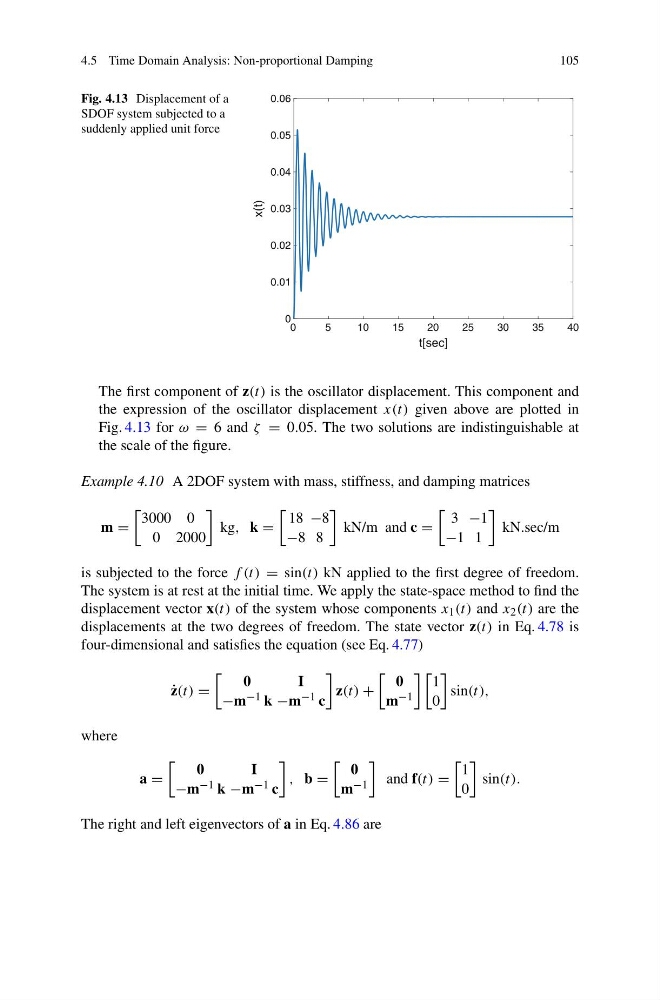
Fig. 4.13 Displacement of a
SDOF system subjected to a
suddenly applied unit force
0
5
10
15
20
25
30
35
40
t[sec]
0
0.01
0.02
0.03
0.04
0.05
0.06
x(t)
The first component of z(t) is the oscillator displacement. This component and
the expression of the oscillator displacement x(t) given above are plotted in
Fig. 4.13 for ω = 6 and ζ = 0.05. The two solutions are indistinguishable at
the scale of the figure.
Example 4.10 A 2DOF system with mass, stiffness, and damping matrices
m =
3000 0
0 2000
kg, k =
18 −8
−8 8
kN/m and c =
3 −1
−1 1
kN.sec/m
is subjected to the force f (t) = sin(t) kN applied to the first degree of freedom.
The system is at rest at the initial time. We apply the state-space method to find the
displacement vector x(t) of the system whose components x 1 (t) and x 2 (t) are the
displacements at the two degrees of freedom. The state vector z(t) in Eq. 4.78 is
four-dimensional and satisfies the equation (see Eq. 4.77)
˙
z(t) =
0
I
−m −1 k −m −1 c
z(t) +
0
m −1
1
0
sin(t),
where
a =
0
I
−m −1 k −m −1 c
, b =
0
m −1
and f(t) =
1
0
sin(t).
The right and left eigenvectors of a in Eq. 4.86 are
105
Fig. 4.13 Displacement of a
SDOF system subjected to a
suddenly applied unit force
0
5
10
15
20
25
30
35
40
t[sec]
0
0.01
0.02
0.03
0.04
0.05
0.06
x(t)
The first component of z(t) is the oscillator displacement. This component and
the expression of the oscillator displacement x(t) given above are plotted in
Fig. 4.13 for ω = 6 and ζ = 0.05. The two solutions are indistinguishable at
the scale of the figure.
Example 4.10 A 2DOF system with mass, stiffness, and damping matrices
m =
3000 0
0 2000
kg, k =
18 −8
−8 8
kN/m and c =
3 −1
−1 1
kN.sec/m
is subjected to the force f (t) = sin(t) kN applied to the first degree of freedom.
The system is at rest at the initial time. We apply the state-space method to find the
displacement vector x(t) of the system whose components x 1 (t) and x 2 (t) are the
displacements at the two degrees of freedom. The state vector z(t) in Eq. 4.78 is
four-dimensional and satisfies the equation (see Eq. 4.77)
˙
z(t) =
0
I
−m −1 k −m −1 c
z(t) +
0
m −1
1
0
sin(t),
where
a =
0
I
−m −1 k −m −1 c
, b =
0
m −1
and f(t) =
1
0
sin(t).
The right and left eigenvectors of a in Eq. 4.86 are