

7 On Geodesic Triangles with Right Angles in a Dually Flat Space
187
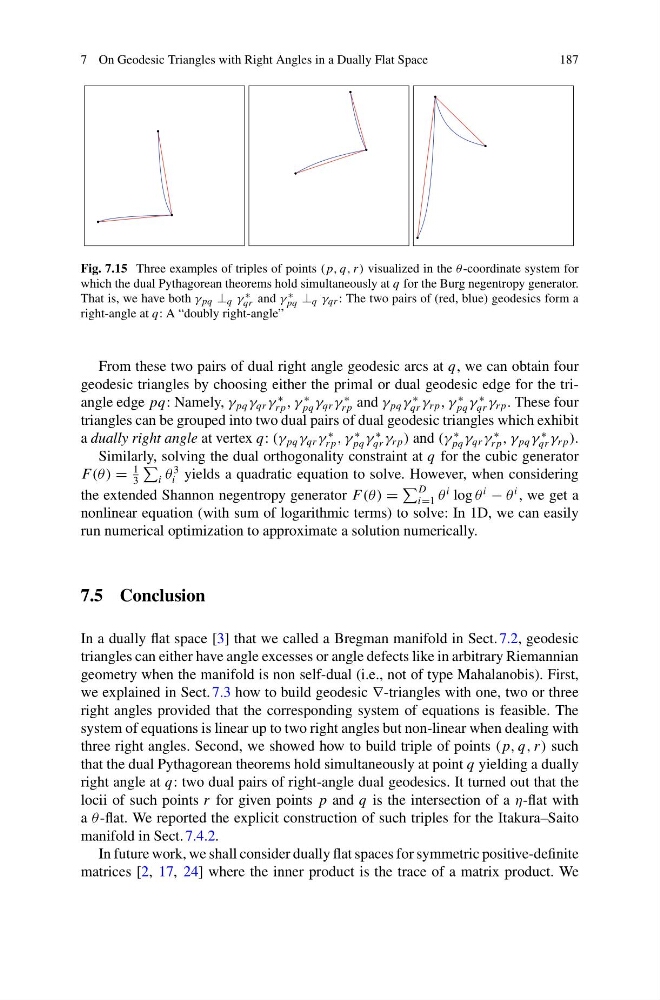
Fig. 7.15 Three examples of triples of points ( p, q, r ) visualized in the θ-coordinate system for
which the dual Pythagorean theorems hold simultaneously at q for the Burg negentropy generator.
That is, we have both γ pq ⊥ q γ ∗
qr and γ ∗
pq ⊥ q γ qr : The two pairs of (red, blue) geodesics form a
right-angle at q: A “doubly right-angle”
From these two pairs of dual right angle geodesic arcs at q, we can obtain four
geodesic triangles by choosing either the primal or dual geodesic edge for the triangle edge pq: Namely, γ pq γ qr γ
∗
r p , γ
∗
pq γ qr γ
∗
r p and γ pq γ
∗
qr γ r p , γ
∗
pq γ
∗
qr γ r p . These four
triangles can be grouped into two dual pairs of dual geodesic triangles which exhibit
a dually right angle at vertex q: (γ pq γ qr γ
∗
r p , γ
∗
pq γ
∗
qr γ r p ) and (γ
∗
pq γ qr γ
∗
r p , γ pq γ
∗
qr γ r p ).
Similarly, solving the dual orthogonality constraint at q for the cubic generator
F(θ ) =
1
3
i θ
3
i yields a quadratic equation to solve. However, when considering
the extended Shannon negentropy generator F(θ ) =
D
i=1 θ
i log θ
i
− θ
i , we get a
nonlinear equation (with sum of logarithmic terms) to solve: In 1D, we can easily
run numerical optimization to approximate a solution numerically.
7.5 Conclusion
In a dually flat space [3] that we called a Bregman manifold in Sect. 7.2, geodesic
triangles can either have angle excesses or angle defects like in arbitrary Riemannian
geometry when the manifold is non self-dual (i.e., not of type Mahalanobis). First,
we explained in Sect. 7.3 how to build geodesic ∇-triangles with one, two or three
right angles provided that the corresponding system of equations is feasible. The
system of equations is linear up to two right angles but non-linear when dealing with
three right angles. Second, we showed how to build triple of points ( p, q, r ) such
that the dual Pythagorean theorems hold simultaneously at point q yielding a dually
right angle at q: two dual pairs of right-angle dual geodesics. It turned out that the
locii of such points r for given points p and q is the intersection of a η-flat with
a θ -flat. We reported the explicit construction of such triples for the Itakura–Saito
manifold in Sect. 7.4.2.
In future work, we shall consider dually flat spaces for symmetric positive-definite
matrices [2, 17, 24] where the inner product is the trace of a matrix product. We
187
Fig. 7.15 Three examples of triples of points ( p, q, r ) visualized in the θ-coordinate system for
which the dual Pythagorean theorems hold simultaneously at q for the Burg negentropy generator.
That is, we have both γ pq ⊥ q γ ∗
qr and γ ∗
pq ⊥ q γ qr : The two pairs of (red, blue) geodesics form a
right-angle at q: A “doubly right-angle”
From these two pairs of dual right angle geodesic arcs at q, we can obtain four
geodesic triangles by choosing either the primal or dual geodesic edge for the triangle edge pq: Namely, γ pq γ qr γ
∗
r p , γ
∗
pq γ qr γ
∗
r p and γ pq γ
∗
qr γ r p , γ
∗
pq γ
∗
qr γ r p . These four
triangles can be grouped into two dual pairs of dual geodesic triangles which exhibit
a dually right angle at vertex q: (γ pq γ qr γ
∗
r p , γ
∗
pq γ
∗
qr γ r p ) and (γ
∗
pq γ qr γ
∗
r p , γ pq γ
∗
qr γ r p ).
Similarly, solving the dual orthogonality constraint at q for the cubic generator
F(θ ) =
1
3
i θ
3
i yields a quadratic equation to solve. However, when considering
the extended Shannon negentropy generator F(θ ) =
D
i=1 θ
i log θ
i
− θ
i , we get a
nonlinear equation (with sum of logarithmic terms) to solve: In 1D, we can easily
run numerical optimization to approximate a solution numerically.
7.5 Conclusion
In a dually flat space [3] that we called a Bregman manifold in Sect. 7.2, geodesic
triangles can either have angle excesses or angle defects like in arbitrary Riemannian
geometry when the manifold is non self-dual (i.e., not of type Mahalanobis). First,
we explained in Sect. 7.3 how to build geodesic ∇-triangles with one, two or three
right angles provided that the corresponding system of equations is feasible. The
system of equations is linear up to two right angles but non-linear when dealing with
three right angles. Second, we showed how to build triple of points ( p, q, r ) such
that the dual Pythagorean theorems hold simultaneously at point q yielding a dually
right angle at q: two dual pairs of right-angle dual geodesics. It turned out that the
locii of such points r for given points p and q is the intersection of a η-flat with
a θ -flat. We reported the explicit construction of such triples for the Itakura–Saito
manifold in Sect. 7.4.2.
In future work, we shall consider dually flat spaces for symmetric positive-definite
matrices [2, 17, 24] where the inner product is the trace of a matrix product. We