

186
F. Nielsen
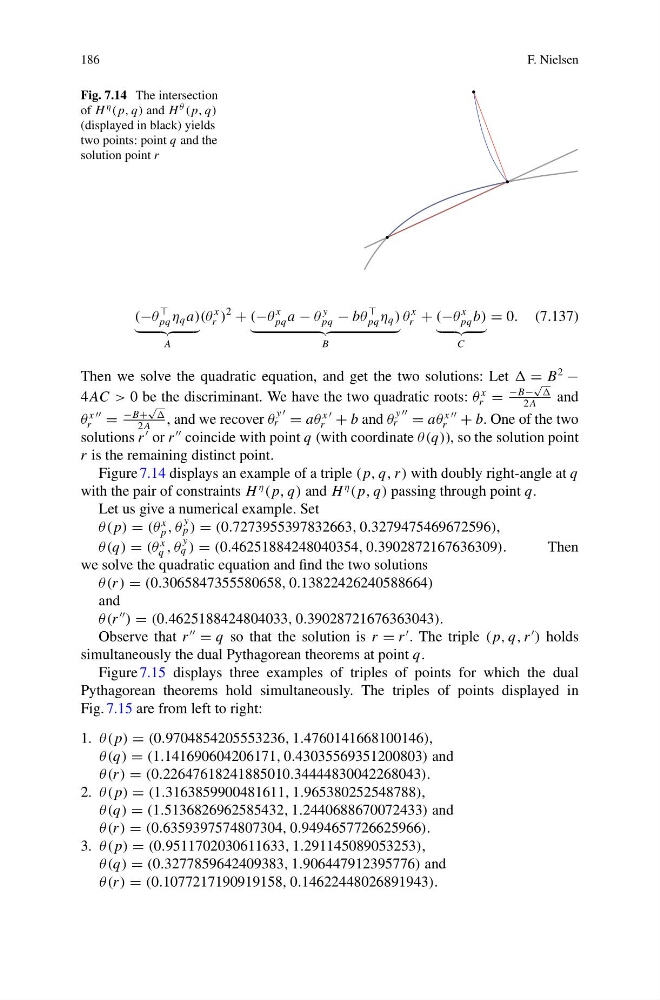
Fig. 7.14 The intersection
of H η ( p, q) and H θ ( p, q)
(displayed in black) yields
two points: point q and the
solution point r
(−θ
pq η q a)
A
(θ
x
r )
2
+ (−θ
x
pq a − θ
y
pq − bθ
pq η q )
B
θ
x
r + (−θ
x
pq b)
C
= 0. (7.137)
Then we solve the quadratic equation, and get the two solutions: Let = B
2
−
4 AC > 0 be the discriminant. We have the two quadratic roots: θ
x
r =
−B−
√
2 A
and
θ
x
r
=
−B+
√
2 A
, and we recover θ
y
r
= aθ
x
r
+ b and θ
y
r
= aθ
x
r
+ b. One of the two
solutions r
or r
coincide with point q (with coordinate θ(q)), so the solution point
r is the remaining distinct point.
Figure 7.14 displays an example of a triple ( p, q, r ) with doubly right-angle at q
with the pair of constraints H
η
( p, q) and H
η
( p, q) passing through point q.
Let us give a numerical example. Set
θ( p) = (θ
x
p , θ
y
p ) = (0.7273955397832663, 0.3279475469672596),
θ(q) = (θ
x
q , θ
y
q ) = (0.46251884248040354, 0.3902872167636309).
Then
we solve the quadratic equation and find the two solutions
θ(r ) = (0.3065847355580658, 0.13822426240588664)
and
θ(r
) = (0.4625188424804033, 0.39028721676363043).
Observe that r
= q so that the solution is r = r
. The triple ( p, q, r
) holds
simultaneously the dual Pythagorean theorems at point q.
Figure 7.15 displays three examples of triples of points for which the dual
Pythagorean theorems hold simultaneously. The triples of points displayed in
Fig. 7.15 are from left to right:
1. θ( p) = (0.9704854205553236, 1.4760141668100146),
θ(q) = (1.141690604206171, 0.43035569351200803) and
θ(r ) = (0.22647618241885010.34444830042268043).
2. θ( p) = (1.3163859900481611, 1.965380252548788),
θ(q) = (1.5136826962585432, 1.2440688670072433) and
θ(r ) = (0.6359397574807304, 0.9494657726625966).
3. θ( p) = (0.9511702030611633, 1.291145089053253),
θ(q) = (0.3277859642409383, 1.906447912395776) and
θ(r ) = (0.1077217190919158, 0.14622448026891943).
F. Nielsen
Fig. 7.14 The intersection
of H η ( p, q) and H θ ( p, q)
(displayed in black) yields
two points: point q and the
solution point r
(−θ
pq η q a)
A
(θ
x
r )
2
+ (−θ
x
pq a − θ
y
pq − bθ
pq η q )
B
θ
x
r + (−θ
x
pq b)
C
= 0. (7.137)
Then we solve the quadratic equation, and get the two solutions: Let = B
2
−
4 AC > 0 be the discriminant. We have the two quadratic roots: θ
x
r =
−B−
√
2 A
and
θ
x
r
=
−B+
√
2 A
, and we recover θ
y
r
= aθ
x
r
+ b and θ
y
r
= aθ
x
r
+ b. One of the two
solutions r
or r
coincide with point q (with coordinate θ(q)), so the solution point
r is the remaining distinct point.
Figure 7.14 displays an example of a triple ( p, q, r ) with doubly right-angle at q
with the pair of constraints H
η
( p, q) and H
η
( p, q) passing through point q.
Let us give a numerical example. Set
θ( p) = (θ
x
p , θ
y
p ) = (0.7273955397832663, 0.3279475469672596),
θ(q) = (θ
x
q , θ
y
q ) = (0.46251884248040354, 0.3902872167636309).
Then
we solve the quadratic equation and find the two solutions
θ(r ) = (0.3065847355580658, 0.13822426240588664)
and
θ(r
) = (0.4625188424804033, 0.39028721676363043).
Observe that r
= q so that the solution is r = r
. The triple ( p, q, r
) holds
simultaneously the dual Pythagorean theorems at point q.
Figure 7.15 displays three examples of triples of points for which the dual
Pythagorean theorems hold simultaneously. The triples of points displayed in
Fig. 7.15 are from left to right:
1. θ( p) = (0.9704854205553236, 1.4760141668100146),
θ(q) = (1.141690604206171, 0.43035569351200803) and
θ(r ) = (0.22647618241885010.34444830042268043).
2. θ( p) = (1.3163859900481611, 1.965380252548788),
θ(q) = (1.5136826962585432, 1.2440688670072433) and
θ(r ) = (0.6359397574807304, 0.9494657726625966).
3. θ( p) = (0.9511702030611633, 1.291145089053253),
θ(q) = (0.3277859642409383, 1.906447912395776) and
θ(r ) = (0.1077217190919158, 0.14622448026891943).