

188
F. Nielsen
θ-coordinate system
η-coordinate system
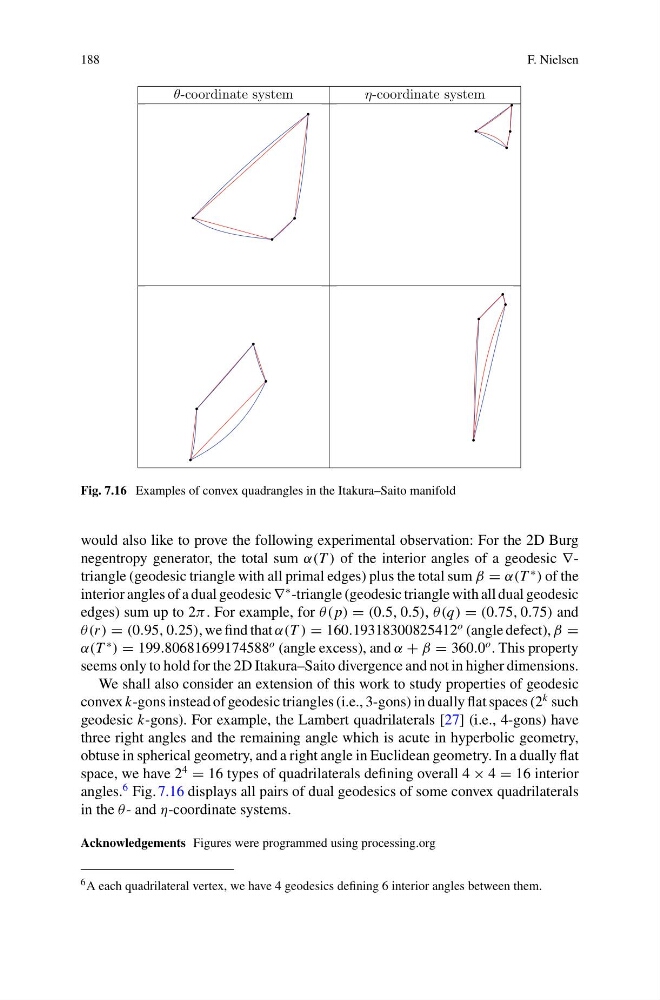
Fig. 7.16 Examples of convex quadrangles in the Itakura–Saito manifold
would also like to prove the following experimental observation: For the 2D Burg
negentropy generator, the total sum α(T ) of the interior angles of a geodesic ∇triangle (geodesic triangle with all primal edges) plus the total sum β = α(T
∗
) of the
interior angles of a dual geodesic ∇
∗ -triangle (geodesic triangle with all dual geodesic
edges) sum up to 2π . For example, for θ( p) = (0.5, 0.5), θ(q) = (0.75, 0.75) and
θ(r ) = (0.95, 0.25), we find that α(T ) = 160.19318300825412
o (angle defect), β =
α(T
∗
) = 199.80681699174588
o (angle excess), and α + β = 360.0
o . This property
seems only to hold for the 2D Itakura–Saito divergence and not in higher dimensions.
We shall also consider an extension of this work to study properties of geodesic
convex k-gons instead of geodesic triangles (i.e., 3-gons) in dually flat spaces (2
k such
geodesic k-gons). For example, the Lambert quadrilaterals [27] (i.e., 4-gons) have
three right angles and the remaining angle which is acute in hyperbolic geometry,
obtuse in spherical geometry, and a right angle in Euclidean geometry. In a dually flat
space, we have 2
4
= 16 types of quadrilaterals defining overall 4 × 4 = 16 interior
angles.
6 Fig. 7.16 displays all pairs of dual geodesics of some convex quadrilaterals
in the θ - and η-coordinate systems.
Acknowledgements Figures were programmed using processing.org
6 A each quadrilateral vertex, we have 4 geodesics defining 6 interior angles between them.
F. Nielsen
θ-coordinate system
η-coordinate system
Fig. 7.16 Examples of convex quadrangles in the Itakura–Saito manifold
would also like to prove the following experimental observation: For the 2D Burg
negentropy generator, the total sum α(T ) of the interior angles of a geodesic ∇triangle (geodesic triangle with all primal edges) plus the total sum β = α(T
∗
) of the
interior angles of a dual geodesic ∇
∗ -triangle (geodesic triangle with all dual geodesic
edges) sum up to 2π . For example, for θ( p) = (0.5, 0.5), θ(q) = (0.75, 0.75) and
θ(r ) = (0.95, 0.25), we find that α(T ) = 160.19318300825412
o (angle defect), β =
α(T
∗
) = 199.80681699174588
o (angle excess), and α + β = 360.0
o . This property
seems only to hold for the 2D Itakura–Saito divergence and not in higher dimensions.
We shall also consider an extension of this work to study properties of geodesic
convex k-gons instead of geodesic triangles (i.e., 3-gons) in dually flat spaces (2
k such
geodesic k-gons). For example, the Lambert quadrilaterals [27] (i.e., 4-gons) have
three right angles and the remaining angle which is acute in hyperbolic geometry,
obtuse in spherical geometry, and a right angle in Euclidean geometry. In a dually flat
space, we have 2
4
= 16 types of quadrilaterals defining overall 4 × 4 = 16 interior
angles.
6 Fig. 7.16 displays all pairs of dual geodesics of some convex quadrilaterals
in the θ - and η-coordinate systems.
Acknowledgements Figures were programmed using processing.org
6 A each quadrilateral vertex, we have 4 geodesics defining 6 interior angles between them.