

1 IG of Poincaré inequalities …
7
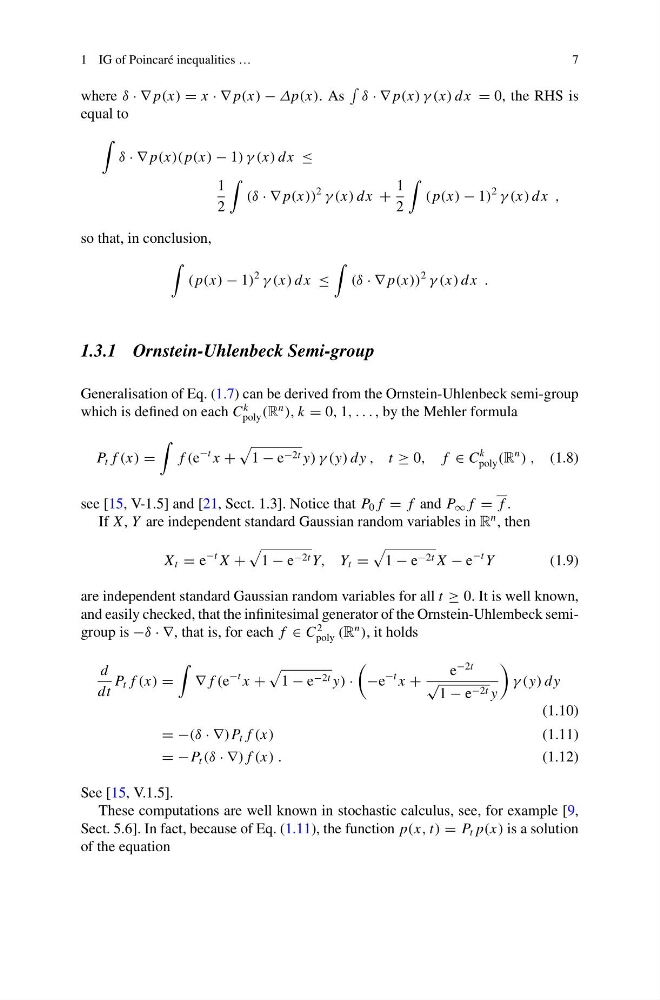
where δ · ∇ p(x) = x · ∇ p(x) − Δp(x). As
δ · ∇ p(x) γ (x) dx = 0, the RHS is
equal to
δ · ∇ p(x)( p(x) − 1) γ (x) dx ≤
1
2
(δ · ∇ p(x))
2
γ (x) dx +
1
2
( p(x) − 1)
2
γ (x) dx ,
so that, in conclusion,
( p(x) − 1)
2
γ (x) dx ≤
(δ · ∇ p(x))
2
γ (x) dx .
1.3.1 Ornstein-Uhlenbeck Semi-group
Generalisation of Eq. (1.7) can be derived from the Ornstein-Uhlenbeck semi-group
which is defined on each C
k
poly (R
n
), k = 0, 1, . . . , by the Mehler formula
P t f (x) =
f (e
−t x +
1 − e −2t y) γ (y) dy , t ≥ 0, f ∈ C
k
poly (R
n
) , (1.8)
see [15, V-1.5] and [21, Sect. 1.3]. Notice that P 0 f = f and P ∞ f = f .
If X , Y are independent standard Gaussian random variables in R
n , then
X t = e
−t X +
1 − e −2t Y, Y t =
1 − e −2t X − e
−t Y
(1.9)
are independent standard Gaussian random variables for all t ≥ 0. It is well known,
and easily checked, that the infinitesimal generator of the Ornstein-Uhlembeck semigroup is −δ · ∇, that is, for each f ∈ C
2
poly (R
n
), it holds
d
dt
P t f (x) =
∇ f (e
−t x +
1 − e −2t y) ·
−e
−t x +
e
−2t
√
1 − e −2t y
γ (y) dy
(1.10)
= −(δ · ∇)P t f (x)
(1.11)
= −P t (δ · ∇) f (x) .
(1.12)
See [15, V.1.5].
These computations are well known in stochastic calculus, see, for example [9,
Sect. 5.6]. In fact, because of Eq. (1.11), the function p(x, t) = P t p(x) is a solution
of the equation
7
where δ · ∇ p(x) = x · ∇ p(x) − Δp(x). As
δ · ∇ p(x) γ (x) dx = 0, the RHS is
equal to
δ · ∇ p(x)( p(x) − 1) γ (x) dx ≤
1
2
(δ · ∇ p(x))
2
γ (x) dx +
1
2
( p(x) − 1)
2
γ (x) dx ,
so that, in conclusion,
( p(x) − 1)
2
γ (x) dx ≤
(δ · ∇ p(x))
2
γ (x) dx .
1.3.1 Ornstein-Uhlenbeck Semi-group
Generalisation of Eq. (1.7) can be derived from the Ornstein-Uhlenbeck semi-group
which is defined on each C
k
poly (R
n
), k = 0, 1, . . . , by the Mehler formula
P t f (x) =
f (e
−t x +
1 − e −2t y) γ (y) dy , t ≥ 0, f ∈ C
k
poly (R
n
) , (1.8)
see [15, V-1.5] and [21, Sect. 1.3]. Notice that P 0 f = f and P ∞ f = f .
If X , Y are independent standard Gaussian random variables in R
n , then
X t = e
−t X +
1 − e −2t Y, Y t =
1 − e −2t X − e
−t Y
(1.9)
are independent standard Gaussian random variables for all t ≥ 0. It is well known,
and easily checked, that the infinitesimal generator of the Ornstein-Uhlembeck semigroup is −δ · ∇, that is, for each f ∈ C
2
poly (R
n
), it holds
d
dt
P t f (x) =
∇ f (e
−t x +
1 − e −2t y) ·
−e
−t x +
e
−2t
√
1 − e −2t y
γ (y) dy
(1.10)
= −(δ · ∇)P t f (x)
(1.11)
= −P t (δ · ∇) f (x) .
(1.12)
See [15, V.1.5].
These computations are well known in stochastic calculus, see, for example [9,
Sect. 5.6]. In fact, because of Eq. (1.11), the function p(x, t) = P t p(x) is a solution
of the equation