

6
G. Pistone
A key result is the proof of the following statement of necessary and sufficient
conditions, see [5] and [29, Theorem 4.7].
Proposition 1 For all p, q ∈ E (γ ) it holds q = e
u−K p (u)
· p, where u ∈
L (cosh −1) (γ ), E p [u] = 0, and u belongs to the interior of the proper domain of
the convex function K p . This property is equivalent to any of the following:
1. p and q are connected by an open exponential arc;
2. L (cosh −1) ( p) = L (cosh −1) (q) and the norms are equivalent;
3. p/q ∈ ∪ a>1 L
a
(q) and q/ p ∈ ∪ a>1 L
a
( p).
Item 2 ensures that all the fibers of the statistical bundle, namely S p E (γ ), p ∈
E (γ ), are isomorphic. Item 3 gives a explicit description of the exponential manifold.
For example, let p be a positive probability density with respect to γ , and take q = 1
and a = 2. Then sufficient conditions for p ∈ E (γ ) are
p(x)
2
γ (x) dx < ∞ and
1
p(x)
γ (x) dx < ∞ .
It is interesting to note that there is, so to say, a bound above and a bound below.
1.3 Bounding the Orlicz Norm with the Orlicz Norm
of the Gradient
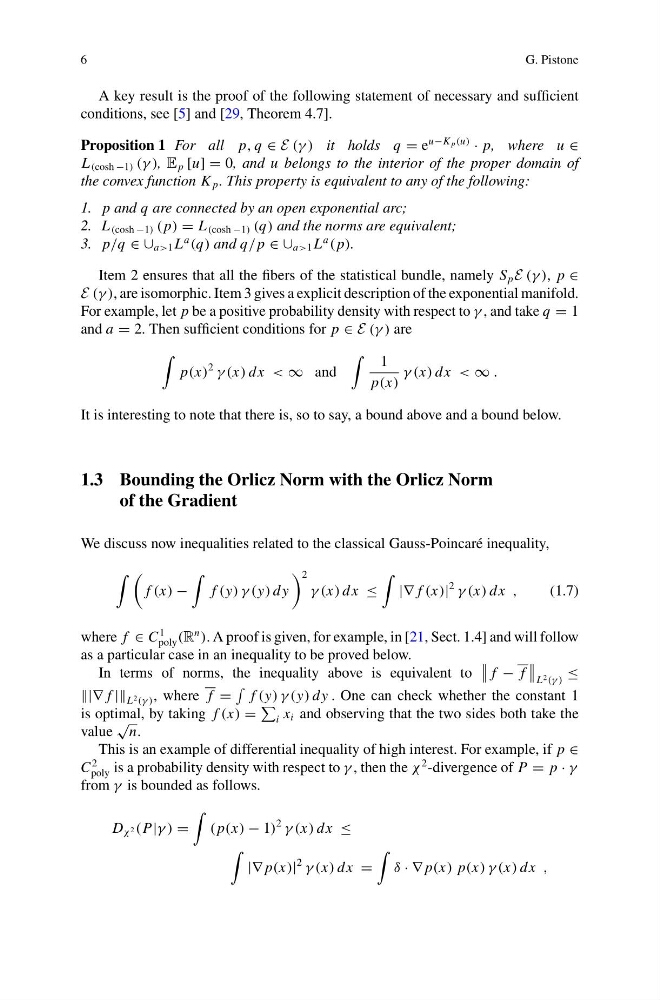
We discuss now inequalities related to the classical Gauss-Poincaré inequality,
f (x) −
f (y) γ (y) dy
2
γ (x) dx ≤
|∇ f (x)|
2
γ (x) dx ,
(1.7)
where f ∈ C
1
poly (R
n
). A proof is given, for example, in [21, Sect. 1.4] and will follow
as a particular case in an inequality to be proved below.
In terms of norms, the inequality above is equivalent to
f − f
L 2 (γ )
≤
|∇ f || L 2 (γ ) , where f =
f (y) γ (y) dy . One can check whether the constant 1
is optimal, by taking f (x) =
i x i and observing that the two sides both take the
value
√
n.
This is an example of differential inequality of high interest. For example, if p ∈
C
2
poly is a probability density with respect to γ , then the χ
2 -divergence of P = p · γ
from γ is bounded as follows.
D χ 2 (P|γ ) =
( p(x) − 1)
2
γ (x) dx ≤
|∇ p(x)|
2
γ (x) dx =
δ · ∇ p(x) p(x) γ (x) dx ,
G. Pistone
A key result is the proof of the following statement of necessary and sufficient
conditions, see [5] and [29, Theorem 4.7].
Proposition 1 For all p, q ∈ E (γ ) it holds q = e
u−K p (u)
· p, where u ∈
L (cosh −1) (γ ), E p [u] = 0, and u belongs to the interior of the proper domain of
the convex function K p . This property is equivalent to any of the following:
1. p and q are connected by an open exponential arc;
2. L (cosh −1) ( p) = L (cosh −1) (q) and the norms are equivalent;
3. p/q ∈ ∪ a>1 L
a
(q) and q/ p ∈ ∪ a>1 L
a
( p).
Item 2 ensures that all the fibers of the statistical bundle, namely S p E (γ ), p ∈
E (γ ), are isomorphic. Item 3 gives a explicit description of the exponential manifold.
For example, let p be a positive probability density with respect to γ , and take q = 1
and a = 2. Then sufficient conditions for p ∈ E (γ ) are
p(x)
2
γ (x) dx < ∞ and
1
p(x)
γ (x) dx < ∞ .
It is interesting to note that there is, so to say, a bound above and a bound below.
1.3 Bounding the Orlicz Norm with the Orlicz Norm
of the Gradient
We discuss now inequalities related to the classical Gauss-Poincaré inequality,
f (x) −
f (y) γ (y) dy
2
γ (x) dx ≤
|∇ f (x)|
2
γ (x) dx ,
(1.7)
where f ∈ C
1
poly (R
n
). A proof is given, for example, in [21, Sect. 1.4] and will follow
as a particular case in an inequality to be proved below.
In terms of norms, the inequality above is equivalent to
f − f
L 2 (γ )
≤
|∇ f || L 2 (γ ) , where f =
f (y) γ (y) dy . One can check whether the constant 1
is optimal, by taking f (x) =
i x i and observing that the two sides both take the
value
√
n.
This is an example of differential inequality of high interest. For example, if p ∈
C
2
poly is a probability density with respect to γ , then the χ
2 -divergence of P = p · γ
from γ is bounded as follows.
D χ 2 (P|γ ) =
( p(x) − 1)
2
γ (x) dx ≤
|∇ p(x)|
2
γ (x) dx =
δ · ∇ p(x) p(x) γ (x) dx ,