

8
G. Pistone
∂
∂t
p(x, t) − Δp(x, t) + x · ∇ p(x, t) = 0 , p(x, 0) = p(x) ,
which is the Kolmogorov equation for the diffusion d X t = −X t +
√
2dW t . Similarly, the function u(x) =
∞
0 e
−t P t f (x) dt is a solution of the equation
δ · ∇u(x) + u(x) = f (x) .
By the change of variable Eq. (1.9) and Jensen’s inequality, it easily follows that
for each convex function Φ it holds
Φ(P t f (x)) γ (x) dx ≤
Φ( f (x)) γ (x) dx .
(1.13)
That is, for all t ≥ 0, the mapping f → P t f is non-expansive for the norm of each
Orlicz space L Φ (γ ).
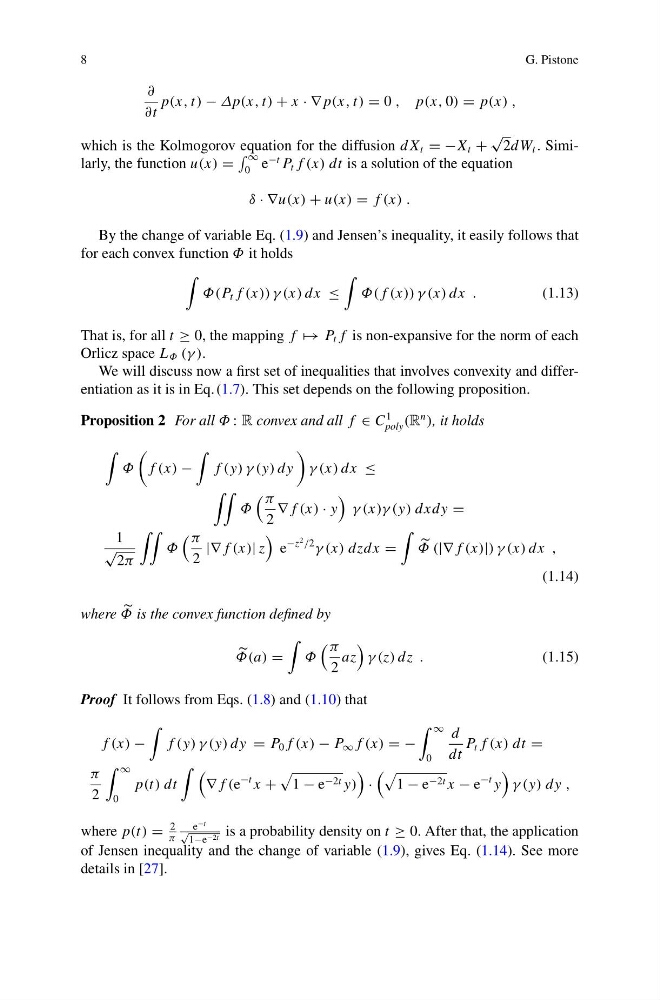
We will discuss now a first set of inequalities that involves convexity and differentiation as it is in Eq. (1.7). This set depends on the following proposition.
Proposition 2 For all Φ : R convex and all f ∈ C
1
poly (R
n
), it holds
Φ
f (x) −
f (y) γ (y) dy
γ (x) dx ≤
Φ
π
2
∇ f (x) · y
γ (x)γ (y) dxdy =
1
√
2π
Φ
π
2
|∇ f (x)| z
e
−z
2 /2
γ (x) dzdx =
Φ (|∇ f (x)|) γ (x) dx ,
(1.14)
where
Φ is the convex function defined by
Φ(a) =
Φ
π
2
az
γ (z) dz .
(1.15)
Proof It follows from Eqs. (1.8) and (1.10) that
f (x) −
f (y) γ (y) dy = P 0 f (x) − P ∞ f (x) = −
∞
0
d
dt
P t f (x) dt =
π
2
∞
0
p(t) dt
∇ f (e
−t x +
1 − e −2t y)
·
1 − e −2t x − e
−t y
γ (y) dy ,
where p(t) =
2
π
e
−t
√
1−e −2t is a probability density on t ≥ 0. After that, the application
of Jensen inequality and the change of variable (1.9), gives Eq. (1.14). See more
details in [27].
G. Pistone
∂
∂t
p(x, t) − Δp(x, t) + x · ∇ p(x, t) = 0 , p(x, 0) = p(x) ,
which is the Kolmogorov equation for the diffusion d X t = −X t +
√
2dW t . Similarly, the function u(x) =
∞
0 e
−t P t f (x) dt is a solution of the equation
δ · ∇u(x) + u(x) = f (x) .
By the change of variable Eq. (1.9) and Jensen’s inequality, it easily follows that
for each convex function Φ it holds
Φ(P t f (x)) γ (x) dx ≤
Φ( f (x)) γ (x) dx .
(1.13)
That is, for all t ≥ 0, the mapping f → P t f is non-expansive for the norm of each
Orlicz space L Φ (γ ).
We will discuss now a first set of inequalities that involves convexity and differentiation as it is in Eq. (1.7). This set depends on the following proposition.
Proposition 2 For all Φ : R convex and all f ∈ C
1
poly (R
n
), it holds
Φ
f (x) −
f (y) γ (y) dy
γ (x) dx ≤
Φ
π
2
∇ f (x) · y
γ (x)γ (y) dxdy =
1
√
2π
Φ
π
2
|∇ f (x)| z
e
−z
2 /2
γ (x) dzdx =
Φ (|∇ f (x)|) γ (x) dx ,
(1.14)
where
Φ is the convex function defined by
Φ(a) =
Φ
π
2
az
γ (z) dz .
(1.15)
Proof It follows from Eqs. (1.8) and (1.10) that
f (x) −
f (y) γ (y) dy = P 0 f (x) − P ∞ f (x) = −
∞
0
d
dt
P t f (x) dt =
π
2
∞
0
p(t) dt
∇ f (e
−t x +
1 − e −2t y)
·
1 − e −2t x − e
−t y
γ (y) dy ,
where p(t) =
2
π
e
−t
√
1−e −2t is a probability density on t ≥ 0. After that, the application
of Jensen inequality and the change of variable (1.9), gives Eq. (1.14). See more
details in [27].