

7 On Geodesic Triangles with Right Angles in a Dually Flat Space
169
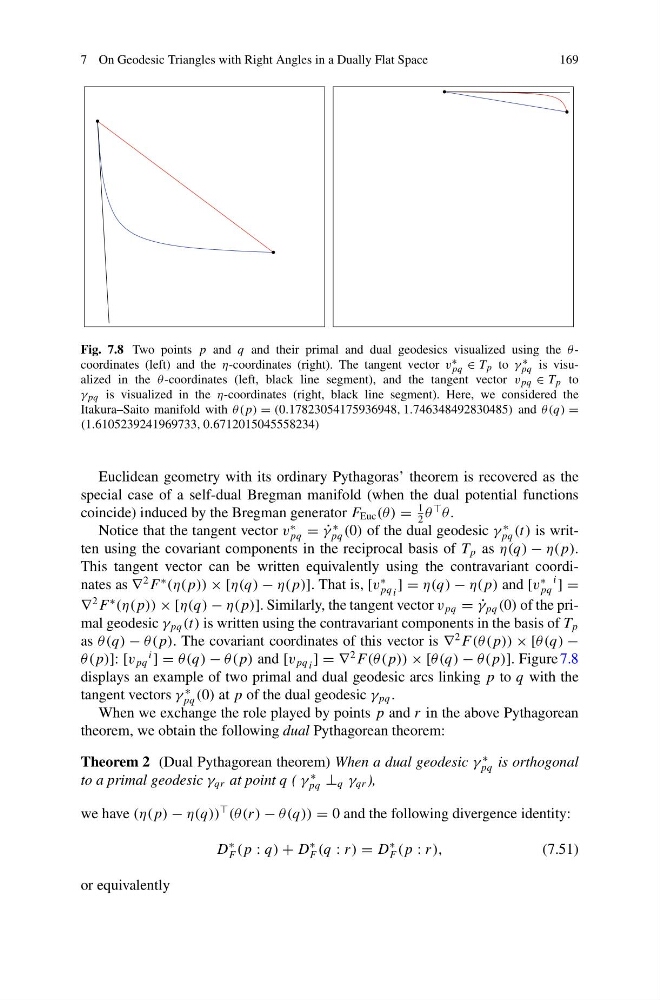
Fig. 7.8 Two points p and q and their primal and dual geodesics visualized using the θcoordinates (left) and the η-coordinates (right). The tangent vector v ∗
pq ∈ T p to γ ∗
pq is visualized in the θ-coordinates (left, black line segment), and the tangent vector v pq ∈ T p to
γ pq is visualized in the η-coordinates (right, black line segment). Here, we considered the
Itakura–Saito manifold with θ( p) = (0.17823054175936948, 1.746348492830485) and θ(q) =
(1.6105239241969733, 0.6712015045558234)
Euclidean geometry with its ordinary Pythagoras’ theorem is recovered as the
special case of a self-dual Bregman manifold (when the dual potential functions
coincide) induced by the Bregman generator F Euc (θ ) =
1
2
θ
θ .
Notice that the tangent vector v
∗
pq = ˙
γ
∗
pq (0) of the dual geodesic γ
∗
pq (t) is written using the covariant components in the reciprocal basis of T p as η(q) − η( p).
This tangent vector can be written equivalently using the contravariant coordinates as ∇
2 F
∗
(η( p)) × [η(q) − η( p)]. That is, [v
∗
pq i
] = η(q) − η( p) and [v
∗
pq
i
] =
∇
2 F
∗
(η( p)) × [η(q) − η( p)]. Similarly, the tangent vector v pq = ˙
γ pq (0) of the primal geodesic γ pq (t) is written using the contravariant components in the basis of T p
as θ(q) − θ( p). The covariant coordinates of this vector is ∇
2 F(θ ( p)) × [θ(q) −
θ( p)]: [v pq
i
] = θ(q) − θ( p) and [v pq i ] = ∇
2 F(θ ( p)) × [θ(q) − θ( p)]. Figure 7.8
displays an example of two primal and dual geodesic arcs linking p to q with the
tangent vectors γ
∗
pq (0) at p of the dual geodesic γ pq .
When we exchange the role played by points p and r in the above Pythagorean
theorem, we obtain the following dual Pythagorean theorem:
Theorem 2 (Dual Pythagorean theorem) When a dual geodesic γ
∗
pq is orthogonal
to a primal geodesic γ qr at point q ( γ
∗
pq ⊥ q γ qr ),
we have (η( p) − η(q))
(θ (r ) − θ(q)) = 0 and the following divergence identity:
D
∗
F ( p : q) + D
∗
F (q : r ) = D
∗
F ( p : r ),
(7.51)
or equivalently
169
Fig. 7.8 Two points p and q and their primal and dual geodesics visualized using the θcoordinates (left) and the η-coordinates (right). The tangent vector v ∗
pq ∈ T p to γ ∗
pq is visualized in the θ-coordinates (left, black line segment), and the tangent vector v pq ∈ T p to
γ pq is visualized in the η-coordinates (right, black line segment). Here, we considered the
Itakura–Saito manifold with θ( p) = (0.17823054175936948, 1.746348492830485) and θ(q) =
(1.6105239241969733, 0.6712015045558234)
Euclidean geometry with its ordinary Pythagoras’ theorem is recovered as the
special case of a self-dual Bregman manifold (when the dual potential functions
coincide) induced by the Bregman generator F Euc (θ ) =
1
2
θ
θ .
Notice that the tangent vector v
∗
pq = ˙
γ
∗
pq (0) of the dual geodesic γ
∗
pq (t) is written using the covariant components in the reciprocal basis of T p as η(q) − η( p).
This tangent vector can be written equivalently using the contravariant coordinates as ∇
2 F
∗
(η( p)) × [η(q) − η( p)]. That is, [v
∗
pq i
] = η(q) − η( p) and [v
∗
pq
i
] =
∇
2 F
∗
(η( p)) × [η(q) − η( p)]. Similarly, the tangent vector v pq = ˙
γ pq (0) of the primal geodesic γ pq (t) is written using the contravariant components in the basis of T p
as θ(q) − θ( p). The covariant coordinates of this vector is ∇
2 F(θ ( p)) × [θ(q) −
θ( p)]: [v pq
i
] = θ(q) − θ( p) and [v pq i ] = ∇
2 F(θ ( p)) × [θ(q) − θ( p)]. Figure 7.8
displays an example of two primal and dual geodesic arcs linking p to q with the
tangent vectors γ
∗
pq (0) at p of the dual geodesic γ pq .
When we exchange the role played by points p and r in the above Pythagorean
theorem, we obtain the following dual Pythagorean theorem:
Theorem 2 (Dual Pythagorean theorem) When a dual geodesic γ
∗
pq is orthogonal
to a primal geodesic γ qr at point q ( γ
∗
pq ⊥ q γ qr ),
we have (η( p) − η(q))
(θ (r ) − θ(q)) = 0 and the following divergence identity:
D
∗
F ( p : q) + D
∗
F (q : r ) = D
∗
F ( p : r ),
(7.51)
or equivalently