

170
F. Nielsen
p
q
r
c
a
b
C
c
2 = a
2 + b
2
2ab cos C
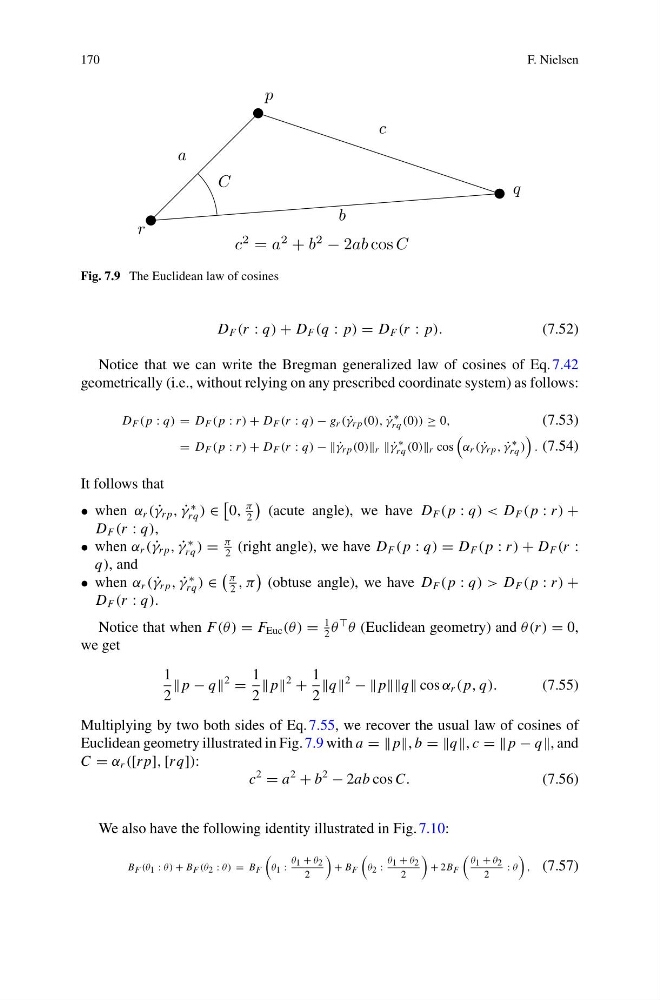
Fig. 7.9 The Euclidean law of cosines
D F (r : q) + D F (q : p) = D F (r : p).
(7.52)
Notice that we can write the Bregman generalized law of cosines of Eq. 7.42
geometrically (i.e., without relying on any prescribed coordinate system) as follows:
D F ( p : q) = D F ( p : r ) + D F (r : q) − g r ( ˙
γ r p (0), ˙
γ
∗
rq (0)) ≥ 0,
(7.53)
= D F ( p : r ) + D F (r : q) − − ˙
γ r p (0) r ˙
γ
∗
rq (0) r cos
α r ( ˙
γ r p , ˙
γ
∗
rq )
. (7.54)
It follows that
• when α r ( ˙
γ r p , ˙
γ
∗
rq ) ∈
0,
π
2
(acute angle), we have D F ( p : q) < D F ( p : r ) +
D F (r : q),
• when α r ( ˙
γ r p , ˙
γ
∗
rq ) =
π
2
(right angle), we have D F ( p : q) = D F ( p : r ) + D F (r :
q), and
• when α r ( ˙
γ r p , ˙
γ
∗
rq ) ∈
π
2
, π
(obtuse angle), we have D F ( p : q) > D F ( p : r ) +
D F (r : q).
Notice that when F(θ ) = F Euc (θ ) =
1
2
θ
θ (Euclidean geometry) and θ(r ) = 0,
we get
1
2
p − q
2
=
1
2
p
2
+
1
2
2
− −p cos α r ( p, q).
(7.55)
Multiplying by two both sides of Eq. 7.55, we recover the usual law of cosines of
Euclidean geometry illustrated in Fig. 7.9 with a = =p b = =q c = =p − q, and
C = α r ([r p], [rq]):
c
2
= a
2
+ b
2
− 2ab cos C.
(7.56)
We also have the following identity illustrated in Fig. 7.10:
B F (θ 1 : θ) + B F (θ 2 : θ) = B F
θ 1 :
θ 1 + θ 2
2
+ B F
θ 2 :
θ 1 + θ 2
2
+ 2B F
θ 1 + θ 2
2
: θ
, (7.57)
F. Nielsen
p
q
r
c
a
b
C
c
2 = a
2 + b
2
2ab cos C
Fig. 7.9 The Euclidean law of cosines
D F (r : q) + D F (q : p) = D F (r : p).
(7.52)
Notice that we can write the Bregman generalized law of cosines of Eq. 7.42
geometrically (i.e., without relying on any prescribed coordinate system) as follows:
D F ( p : q) = D F ( p : r ) + D F (r : q) − g r ( ˙
γ r p (0), ˙
γ
∗
rq (0)) ≥ 0,
(7.53)
= D F ( p : r ) + D F (r : q) − − ˙
γ r p (0) r ˙
γ
∗
rq (0) r cos
α r ( ˙
γ r p , ˙
γ
∗
rq )
. (7.54)
It follows that
• when α r ( ˙
γ r p , ˙
γ
∗
rq ) ∈
0,
π
2
(acute angle), we have D F ( p : q) < D F ( p : r ) +
D F (r : q),
• when α r ( ˙
γ r p , ˙
γ
∗
rq ) =
π
2
(right angle), we have D F ( p : q) = D F ( p : r ) + D F (r :
q), and
• when α r ( ˙
γ r p , ˙
γ
∗
rq ) ∈
π
2
, π
(obtuse angle), we have D F ( p : q) > D F ( p : r ) +
D F (r : q).
Notice that when F(θ ) = F Euc (θ ) =
1
2
θ
θ (Euclidean geometry) and θ(r ) = 0,
we get
1
2
p − q
2
=
1
2
p
2
+
1
2
2
− −p cos α r ( p, q).
(7.55)
Multiplying by two both sides of Eq. 7.55, we recover the usual law of cosines of
Euclidean geometry illustrated in Fig. 7.9 with a = =p b = =q c = =p − q, and
C = α r ([r p], [rq]):
c
2
= a
2
+ b
2
− 2ab cos C.
(7.56)
We also have the following identity illustrated in Fig. 7.10:
B F (θ 1 : θ) + B F (θ 2 : θ) = B F
θ 1 :
θ 1 + θ 2
2
+ B F
θ 2 :
θ 1 + θ 2
2
+ 2B F
θ 1 + θ 2
2
: θ
, (7.57)