

168
F. Nielsen
p
q
r
γpq(t)
γ
∗
qr (t
)
γpq ⊥q γ
∗
qr
DF (γpq(t) : γqr(t
)) = DF (γpq(t) : q) + DF (q : γ
∗
qr (t
)), ∀t, t
∈ (0, 1).
p
q
r
DF (p : r)) = DF (p : q) + DF (q : r)
˙
γpq(0) ⊥ ˙
γ
∗
qr (0)
γpq
γ
∗
qr
BF (θ(p) : θ(r)) = BF (θ(p) : θ(q)) + BF (θ(q) : θ(r))
(θ(p) θ(q))
(η(r) η(q)) = 0
˙
γpq(0) q ˙
γ
∗
qr (0)
˙
γ
∗
qr (0)
˙
γpq(0)
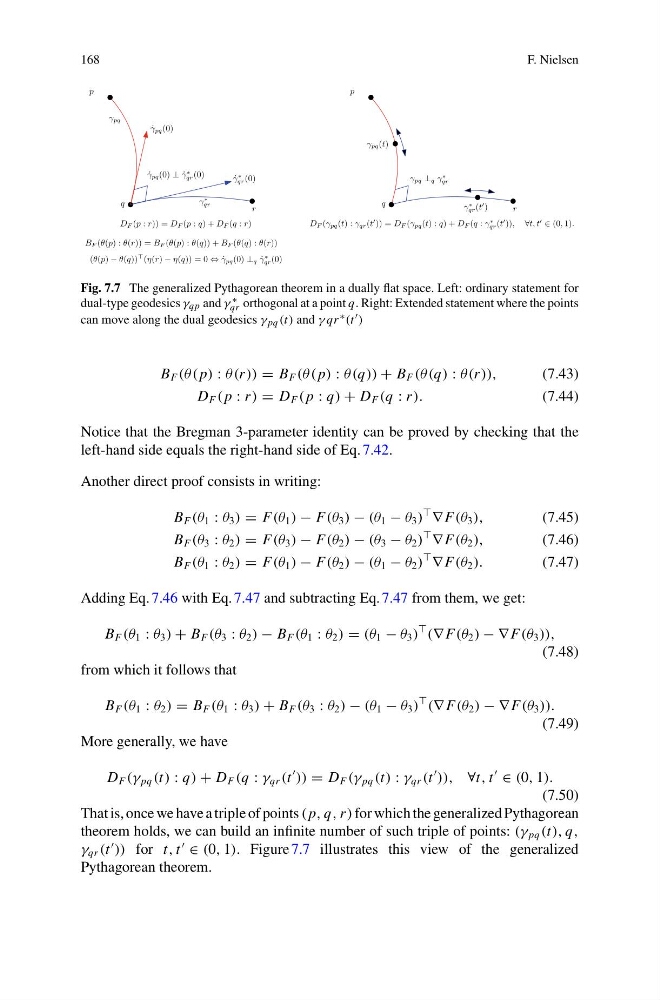
Fig. 7.7 The generalized Pythagorean theorem in a dually flat space. Left: ordinary statement for
dual-type geodesics γ qp and γ ∗
qr orthogonal at a point q. Right: Extended statement where the points
can move along the dual geodesics γ pq (t) and γ qr ∗ (t )
B F (θ ( p) : θ(r )) = B F (θ ( p) : θ(q)) + B F (θ (q) : θ(r )),
(7.43)
D F ( p : r ) = D F ( p : q) + D F (q : r ).
(7.44)
Notice that the Bregman 3-parameter identity can be proved by checking that the
left-hand side equals the right-hand side of Eq. 7.42.
Another direct proof consists in writing:
B F (θ 1 : θ 3 ) = F(θ 1 ) − F(θ 3 ) − (θ 1 − θ 3 )
∇ F(θ 3 ),
(7.45)
B F (θ 3 : θ 2 ) = F(θ 3 ) − F(θ 2 ) − (θ 3 − θ 2 )
∇ F(θ 2 ),
(7.46)
B F (θ 1 : θ 2 ) = F(θ 1 ) − F(θ 2 ) − (θ 1 − θ 2 )
∇ F(θ 2 ).
(7.47)
Adding Eq. 7.46 with Eq. 7.47 and subtracting Eq. 7.47 from them, we get:
B F (θ 1 : θ 3 ) + B F (θ 3 : θ 2 ) − B F (θ 1 : θ 2 ) = (θ 1 − θ 3 )
(∇ F(θ 2 ) − ∇ F(θ 3 )),
(7.48)
from which it follows that
B F (θ 1 : θ 2 ) = B F (θ 1 : θ 3 ) + B F (θ 3 : θ 2 ) − (θ 1 − θ 3 )
(∇ F(θ 2 ) − ∇ F(θ 3 )).
(7.49)
More generally, we have
D F (γ pq (t) : q) + D F (q : γ qr (t
)) = D F (γ pq (t) : γ qr (t
)), ∀t, t
∈ (0, 1).
(7.50)
That is, once we have a triple of points ( p, q, r ) for which the generalized Pythagorean
theorem holds, we can build an infinite number of such triple of points: (γ pq (t), q,
γ qr (t
)) for t, t
∈ (0, 1). Figure 7.7 illustrates this view of the generalized
Pythagorean theorem.
F. Nielsen
p
q
r
γpq(t)
γ
∗
qr (t
)
γpq ⊥q γ
∗
qr
DF (γpq(t) : γqr(t
)) = DF (γpq(t) : q) + DF (q : γ
∗
qr (t
)), ∀t, t
∈ (0, 1).
p
q
r
DF (p : r)) = DF (p : q) + DF (q : r)
˙
γpq(0) ⊥ ˙
γ
∗
qr (0)
γpq
γ
∗
qr
BF (θ(p) : θ(r)) = BF (θ(p) : θ(q)) + BF (θ(q) : θ(r))
(θ(p) θ(q))
(η(r) η(q)) = 0
˙
γpq(0) q ˙
γ
∗
qr (0)
˙
γ
∗
qr (0)
˙
γpq(0)
Fig. 7.7 The generalized Pythagorean theorem in a dually flat space. Left: ordinary statement for
dual-type geodesics γ qp and γ ∗
qr orthogonal at a point q. Right: Extended statement where the points
can move along the dual geodesics γ pq (t) and γ qr ∗ (t )
B F (θ ( p) : θ(r )) = B F (θ ( p) : θ(q)) + B F (θ (q) : θ(r )),
(7.43)
D F ( p : r ) = D F ( p : q) + D F (q : r ).
(7.44)
Notice that the Bregman 3-parameter identity can be proved by checking that the
left-hand side equals the right-hand side of Eq. 7.42.
Another direct proof consists in writing:
B F (θ 1 : θ 3 ) = F(θ 1 ) − F(θ 3 ) − (θ 1 − θ 3 )
∇ F(θ 3 ),
(7.45)
B F (θ 3 : θ 2 ) = F(θ 3 ) − F(θ 2 ) − (θ 3 − θ 2 )
∇ F(θ 2 ),
(7.46)
B F (θ 1 : θ 2 ) = F(θ 1 ) − F(θ 2 ) − (θ 1 − θ 2 )
∇ F(θ 2 ).
(7.47)
Adding Eq. 7.46 with Eq. 7.47 and subtracting Eq. 7.47 from them, we get:
B F (θ 1 : θ 3 ) + B F (θ 3 : θ 2 ) − B F (θ 1 : θ 2 ) = (θ 1 − θ 3 )
(∇ F(θ 2 ) − ∇ F(θ 3 )),
(7.48)
from which it follows that
B F (θ 1 : θ 2 ) = B F (θ 1 : θ 3 ) + B F (θ 3 : θ 2 ) − (θ 1 − θ 3 )
(∇ F(θ 2 ) − ∇ F(θ 3 )).
(7.49)
More generally, we have
D F (γ pq (t) : q) + D F (q : γ qr (t
)) = D F (γ pq (t) : γ qr (t
)), ∀t, t
∈ (0, 1).
(7.50)
That is, once we have a triple of points ( p, q, r ) for which the generalized Pythagorean
theorem holds, we can build an infinite number of such triple of points: (γ pq (t), q,
γ qr (t
)) for t, t
∈ (0, 1). Figure 7.7 illustrates this view of the generalized
Pythagorean theorem.