

120
F. Barbaresco
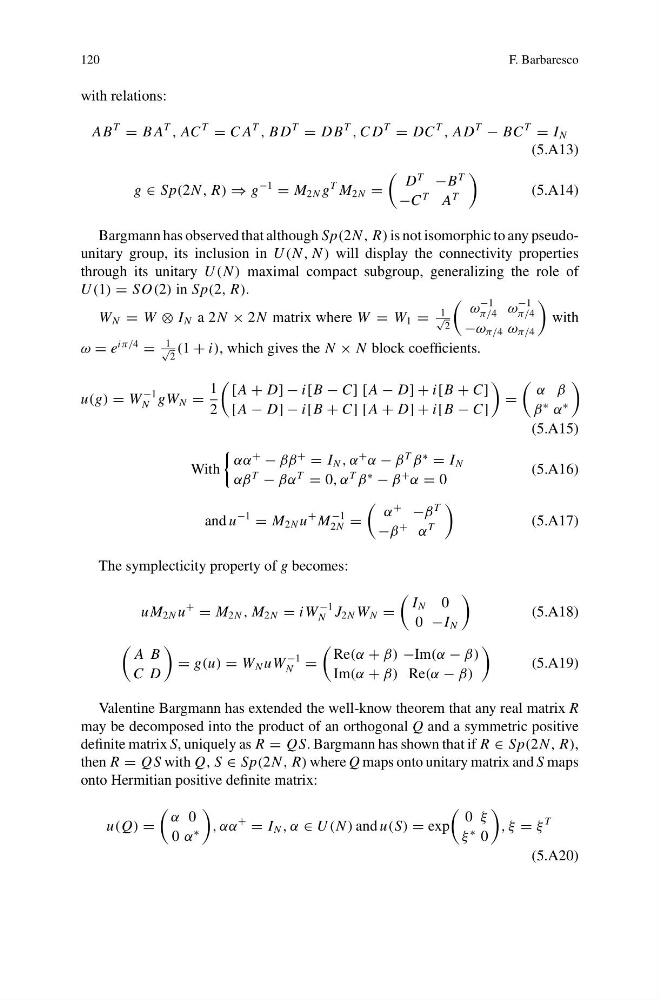
with relations:
AB
T
= B A
T
, AC
T
= C A
T
, B D
T
= D B
T
, C D
T
= DC
T
, AD
T
− BC
T
= I N
(5.A13)
g ∈ Sp(2N , R) ⇒ g
−1
= M 2N g
T M 2N =
D
T
−B
T
−C
T A
T
(5.A14)
Bargmann has observed that although Sp(2N , R) is not isomorphic to any pseudounitary group, its inclusion in U (N , N ) will display the connectivity properties
through its unitary U (N ) maximal compact subgroup, generalizing the role of
U (1) = SO(2) in Sp(2, R).
W N = W ⊗ I N a 2N × 2N matrix where W = W 1 =
1
√
2
ω
−1
π/4 ω
−1
π/4
−ω π/4 ω π/4
with
ω = e
iπ/4
=
1
√
2
(1 + i), which gives the N × N block coefficients.
u(g) = W
−1
N gW N =
1
2
[A + D] − i[B − C] [A − D] + i[B + C]
[A − D] − i[B + C] [A + D] + i[B − C]
=
α β
β
∗
α
∗
(5.A15)
With
αα
+
− ββ
+
= I N , α
+
α − β
T
β
∗
= I N
αβ
T
− βα
T
= 0, α
T
β
∗
− β
+
α = 0
(5.A16)
and u
−1
= M 2N u
+ M
−1
2N =
α
+
−β
T
−β
+
α
T
(5.A17)
The symplecticity property of g becomes:
u M 2N u
+
= M 2N , M 2N = i W
−1
N J 2N W N =
I N 0
0 −I N
(5.A18)
A B
C D
= g(u) = W N uW
−1
N =
Re(α + β) −Im(α − β)
Im(α + β) Re(α − β)
(5.A19)
Valentine Bargmann has extended the well-know theorem that any real matrix R
may be decomposed into the product of an orthogonal Q and a symmetric positive
definite matrix S, uniquely as R = QS. Bargmann has shown that if R ∈ Sp(2N , R),
then R = QS with Q, S ∈ Sp(2N , R) where Q maps onto unitary matrix and S maps
onto Hermitian positive definite matrix:
u(Q) =
α 0
0 α
∗
, αα
+
= I N , α ∈ U (N ) and u(S) = exp
0 ξ
ξ
∗ 0
, ξ = ξ
T
(5.A20)
F. Barbaresco
with relations:
AB
T
= B A
T
, AC
T
= C A
T
, B D
T
= D B
T
, C D
T
= DC
T
, AD
T
− BC
T
= I N
(5.A13)
g ∈ Sp(2N , R) ⇒ g
−1
= M 2N g
T M 2N =
D
T
−B
T
−C
T A
T
(5.A14)
Bargmann has observed that although Sp(2N , R) is not isomorphic to any pseudounitary group, its inclusion in U (N , N ) will display the connectivity properties
through its unitary U (N ) maximal compact subgroup, generalizing the role of
U (1) = SO(2) in Sp(2, R).
W N = W ⊗ I N a 2N × 2N matrix where W = W 1 =
1
√
2
ω
−1
π/4 ω
−1
π/4
−ω π/4 ω π/4
with
ω = e
iπ/4
=
1
√
2
(1 + i), which gives the N × N block coefficients.
u(g) = W
−1
N gW N =
1
2
[A + D] − i[B − C] [A − D] + i[B + C]
[A − D] − i[B + C] [A + D] + i[B − C]
=
α β
β
∗
α
∗
(5.A15)
With
αα
+
− ββ
+
= I N , α
+
α − β
T
β
∗
= I N
αβ
T
− βα
T
= 0, α
T
β
∗
− β
+
α = 0
(5.A16)
and u
−1
= M 2N u
+ M
−1
2N =
α
+
−β
T
−β
+
α
T
(5.A17)
The symplecticity property of g becomes:
u M 2N u
+
= M 2N , M 2N = i W
−1
N J 2N W N =
I N 0
0 −I N
(5.A18)
A B
C D
= g(u) = W N uW
−1
N =
Re(α + β) −Im(α − β)
Im(α + β) Re(α − β)
(5.A19)
Valentine Bargmann has extended the well-know theorem that any real matrix R
may be decomposed into the product of an orthogonal Q and a symmetric positive
definite matrix S, uniquely as R = QS. Bargmann has shown that if R ∈ Sp(2N , R),
then R = QS with Q, S ∈ Sp(2N , R) where Q maps onto unitary matrix and S maps
onto Hermitian positive definite matrix:
u(Q) =
α 0
0 α
∗
, αα
+
= I N , α ∈ U (N ) and u(S) = exp
0 ξ
ξ
∗ 0
, ξ = ξ
T
(5.A20)