

5 Invariant Koszul Form of Homogeneous Bounded Domains …
121
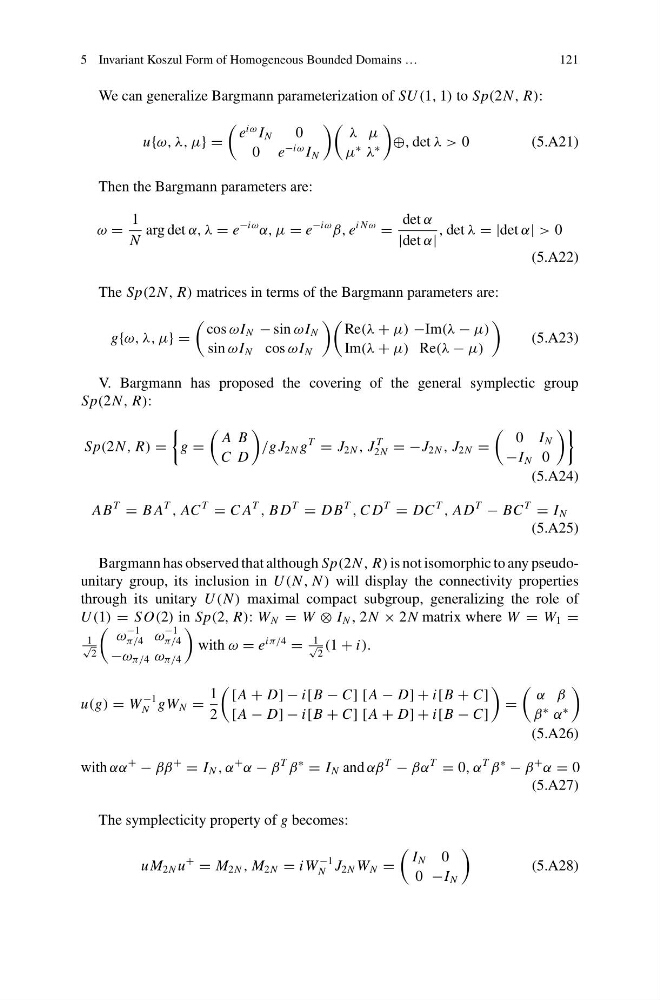
We can generalize Bargmann parameterization of SU (1, 1) to Sp(2N , R):
u{ω, λ, μ} =
e
iω I N
0
0 e
−iω I N
λ μ
μ
∗
λ
∗
⊕, det λ > 0
(5.A21)
Then the Bargmann parameters are:
ω =
1
N
arg det α, λ = e
−iω
α, μ = e
−iω
β, e
i Nω
=
det α
|det α|
, det λ = |det α| > 0
(5.A22)
The Sp(2N , R) matrices in terms of the Bargmann parameters are:
g{ω, λ, μ} =
cos ωI N − sin ωI N
sin ωI N cos ωI N
Re(λ + μ) −Im(λ − μ)
Im(λ + μ) Re(λ − μ)
(5.A23)
V. Bargmann has proposed the covering of the general symplectic group
Sp(2N , R):
Sp(2N , R) =
g =
A B
C D
/g J 2N g
T
= J 2N , J
T
2N = −J 2N , J 2N =
0 I N
−I N 0
(5.A24)
AB
T
= B A
T
, AC
T
= C A
T
, B D
T
= D B
T
, C D
T
= DC
T
, AD
T
− BC
T
= I N
(5.A25)
Bargmann has observed that although Sp(2N , R) is not isomorphic to any pseudounitary group, its inclusion in U (N , N ) will display the connectivity properties
through its unitary U (N ) maximal compact subgroup, generalizing the role of
U (1) = SO(2) in Sp(2, R): W N = W ⊗ I N , 2N × 2N matrix where W = W 1 =
1
√
2
ω
−1
π/4 ω
−1
π/4
−ω π/4 ω π/4
with ω = e
iπ/4
=
1
√
2
(1 + i).
u(g) = W
−1
N gW N =
1
2
[A + D] − i[B − C] [A − D] + i[B + C]
[A − D] − i[B + C] [A + D] + i[B − C]
=
α β
β
∗
α
∗
(5.A26)
with αα
+
− ββ
+
= I N , α
+
α − β
T
β
∗
= I N and αβ
T
− βα
T
= 0, α
T
β
∗
− β
+
α = 0
(5.A27)
The symplecticity property of g becomes:
u M 2N u
+
= M 2N , M 2N = i W
−1
N J 2N W N =
I N 0
0 −I N
(5.A28)
121
We can generalize Bargmann parameterization of SU (1, 1) to Sp(2N , R):
u{ω, λ, μ} =
e
iω I N
0
0 e
−iω I N
λ μ
μ
∗
λ
∗
⊕, det λ > 0
(5.A21)
Then the Bargmann parameters are:
ω =
1
N
arg det α, λ = e
−iω
α, μ = e
−iω
β, e
i Nω
=
det α
|det α|
, det λ = |det α| > 0
(5.A22)
The Sp(2N , R) matrices in terms of the Bargmann parameters are:
g{ω, λ, μ} =
cos ωI N − sin ωI N
sin ωI N cos ωI N
Re(λ + μ) −Im(λ − μ)
Im(λ + μ) Re(λ − μ)
(5.A23)
V. Bargmann has proposed the covering of the general symplectic group
Sp(2N , R):
Sp(2N , R) =
g =
A B
C D
/g J 2N g
T
= J 2N , J
T
2N = −J 2N , J 2N =
0 I N
−I N 0
(5.A24)
AB
T
= B A
T
, AC
T
= C A
T
, B D
T
= D B
T
, C D
T
= DC
T
, AD
T
− BC
T
= I N
(5.A25)
Bargmann has observed that although Sp(2N , R) is not isomorphic to any pseudounitary group, its inclusion in U (N , N ) will display the connectivity properties
through its unitary U (N ) maximal compact subgroup, generalizing the role of
U (1) = SO(2) in Sp(2, R): W N = W ⊗ I N , 2N × 2N matrix where W = W 1 =
1
√
2
ω
−1
π/4 ω
−1
π/4
−ω π/4 ω π/4
with ω = e
iπ/4
=
1
√
2
(1 + i).
u(g) = W
−1
N gW N =
1
2
[A + D] − i[B − C] [A − D] + i[B + C]
[A − D] − i[B + C] [A + D] + i[B − C]
=
α β
β
∗
α
∗
(5.A26)
with αα
+
− ββ
+
= I N , α
+
α − β
T
β
∗
= I N and αβ
T
− βα
T
= 0, α
T
β
∗
− β
+
α = 0
(5.A27)
The symplecticity property of g becomes:
u M 2N u
+
= M 2N , M 2N = i W
−1
N J 2N W N =
I N 0
0 −I N
(5.A28)