

5 Invariant Koszul Form of Homogeneous Bounded Domains …
119
The properties of connectivity of Sp(2, R) is described by its isomorphy with
SU (1, 1). Using unimodular condition:
|α|
2
− |β|
2
= 1 ⇒ α
2
R + α
2
I − β
2
R = 1 + β
2
I ≥ 1
with α = α R + iα I and β = β R + iβ I
If β I is fixed, (α R , α I , β R ) are constrained to define a one-sheeted revolution
hyperboloid, with its circular waist in the α plane.
To SU (1, 1), we can associate the simply-connected universal covering group,
using the maximal compact subgroup U (1) and corresponding to the Iwasawa decomposition (factorization of a noncompact semisimple group into its maximal compact
subgroup times a solvable subgroup).
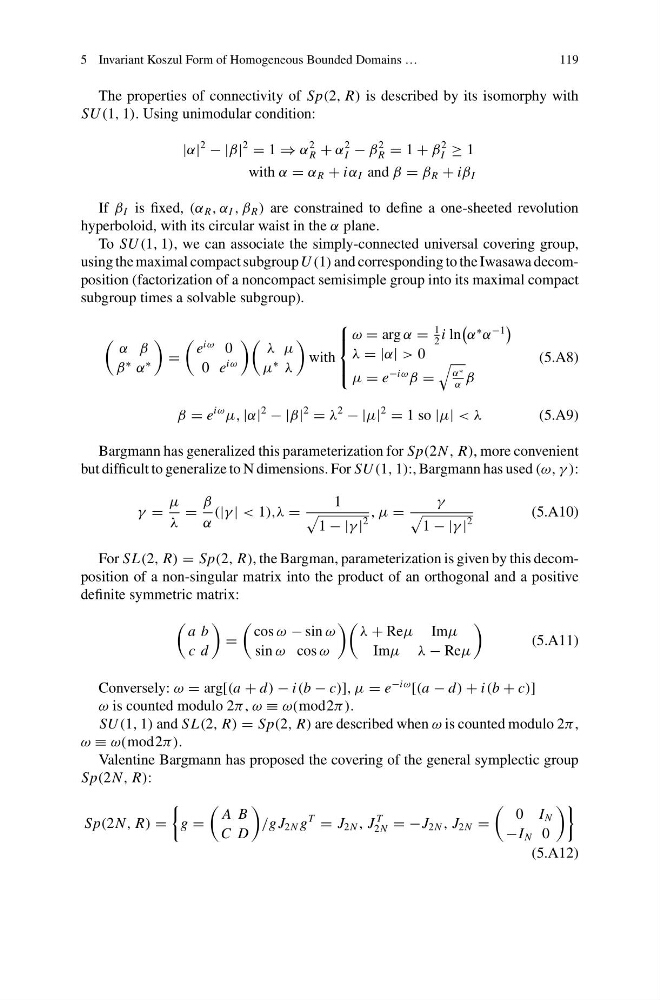
α β
β
∗
α
∗
=
e
iω 0
0 e
iω
λ μ
μ
∗
λ
with
⎧
⎪ ⎨
⎪ ⎩
ω = arg α =
1
2
i ln
α
∗
α
−1
λ = |α| > 0
μ = e
−iω
β =
α ∗
α
β
(5.A8)
β = e
iω
μ, |α|
2
− |β|
2
= λ
2
− |μ|
2
= 1 so |μ| < λ
(5.A9)
Bargmann has generalized this parameterization for Sp(2N , R), more convenient
but difficult to generalize to N dimensions. For SU (1, 1):, Bargmann has used (ω, γ ):
γ =
μ
λ
=
β
α
(|γ | < 1),λ =
1
1 − |γ |
2
, μ =
γ
1 − |γ |
2
(5.A10)
For SL(2, R) = Sp(2, R), the Bargman, parameterization is given by this decomposition of a non-singular matrix into the product of an orthogonal and a positive
definite symmetric matrix:
a b
c d
=
cos ω − sin ω
sin ω cos ω
λ + Reμ Imμ
Imμ λ − Reμ
(5.A11)
Conversely: ω = arg[(a + d) − i(b − c)], μ = e
−iω [(a − d) + i(b + c)]
ω is counted modulo 2π , ω ≡ ω(mod2π).
SU (1, 1) and SL(2, R) = Sp(2, R) are described when ω is counted modulo 2π ,
ω ≡ ω(mod2π ).
Valentine Bargmann has proposed the covering of the general symplectic group
Sp(2N , R):
Sp(2N , R) =
g =
A B
C D
/g J 2N g
T
= J 2N , J
T
2N = −J 2N , J 2N =
0 I N
−I N 0
(5.A12)
119
The properties of connectivity of Sp(2, R) is described by its isomorphy with
SU (1, 1). Using unimodular condition:
|α|
2
− |β|
2
= 1 ⇒ α
2
R + α
2
I − β
2
R = 1 + β
2
I ≥ 1
with α = α R + iα I and β = β R + iβ I
If β I is fixed, (α R , α I , β R ) are constrained to define a one-sheeted revolution
hyperboloid, with its circular waist in the α plane.
To SU (1, 1), we can associate the simply-connected universal covering group,
using the maximal compact subgroup U (1) and corresponding to the Iwasawa decomposition (factorization of a noncompact semisimple group into its maximal compact
subgroup times a solvable subgroup).
α β
β
∗
α
∗
=
e
iω 0
0 e
iω
λ μ
μ
∗
λ
with
⎧
⎪ ⎨
⎪ ⎩
ω = arg α =
1
2
i ln
α
∗
α
−1
λ = |α| > 0
μ = e
−iω
β =
α ∗
α
β
(5.A8)
β = e
iω
μ, |α|
2
− |β|
2
= λ
2
− |μ|
2
= 1 so |μ| < λ
(5.A9)
Bargmann has generalized this parameterization for Sp(2N , R), more convenient
but difficult to generalize to N dimensions. For SU (1, 1):, Bargmann has used (ω, γ ):
γ =
μ
λ
=
β
α
(|γ | < 1),λ =
1
1 − |γ |
2
, μ =
γ
1 − |γ |
2
(5.A10)
For SL(2, R) = Sp(2, R), the Bargman, parameterization is given by this decomposition of a non-singular matrix into the product of an orthogonal and a positive
definite symmetric matrix:
a b
c d
=
cos ω − sin ω
sin ω cos ω
λ + Reμ Imμ
Imμ λ − Reμ
(5.A11)
Conversely: ω = arg[(a + d) − i(b − c)], μ = e
−iω [(a − d) + i(b + c)]
ω is counted modulo 2π , ω ≡ ω(mod2π).
SU (1, 1) and SL(2, R) = Sp(2, R) are described when ω is counted modulo 2π ,
ω ≡ ω(mod2π ).
Valentine Bargmann has proposed the covering of the general symplectic group
Sp(2N , R):
Sp(2N , R) =
g =
A B
C D
/g J 2N g
T
= J 2N , J
T
2N = −J 2N , J 2N =
0 I N
−I N 0
(5.A12)