

112
F. Barbaresco
( )
( )
( )
*
*
*
*
*
*
1
1
2
2
3
3
2
*
2
2
*
2
2
2
( )
,
,
,
1
2
1
1
( )
1
2
1
1
J z J z z u J z z u J z z u
z
z
z
z
J z
z
z
z
z
ρ
=
+
+
⎛
⎞
+
⎜
−
⎟
−
−
⎜
⎟ ∈
= ⎜
⎟
+
⎜
⎟
−
⎜
⎟
−
−
⎝
⎠
g
(5.41)
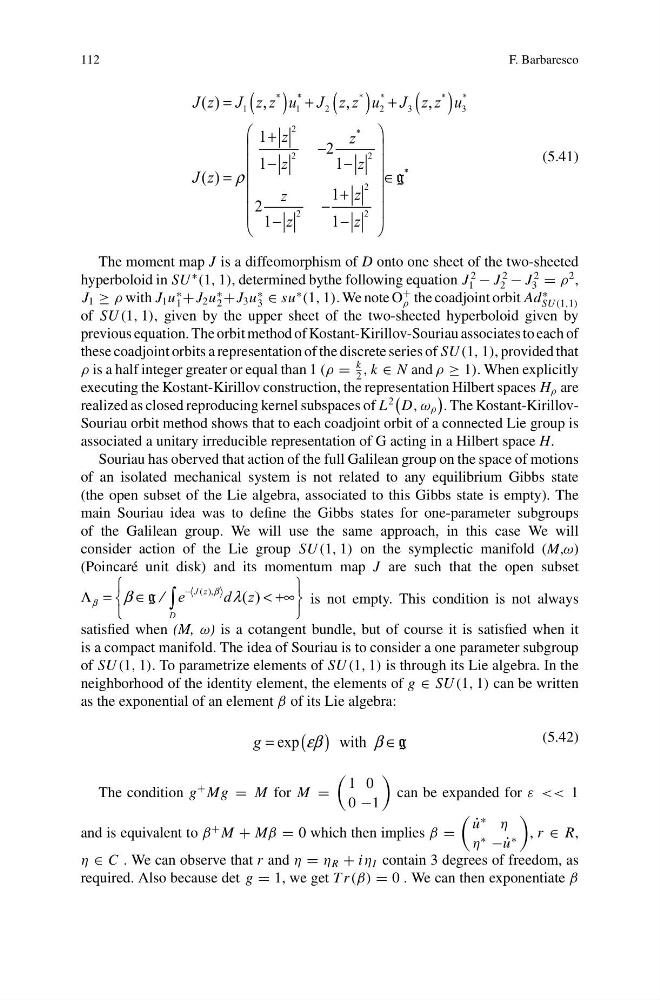
The moment map J is a diffeomorphism of D onto one sheet of the two-sheeted
hyperboloid in SU
∗
(1, 1), determined bythe following equation J
2
1 − J
2
2 − J
2
3 = ρ
2 ,
J 1 ≥ ρ with J 1 u
∗
1 + J 2 u
∗
2 + J 3 u
∗
3 ∈ su
∗
(1, 1). We note O
+
ρ the coadjoint orbit Ad
∗
SU (1,1)
of SU (1, 1), given by the upper sheet of the two-sheeted hyperboloid given by
previous equation. The orbit method of Kostant-Kirillov-Souriau associates to each of
these coadjoint orbits a representation of the discrete series of SU (1, 1), provided that
ρ is a half integer greater or equal than 1 (ρ =
k
2
, k ∈ N and ρ ≥ 1). When explicitly
executing the Kostant-Kirillov construction, the representation Hilbert spaces H ρ are
realized as closed reproducing kernel subspaces of L
2
D, ω ρ
. The Kostant-KirillovSouriau orbit method shows that to each coadjoint orbit of a connected Lie group is
associated a unitary irreducible representation of G acting in a Hilbert space H.
Souriau has oberved that action of the full Galilean group on the space of motions
of an isolated mechanical system is not related to any equilibrium Gibbs state
(the open subset of the Lie algebra, associated to this Gibbs state is empty). The
main Souriau idea was to define the Gibbs states for one-parameter subgroups
of the Galilean group. We will use the same approach, in this case We will
consider action of the Lie group SU (1, 1) on the symplectic manifold (M,ω)
(Poincaré unit disk) and its momentum map J are such that the open subset
( ),
( )
J z
D
e
d z
β
β
β
λ
−
⎫
⎧
Λ =
∈
< +∞ ⎬
⎨
⎭
⎩
∫
g /
is not empty. This condition is not always
satisfied when (M, ω) is a cotangent bundle, but of course it is satisfied when it
is a compact manifold. The idea of Souriau is to consider a one parameter subgroup
of SU (1, 1). To parametrize elements of SU (1, 1) is through its Lie algebra. In the
neighborhood of the identity element, the elements of g ∈ SU (1, 1) can be written
as the exponential of an element β of its Lie algebra:
( )
exp
with
g
εβ
β
=
∈ g
(5.42)
The condition g
+ Mg = M for M =
1 0
0 −1
can be expanded for ε << 1
and is equivalent to β
+ M + Mβ = 0 which then implies β =
˙
u
∗
η
η
∗
− ˙
u
∗
, r ∈ R,
η ∈ C . We can observe that r and η = η R + iη I contain 3 degrees of freedom, as
required. Also because det g = 1, we get T r(β) = 0 . We can then exponentiate β
F. Barbaresco
( )
( )
( )
*
*
*
*
*
*
1
1
2
2
3
3
2
*
2
2
*
2
2
2
( )
,
,
,
1
2
1
1
( )
1
2
1
1
J z J z z u J z z u J z z u
z
z
z
z
J z
z
z
z
z
ρ
=
+
+
⎛
⎞
+
⎜
−
⎟
−
−
⎜
⎟ ∈
= ⎜
⎟
+
⎜
⎟
−
⎜
⎟
−
−
⎝
⎠
g
(5.41)
The moment map J is a diffeomorphism of D onto one sheet of the two-sheeted
hyperboloid in SU
∗
(1, 1), determined bythe following equation J
2
1 − J
2
2 − J
2
3 = ρ
2 ,
J 1 ≥ ρ with J 1 u
∗
1 + J 2 u
∗
2 + J 3 u
∗
3 ∈ su
∗
(1, 1). We note O
+
ρ the coadjoint orbit Ad
∗
SU (1,1)
of SU (1, 1), given by the upper sheet of the two-sheeted hyperboloid given by
previous equation. The orbit method of Kostant-Kirillov-Souriau associates to each of
these coadjoint orbits a representation of the discrete series of SU (1, 1), provided that
ρ is a half integer greater or equal than 1 (ρ =
k
2
, k ∈ N and ρ ≥ 1). When explicitly
executing the Kostant-Kirillov construction, the representation Hilbert spaces H ρ are
realized as closed reproducing kernel subspaces of L
2
D, ω ρ
. The Kostant-KirillovSouriau orbit method shows that to each coadjoint orbit of a connected Lie group is
associated a unitary irreducible representation of G acting in a Hilbert space H.
Souriau has oberved that action of the full Galilean group on the space of motions
of an isolated mechanical system is not related to any equilibrium Gibbs state
(the open subset of the Lie algebra, associated to this Gibbs state is empty). The
main Souriau idea was to define the Gibbs states for one-parameter subgroups
of the Galilean group. We will use the same approach, in this case We will
consider action of the Lie group SU (1, 1) on the symplectic manifold (M,ω)
(Poincaré unit disk) and its momentum map J are such that the open subset
( ),
( )
J z
D
e
d z
β
β
β
λ
−
⎫
⎧
Λ =
∈
< +∞ ⎬
⎨
⎭
⎩
∫
g /
is not empty. This condition is not always
satisfied when (M, ω) is a cotangent bundle, but of course it is satisfied when it
is a compact manifold. The idea of Souriau is to consider a one parameter subgroup
of SU (1, 1). To parametrize elements of SU (1, 1) is through its Lie algebra. In the
neighborhood of the identity element, the elements of g ∈ SU (1, 1) can be written
as the exponential of an element β of its Lie algebra:
( )
exp
with
g
εβ
β
=
∈ g
(5.42)
The condition g
+ Mg = M for M =
1 0
0 −1
can be expanded for ε << 1
and is equivalent to β
+ M + Mβ = 0 which then implies β =
˙
u
∗
η
η
∗
− ˙
u
∗
, r ∈ R,
η ∈ C . We can observe that r and η = η R + iη I contain 3 degrees of freedom, as
required. Also because det g = 1, we get T r(β) = 0 . We can then exponentiate β