

5 Invariant Koszul Form of Homogeneous Bounded Domains …
111
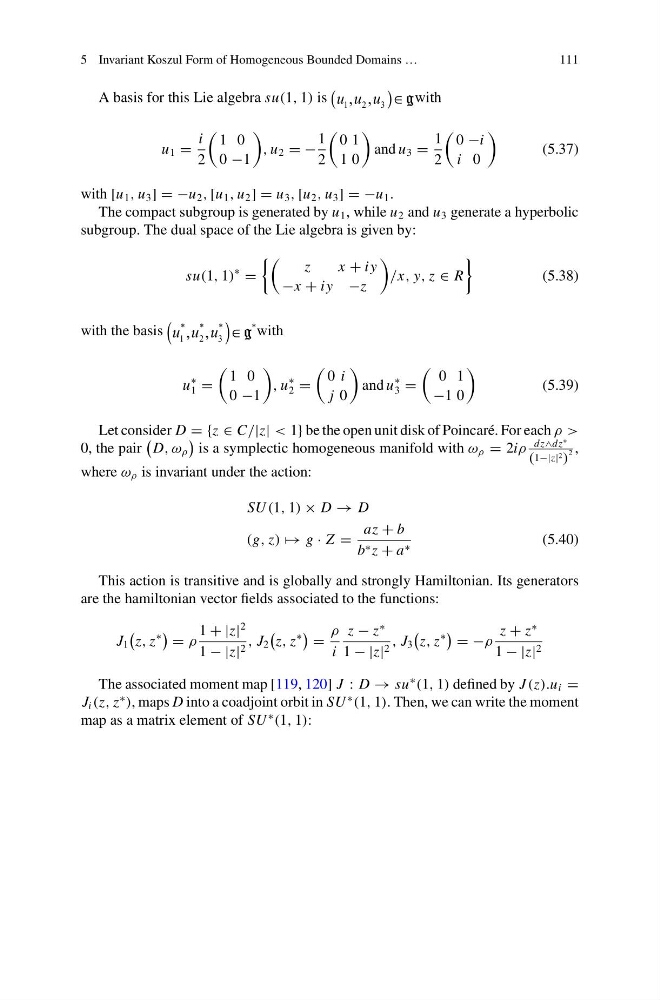
A basis for this Lie algebra su(1, 1) is (
)
1 2
3
, ,
u u u ∈gwith
u 1 =
i
2
1 0
0 −1
, u 2 = −
1
2
0 1
1 0
and u 3 =
1
2
0 −i
i 0
(5.37)
with [u 1 , u 3 ] = −u 2 , [u 1 , u 2 ] = u 3 , [u 2 , u 3 ] = −u 1 .
The compact subgroup is generated by u 1 , while u 2 and u 3 generate a hyperbolic
subgroup. The dual space of the Lie algebra is given by:
su(1, 1)
∗
=
z
x + iy
−x + iy −z
/x, y, z ∈ R
(5.38)
with the basis (
)
*
*
*
*
1
2
3
, ,
u u u ∈g with
u
∗
1 =
1 0
0 −1
, u
∗
2 =
0 i
j 0
and u
∗
3 =
0 1
−1 0
(5.39)
Let consider D = {z ∈ C/|z| < 1} be the open unit disk of Poincaré. For each ρ >
0, the pair
D, ω ρ
is a symplectic homogeneous manifold with ω ρ = 2iρ
dz∧dz
∗
(1−|z|
2
)
2 ,
where ω ρ is invariant under the action:
SU (1, 1) × D → D
(g, z) → g · Z =
az + b
b ∗ z + a ∗
(5.40)
This action is transitive and is globally and strongly Hamiltonian. Its generators
are the hamiltonian vector fields associated to the functions:
J 1
z, z
∗
= ρ
1 + |z|
2
1 − |z| 2 , J 2
z, z
∗
=
ρ
i
z − z
∗
1 − |z| 2 , J 3
z, z
∗
= −ρ
z + z
∗
1 − |z| 2
The associated moment map [119, 120] J : D → su
∗
(1, 1) defined by J (z).u i =
J i (z, z
∗
), maps D into a coadjoint orbit in SU
∗
(1, 1). Then, we can write the moment
map as a matrix element of SU
∗
(1, 1):
111
A basis for this Lie algebra su(1, 1) is (
)
1 2
3
, ,
u u u ∈gwith
u 1 =
i
2
1 0
0 −1
, u 2 = −
1
2
0 1
1 0
and u 3 =
1
2
0 −i
i 0
(5.37)
with [u 1 , u 3 ] = −u 2 , [u 1 , u 2 ] = u 3 , [u 2 , u 3 ] = −u 1 .
The compact subgroup is generated by u 1 , while u 2 and u 3 generate a hyperbolic
subgroup. The dual space of the Lie algebra is given by:
su(1, 1)
∗
=
z
x + iy
−x + iy −z
/x, y, z ∈ R
(5.38)
with the basis (
)
*
*
*
*
1
2
3
, ,
u u u ∈g with
u
∗
1 =
1 0
0 −1
, u
∗
2 =
0 i
j 0
and u
∗
3 =
0 1
−1 0
(5.39)
Let consider D = {z ∈ C/|z| < 1} be the open unit disk of Poincaré. For each ρ >
0, the pair
D, ω ρ
is a symplectic homogeneous manifold with ω ρ = 2iρ
dz∧dz
∗
(1−|z|
2
)
2 ,
where ω ρ is invariant under the action:
SU (1, 1) × D → D
(g, z) → g · Z =
az + b
b ∗ z + a ∗
(5.40)
This action is transitive and is globally and strongly Hamiltonian. Its generators
are the hamiltonian vector fields associated to the functions:
J 1
z, z
∗
= ρ
1 + |z|
2
1 − |z| 2 , J 2
z, z
∗
=
ρ
i
z − z
∗
1 − |z| 2 , J 3
z, z
∗
= −ρ
z + z
∗
1 − |z| 2
The associated moment map [119, 120] J : D → su
∗
(1, 1) defined by J (z).u i =
J i (z, z
∗
), maps D into a coadjoint orbit in SU
∗
(1, 1). Then, we can write the moment
map as a matrix element of SU
∗
(1, 1):