

5 Invariant Koszul Form of Homogeneous Bounded Domains …
113
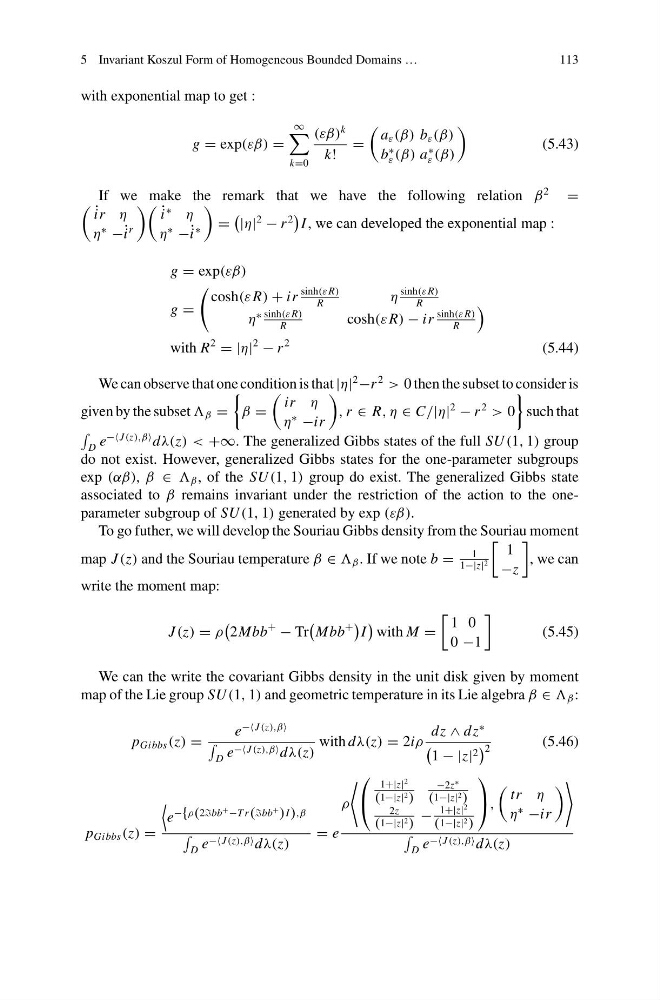
with exponential map to get :
g = exp(εβ) =
∞
k=0
(εβ)
k
k!
=
a ε (β) b ε (β)
b
∗
ε (β) a
∗
ε (β)
(5.43)
If we make the remark that we have the following relation β
2
=
˙
ir η
η
∗
− ˙
i
r
˙
i
∗
η
η
∗
− ˙
i
∗
=
|η|
2
− r
2
I , we can developed the exponential map :
g = exp(εβ)
g =
cosh(ε R) + ir
sinh(ε R)
R
η
sinh(ε R)
R
η
∗ sinh(ε R)
R
cosh(ε R) − ir
sinh(ε R)
R
with R
2
= |η|
2
− r
2
(5.44)
We can observe that one condition is that |η|
2
−r
2
> 0 then the subset to consider is
given by the subset β =
β =
ir η
η
∗
−ir
, r ∈ R, η ∈ C/|η|
2
− r
2
> 0
such that
D e
−J (z),β dλ(z) < +∞. The generalized Gibbs states of the full SU (1, 1) group
do not exist. However, generalized Gibbs states for the one-parameter subgroups
exp (αβ), β ∈ β , of the SU (1, 1) group do exist. The generalized Gibbs state
associated to β remains invariant under the restriction of the action to the oneparameter subgroup of SU (1, 1) generated by exp (εβ).
To go futher, we will develop the Souriau Gibbs density from the Souriau moment
map J (z) and the Souriau temperature β ∈ β . If we note b =
1
1−|z| 2
1
−z
, we can
write the moment map:
J (z) = ρ
2Mbb
+
− Tr
Mbb
+
I
with M =
1 0
0 −1
(5.45)
We can the write the covariant Gibbs density in the unit disk given by moment
map of the Lie group SU (1, 1) and geometric temperature in its Lie algebra β ∈ β :
p Gibbs (z) =
e
−J (z),β
D e −J (z),β dλ(z)
with dλ(z) = 2iρ
dz ∧ dz
∗
1 − |z| 2
2
(5.46)
p Gibbs (z) =
e
−{ρ(2bb
+ −T r(bb
+
)I),β
D e −J (z),β dλ(z)
= e
ρ
⎛
⎝
1+|z|
2
(1−|z|
2
)
−2z
∗
(1−|z|
2
)
2z
(1−|z|
2
)
−
1+|z|
2
(1−|z|
2
)
⎞
⎠ ,
tr η
η
∗
−ir
D e −J (z),β dλ(z)
113
with exponential map to get :
g = exp(εβ) =
∞
k=0
(εβ)
k
k!
=
a ε (β) b ε (β)
b
∗
ε (β) a
∗
ε (β)
(5.43)
If we make the remark that we have the following relation β
2
=
˙
ir η
η
∗
− ˙
i
r
˙
i
∗
η
η
∗
− ˙
i
∗
=
|η|
2
− r
2
I , we can developed the exponential map :
g = exp(εβ)
g =
cosh(ε R) + ir
sinh(ε R)
R
η
sinh(ε R)
R
η
∗ sinh(ε R)
R
cosh(ε R) − ir
sinh(ε R)
R
with R
2
= |η|
2
− r
2
(5.44)
We can observe that one condition is that |η|
2
−r
2
> 0 then the subset to consider is
given by the subset β =
β =
ir η
η
∗
−ir
, r ∈ R, η ∈ C/|η|
2
− r
2
> 0
such that
D e
−J (z),β dλ(z) < +∞. The generalized Gibbs states of the full SU (1, 1) group
do not exist. However, generalized Gibbs states for the one-parameter subgroups
exp (αβ), β ∈ β , of the SU (1, 1) group do exist. The generalized Gibbs state
associated to β remains invariant under the restriction of the action to the oneparameter subgroup of SU (1, 1) generated by exp (εβ).
To go futher, we will develop the Souriau Gibbs density from the Souriau moment
map J (z) and the Souriau temperature β ∈ β . If we note b =
1
1−|z| 2
1
−z
, we can
write the moment map:
J (z) = ρ
2Mbb
+
− Tr
Mbb
+
I
with M =
1 0
0 −1
(5.45)
We can the write the covariant Gibbs density in the unit disk given by moment
map of the Lie group SU (1, 1) and geometric temperature in its Lie algebra β ∈ β :
p Gibbs (z) =
e
−J (z),β
D e −J (z),β dλ(z)
with dλ(z) = 2iρ
dz ∧ dz
∗
1 − |z| 2
2
(5.46)
p Gibbs (z) =
e
−{ρ(2bb
+ −T r(bb
+
)I),β
D e −J (z),β dλ(z)
= e
ρ
⎛
⎝
1+|z|
2
(1−|z|
2
)
−2z
∗
(1−|z|
2
)
2z
(1−|z|
2
)
−
1+|z|
2
(1−|z|
2
)
⎞
⎠ ,
tr η
η
∗
−ir
D e −J (z),β dλ(z)