

4 Effect of Incorporated Inorganic Nanoparticles on Porous Structure. . .
71
Table 4.2 Modeling of adsorption isotherms
BG (Langmuir model)
Ni 2+ (Freundlich model)
A L ,× 10 4 mmol g −1
K L × 10 −5 ,
g mmol −1 R 2
A F mmol
g −1
1/n
R 2
Sample
Experimental Calculated
Dowex MAC-3
4.11
5.21
3.81
0.98
238
0.80 0.98
Dowex MAC-3/ZHP 4.89
5.83
4.36
0.97 1818
0.96 0.98
Dowex HCR-S
3.41
5.51
51.19
0.99
214
0.60 0.99
Dowex HCR-S/ZHP 5.55
7.57
27.26
0.99
338
0.77 0.98
ZHP
3.65
5.05
2.19
0.99
36
0,49 0.99
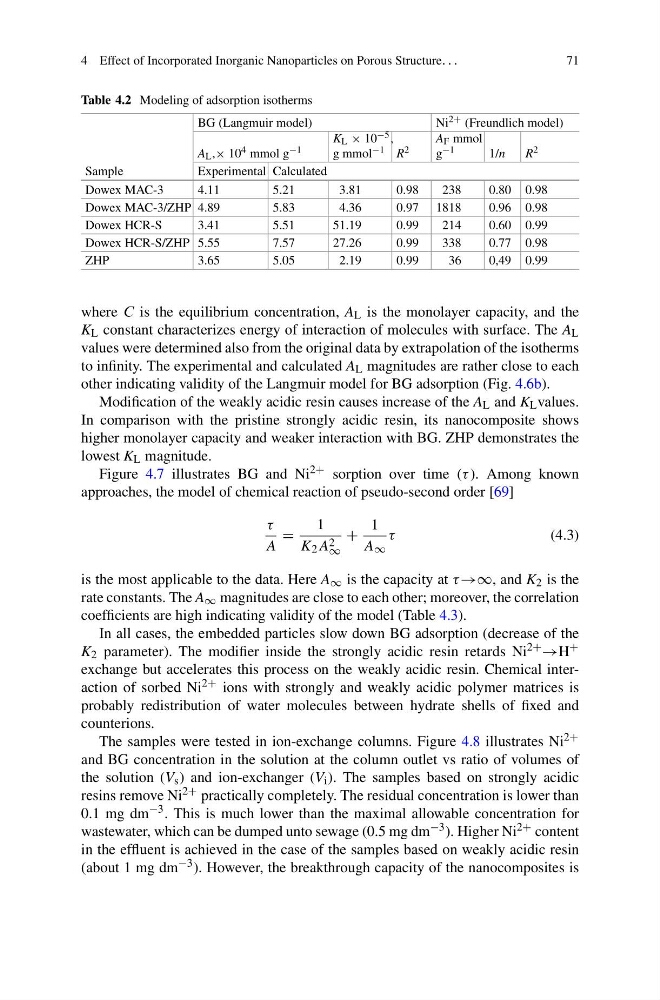
where ´ is the equilibrium concentration, A L is the monolayer capacity, and the
K L constant characterizes energy of interaction of molecules with surface. The A L
values were determined also from the original data by extrapolation of the isotherms
to infinity. The experimental and calculated A L magnitudes are rather close to each
other indicating validity of the Langmuir model for BG adsorption (Fig. 4.6b).
Modification of the weakly acidic resin causes increase of the A L and K L values.
In comparison with the pristine strongly acidic resin, its nanocomposite shows
higher monolayer capacity and weaker interaction with BG. ZHP demonstrates the
lowest K L magnitude.
Figure 4.7 illustrates BG and Ni 2+ sorption over time (τ ). Among known
approaches, the model of chemical reaction of pseudo-second order [69]
τ
A
=
1
K 2 A 2
∞
+
1
A ∞
τ
(4.3)
is the most applicable to the data. Here A ∞ is the capacity at τ →∞, and K 2 is the
rate constants. The A ∞ magnitudes are close to each other; moreover, the correlation
coefficients are high indicating validity of the model (Table 4.3).
In all cases, the embedded particles slow down BG adsorption (decrease of the
K 2 parameter). The modifier inside the strongly acidic resin retards Ni 2+ →H +
exchange but accelerates this process on the weakly acidic resin. Chemical interaction of sorbed Ni 2+ ions with strongly and weakly acidic polymer matrices is
probably redistribution of water molecules between hydrate shells of fixed and
counterions.
The samples were tested in ion-exchange columns. Figure 4.8 illustrates Ni 2+
and BG concentration in the solution at the column outlet vs ratio of volumes of
the solution (V s ) and ion-exchanger (V i ). The samples based on strongly acidic
resins remove Ni 2+ practically completely. The residual concentration is lower than
0.1 mg dm −3 . This is much lower than the maximal allowable concentration for
wastewater, which can be dumped unto sewage (0.5 mg dm −3 ). Higher Ni 2+ content
in the effluent is achieved in the case of the samples based on weakly acidic resin
(about 1 mg dm −3 ). However, the breakthrough capacity of the nanocomposites is
71
Table 4.2 Modeling of adsorption isotherms
BG (Langmuir model)
Ni 2+ (Freundlich model)
A L ,× 10 4 mmol g −1
K L × 10 −5 ,
g mmol −1 R 2
A F mmol
g −1
1/n
R 2
Sample
Experimental Calculated
Dowex MAC-3
4.11
5.21
3.81
0.98
238
0.80 0.98
Dowex MAC-3/ZHP 4.89
5.83
4.36
0.97 1818
0.96 0.98
Dowex HCR-S
3.41
5.51
51.19
0.99
214
0.60 0.99
Dowex HCR-S/ZHP 5.55
7.57
27.26
0.99
338
0.77 0.98
ZHP
3.65
5.05
2.19
0.99
36
0,49 0.99
where ´ is the equilibrium concentration, A L is the monolayer capacity, and the
K L constant characterizes energy of interaction of molecules with surface. The A L
values were determined also from the original data by extrapolation of the isotherms
to infinity. The experimental and calculated A L magnitudes are rather close to each
other indicating validity of the Langmuir model for BG adsorption (Fig. 4.6b).
Modification of the weakly acidic resin causes increase of the A L and K L values.
In comparison with the pristine strongly acidic resin, its nanocomposite shows
higher monolayer capacity and weaker interaction with BG. ZHP demonstrates the
lowest K L magnitude.
Figure 4.7 illustrates BG and Ni 2+ sorption over time (τ ). Among known
approaches, the model of chemical reaction of pseudo-second order [69]
τ
A
=
1
K 2 A 2
∞
+
1
A ∞
τ
(4.3)
is the most applicable to the data. Here A ∞ is the capacity at τ →∞, and K 2 is the
rate constants. The A ∞ magnitudes are close to each other; moreover, the correlation
coefficients are high indicating validity of the model (Table 4.3).
In all cases, the embedded particles slow down BG adsorption (decrease of the
K 2 parameter). The modifier inside the strongly acidic resin retards Ni 2+ →H +
exchange but accelerates this process on the weakly acidic resin. Chemical interaction of sorbed Ni 2+ ions with strongly and weakly acidic polymer matrices is
probably redistribution of water molecules between hydrate shells of fixed and
counterions.
The samples were tested in ion-exchange columns. Figure 4.8 illustrates Ni 2+
and BG concentration in the solution at the column outlet vs ratio of volumes of
the solution (V s ) and ion-exchanger (V i ). The samples based on strongly acidic
resins remove Ni 2+ practically completely. The residual concentration is lower than
0.1 mg dm −3 . This is much lower than the maximal allowable concentration for
wastewater, which can be dumped unto sewage (0.5 mg dm −3 ). Higher Ni 2+ content
in the effluent is achieved in the case of the samples based on weakly acidic resin
(about 1 mg dm −3 ). However, the breakthrough capacity of the nanocomposites is