

72
L. Ponomarova et al.
0
2000
4000
g
l
o
m
m
/
A
-1
0.00
0.02
0.04
0.06
Dowex MAC-3
Dowex MAC-3/ZHP
ZHP
Dowex HCR-S
Dowex HCR-S/ZHP
a
0
1000
2000
3000
4000
τ A
-1
l
o
m
m
g
s
/
-1
0
500
1000
Dowex HCR-S
Dowex HCR-S/ZHP
ZHP
Dowex MAC-3
Dowex MAC-3/ZHP
b
τ / s
τ / s
τ / s
τ / s
0
1000
2000
3000
4000
0
1
x
A
3
g
l
o
m
m
-1
0
5
10
Dowex MAC-3
Dowex NAC-3/ZHP
Dowex HCR-S
Dowex HCR-S/ZHP
c
0
1000
2000
3000
4000
τ
0
1
x
A
/
-5
l
o
m
m
g
s
-1
Dowex MAC-3
Dowex MAC-3/ZHP
Dowex HCR-S
Dowex HCR-S/ZHP
0
1
2
3
d
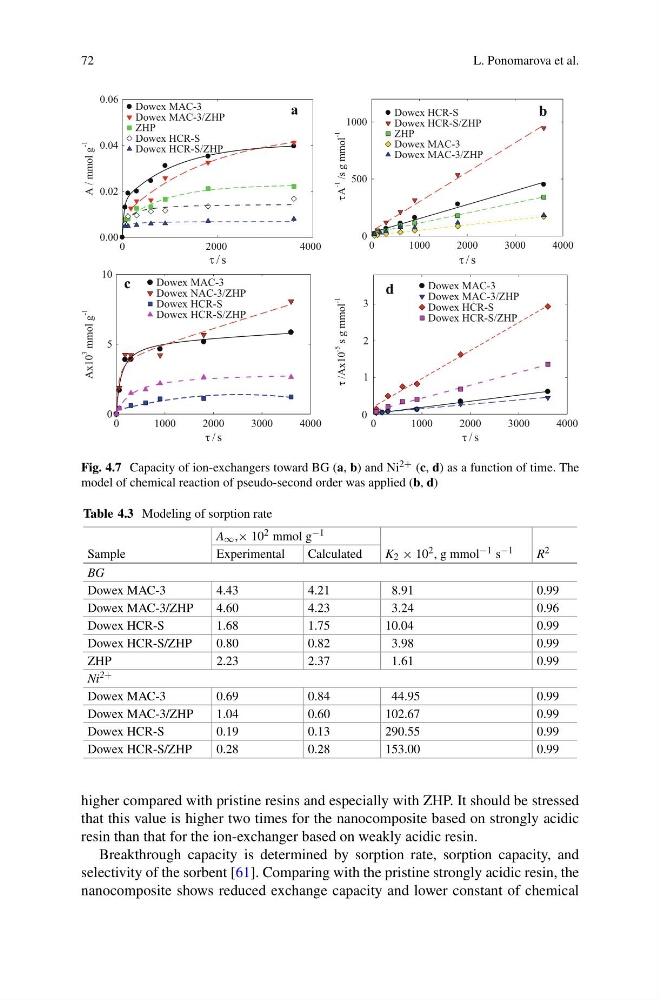
Fig. 4.7 Capacity of ion-exchangers toward BG (a, b) and Ni 2+ (c, d) as a function of time. The
model of chemical reaction of pseudo-second order was applied (b, d)
Table 4.3 Modeling of sorption rate
A ∞ ,× 10 2 mmol g −1
Sample
Experimental
Calculated
K 2 × 10 2 , g mmol −1 s −1
R 2
BG
Dowex MAC-3
4.43
4.21
8.91
0.99
Dowex MAC-3/ZHP
4.60
4.23
3.24
0.96
Dowex HCR-S
1.68
1.75
10.04
0.99
Dowex HCR-S/ZHP
0.80
0.82
3.98
0.99
ZHP
2.23
2.37
1.61
0.99
Ni 2+
Dowex MAC-3
0.69
0.84
44.95
0.99
Dowex MAC-3/ZHP
1.04
0.60
102.67
0.99
Dowex HCR-S
0.19
0.13
290.55
0.99
Dowex HCR-S/ZHP
0.28
0.28
153.00
0.99
higher compared with pristine resins and especially with ZHP. It should be stressed
that this value is higher two times for the nanocomposite based on strongly acidic
resin than that for the ion-exchanger based on weakly acidic resin.
Breakthrough capacity is determined by sorption rate, sorption capacity, and
selectivity of the sorbent [61]. Comparing with the pristine strongly acidic resin, the
nanocomposite shows reduced exchange capacity and lower constant of chemical
L. Ponomarova et al.
0
2000
4000
g
l
o
m
m
/
A
-1
0.00
0.02
0.04
0.06
Dowex MAC-3
Dowex MAC-3/ZHP
ZHP
Dowex HCR-S
Dowex HCR-S/ZHP
a
0
1000
2000
3000
4000
τ A
-1
l
o
m
m
g
s
/
-1
0
500
1000
Dowex HCR-S
Dowex HCR-S/ZHP
ZHP
Dowex MAC-3
Dowex MAC-3/ZHP
b
τ / s
τ / s
τ / s
τ / s
0
1000
2000
3000
4000
0
1
x
A
3
g
l
o
m
m
-1
0
5
10
Dowex MAC-3
Dowex NAC-3/ZHP
Dowex HCR-S
Dowex HCR-S/ZHP
c
0
1000
2000
3000
4000
τ
0
1
x
A
/
-5
l
o
m
m
g
s
-1
Dowex MAC-3
Dowex MAC-3/ZHP
Dowex HCR-S
Dowex HCR-S/ZHP
0
1
2
3
d
Fig. 4.7 Capacity of ion-exchangers toward BG (a, b) and Ni 2+ (c, d) as a function of time. The
model of chemical reaction of pseudo-second order was applied (b, d)
Table 4.3 Modeling of sorption rate
A ∞ ,× 10 2 mmol g −1
Sample
Experimental
Calculated
K 2 × 10 2 , g mmol −1 s −1
R 2
BG
Dowex MAC-3
4.43
4.21
8.91
0.99
Dowex MAC-3/ZHP
4.60
4.23
3.24
0.96
Dowex HCR-S
1.68
1.75
10.04
0.99
Dowex HCR-S/ZHP
0.80
0.82
3.98
0.99
ZHP
2.23
2.37
1.61
0.99
Ni 2+
Dowex MAC-3
0.69
0.84
44.95
0.99
Dowex MAC-3/ZHP
1.04
0.60
102.67
0.99
Dowex HCR-S
0.19
0.13
290.55
0.99
Dowex HCR-S/ZHP
0.28
0.28
153.00
0.99
higher compared with pristine resins and especially with ZHP. It should be stressed
that this value is higher two times for the nanocomposite based on strongly acidic
resin than that for the ion-exchanger based on weakly acidic resin.
Breakthrough capacity is determined by sorption rate, sorption capacity, and
selectivity of the sorbent [61]. Comparing with the pristine strongly acidic resin, the
nanocomposite shows reduced exchange capacity and lower constant of chemical