

4 Effect of Incorporated Inorganic Nanoparticles on Porous Structure. . .
69
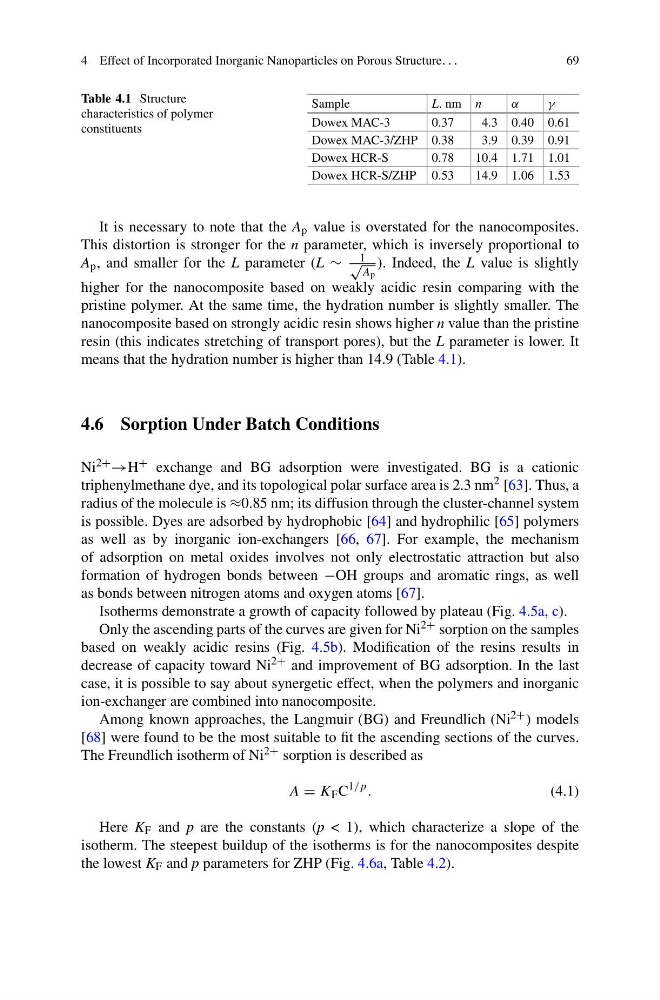
Table 4.1 Structure
characteristics of polymer
constituents
Sample
L. nm n
α
γ
Dowex MAC-3
0.37
4.3 0.40 0.61
Dowex MAC-3/ZHP 0.38
3.9 0.39 0.91
Dowex HCR-S
0.78
10.4 1.71 1.01
Dowex HCR-S/ZHP 0.53
14.9 1.06 1.53
It is necessary to note that the A p value is overstated for the nanocomposites.
This distortion is stronger for the n parameter, which is inversely proportional to
A p , and smaller for the L parameter (L ∼
1
√
A p
). Indeed, the L value is slightly
higher for the nanocomposite based on weakly acidic resin comparing with the
pristine polymer. At the same time, the hydration number is slightly smaller. The
nanocomposite based on strongly acidic resin shows higher n value than the pristine
resin (this indicates stretching of transport pores), but the L parameter is lower. It
means that the hydration number is higher than 14.9 (Table 4.1).
4.6 Sorption Under Batch Conditions
Ni 2+ →H + exchange and BG adsorption were investigated. BG is a cationic
triphenylmethane dye, and its topological polar surface area is 2.3 nm 2 [63]. Thus, a
radius of the molecule is ≈0.85 nm; its diffusion through the cluster-channel system
is possible. Dyes are adsorbed by hydrophobic [64] and hydrophilic [65] polymers
as well as by inorganic ion-exchangers [66, 67]. For example, the mechanism
of adsorption on metal oxides involves not only electrostatic attraction but also
formation of hydrogen bonds between −OH groups and aromatic rings, as well
as bonds between nitrogen atoms and oxygen atoms [67].
Isotherms demonstrate a growth of capacity followed by plateau (Fig. 4.5a, c).
Only the ascending parts of the curves are given for Ni 2+ sorption on the samples
based on weakly acidic resins (Fig. 4.5b). Modification of the resins results in
decrease of capacity toward Ni 2+ and improvement of BG adsorption. In the last
case, it is possible to say about synergetic effect, when the polymers and inorganic
ion-exchanger are combined into nanocomposite.
Among known approaches, the Langmuir (BG) and Freundlich (Ni 2+ ) models
[68] were found to be the most suitable to fit the ascending sections of the curves.
The Freundlich isotherm of Ni 2+ sorption is described as
A = K F C
1/p .
(4.1)
Here K F and p are the constants (p < 1), which characterize a slope of the
isotherm. The steepest buildup of the isotherms is for the nanocomposites despite
the lowest K F and p parameters for ZHP (Fig. 4.6a, Table 4.2).
69
Table 4.1 Structure
characteristics of polymer
constituents
Sample
L. nm n
α
γ
Dowex MAC-3
0.37
4.3 0.40 0.61
Dowex MAC-3/ZHP 0.38
3.9 0.39 0.91
Dowex HCR-S
0.78
10.4 1.71 1.01
Dowex HCR-S/ZHP 0.53
14.9 1.06 1.53
It is necessary to note that the A p value is overstated for the nanocomposites.
This distortion is stronger for the n parameter, which is inversely proportional to
A p , and smaller for the L parameter (L ∼
1
√
A p
). Indeed, the L value is slightly
higher for the nanocomposite based on weakly acidic resin comparing with the
pristine polymer. At the same time, the hydration number is slightly smaller. The
nanocomposite based on strongly acidic resin shows higher n value than the pristine
resin (this indicates stretching of transport pores), but the L parameter is lower. It
means that the hydration number is higher than 14.9 (Table 4.1).
4.6 Sorption Under Batch Conditions
Ni 2+ →H + exchange and BG adsorption were investigated. BG is a cationic
triphenylmethane dye, and its topological polar surface area is 2.3 nm 2 [63]. Thus, a
radius of the molecule is ≈0.85 nm; its diffusion through the cluster-channel system
is possible. Dyes are adsorbed by hydrophobic [64] and hydrophilic [65] polymers
as well as by inorganic ion-exchangers [66, 67]. For example, the mechanism
of adsorption on metal oxides involves not only electrostatic attraction but also
formation of hydrogen bonds between −OH groups and aromatic rings, as well
as bonds between nitrogen atoms and oxygen atoms [67].
Isotherms demonstrate a growth of capacity followed by plateau (Fig. 4.5a, c).
Only the ascending parts of the curves are given for Ni 2+ sorption on the samples
based on weakly acidic resins (Fig. 4.5b). Modification of the resins results in
decrease of capacity toward Ni 2+ and improvement of BG adsorption. In the last
case, it is possible to say about synergetic effect, when the polymers and inorganic
ion-exchanger are combined into nanocomposite.
Among known approaches, the Langmuir (BG) and Freundlich (Ni 2+ ) models
[68] were found to be the most suitable to fit the ascending sections of the curves.
The Freundlich isotherm of Ni 2+ sorption is described as
A = K F C
1/p .
(4.1)
Here K F and p are the constants (p < 1), which characterize a slope of the
isotherm. The steepest buildup of the isotherms is for the nanocomposites despite
the lowest K F and p parameters for ZHP (Fig. 4.6a, Table 4.2).