

68
L. Ponomarova et al.
P/P s
0.0
0.5
1.0
m
c
[
V
3
g
-1
]
0
1
2
Dowex MAC-3
Dowex MAC-3/ZHP
Dowex HCR-S
Dowex HCR-S /ZHP
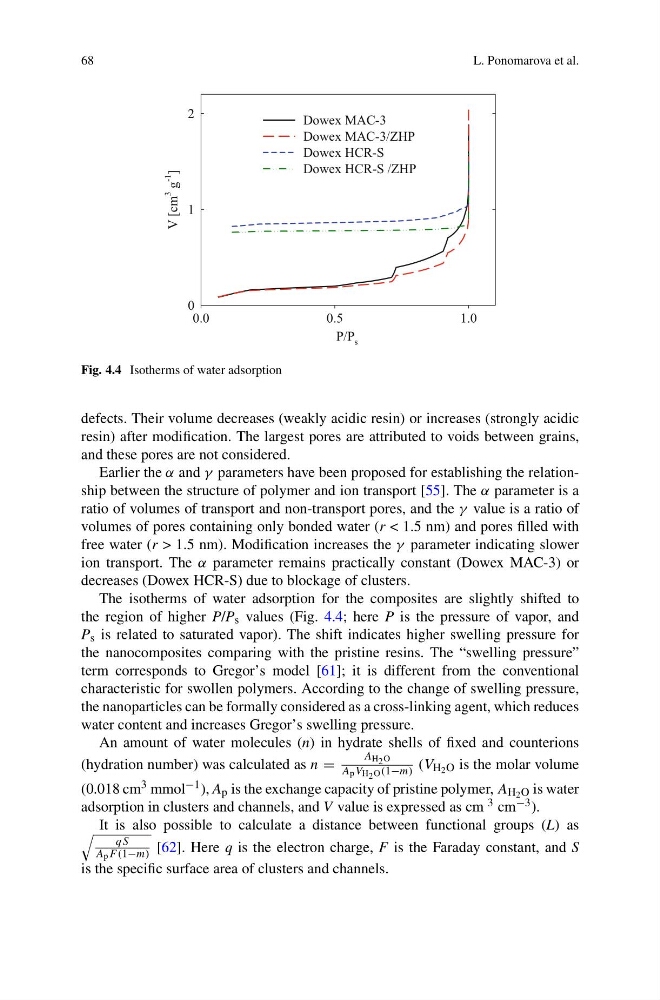
Fig. 4.4 Isotherms of water adsorption
defects. Their volume decreases (weakly acidic resin) or increases (strongly acidic
resin) after modification. The largest pores are attributed to voids between grains,
and these pores are not considered.
Earlier the α and γ parameters have been proposed for establishing the relationship between the structure of polymer and ion transport [55]. The α parameter is a
ratio of volumes of transport and non-transport pores, and the γ value is a ratio of
volumes of pores containing only bonded water (r < 1.5 nm) and pores filled with
free water (r > 1.5 nm). Modification increases the γ parameter indicating slower
ion transport. The α parameter remains practically constant (Dowex MAC-3) or
decreases (Dowex HCR-S) due to blockage of clusters.
The isotherms of water adsorption for the composites are slightly shifted to
the region of higher P/P s values (Fig. 4.4; here P is the pressure of vapor, and
P s is related to saturated vapor). The shift indicates higher swelling pressure for
the nanocomposites comparing with the pristine resins. The “swelling pressure”
term corresponds to Gregor’s model [61]; it is different from the conventional
characteristic for swollen polymers. According to the change of swelling pressure,
the nanoparticles can be formally considered as a cross-linking agent, which reduces
water content and increases Gregor’s swelling pressure.
An amount of water molecules (n) in hydrate shells of fixed and counterions
(hydration number) was calculated as n =
A H 2 O
A p V H 2 O (1−m) (V H 2 O is the molar volume
(0.018 cm 3 mmol −1 ), A p is the exchange capacity of pristine polymer, A H 2 O is water
adsorption in clusters and channels, and V value is expressed as cm 3 cm −3 ).
It is also possible to calculate a distance between functional groups (L) as
qS
A p F (1−m) [62]. Here q is the electron charge, F is the Faraday constant, and S
is the specific surface area of clusters and channels.
L. Ponomarova et al.
P/P s
0.0
0.5
1.0
m
c
[
V
3
g
-1
]
0
1
2
Dowex MAC-3
Dowex MAC-3/ZHP
Dowex HCR-S
Dowex HCR-S /ZHP
Fig. 4.4 Isotherms of water adsorption
defects. Their volume decreases (weakly acidic resin) or increases (strongly acidic
resin) after modification. The largest pores are attributed to voids between grains,
and these pores are not considered.
Earlier the α and γ parameters have been proposed for establishing the relationship between the structure of polymer and ion transport [55]. The α parameter is a
ratio of volumes of transport and non-transport pores, and the γ value is a ratio of
volumes of pores containing only bonded water (r < 1.5 nm) and pores filled with
free water (r > 1.5 nm). Modification increases the γ parameter indicating slower
ion transport. The α parameter remains practically constant (Dowex MAC-3) or
decreases (Dowex HCR-S) due to blockage of clusters.
The isotherms of water adsorption for the composites are slightly shifted to
the region of higher P/P s values (Fig. 4.4; here P is the pressure of vapor, and
P s is related to saturated vapor). The shift indicates higher swelling pressure for
the nanocomposites comparing with the pristine resins. The “swelling pressure”
term corresponds to Gregor’s model [61]; it is different from the conventional
characteristic for swollen polymers. According to the change of swelling pressure,
the nanoparticles can be formally considered as a cross-linking agent, which reduces
water content and increases Gregor’s swelling pressure.
An amount of water molecules (n) in hydrate shells of fixed and counterions
(hydration number) was calculated as n =
A H 2 O
A p V H 2 O (1−m) (V H 2 O is the molar volume
(0.018 cm 3 mmol −1 ), A p is the exchange capacity of pristine polymer, A H 2 O is water
adsorption in clusters and channels, and V value is expressed as cm 3 cm −3 ).
It is also possible to calculate a distance between functional groups (L) as
qS
A p F (1−m) [62]. Here q is the electron charge, F is the Faraday constant, and S
is the specific surface area of clusters and channels.