

4 Effect of Incorporated Inorganic Nanoparticles on Porous Structure. . .
67
Mass fraction (m) of ZHP was 0.08 (Dowex MAC-3) and ≈0.39 (Dowex HCRS). It should be noted that this parameter for one-time modified Dowex HCR-S
is 0.18 [40, 55]. The smaller m value for the weakly acidic resin is due to lower
loading of the weakly acidic resin with acidic ZrOCl 2 solution. This solution
penetrates to the grains as an additionally sorbed electrolyte. In the case of strongly
acidic resin, partial substitution of counterions by cations of soluble zirconium
hydroxocomplexes is possible.
4.5 Porous Structure of Polymer Constituent
Since thermal pretreatment before the MSCP measurements provides no dehydration of ZHP, the results are related only to the polymer constituent. The data of
porosimetric measurements for amorphous ZHP are given in [40]. Mesopores, a
radius of which is 2.5 nm, are dominant.
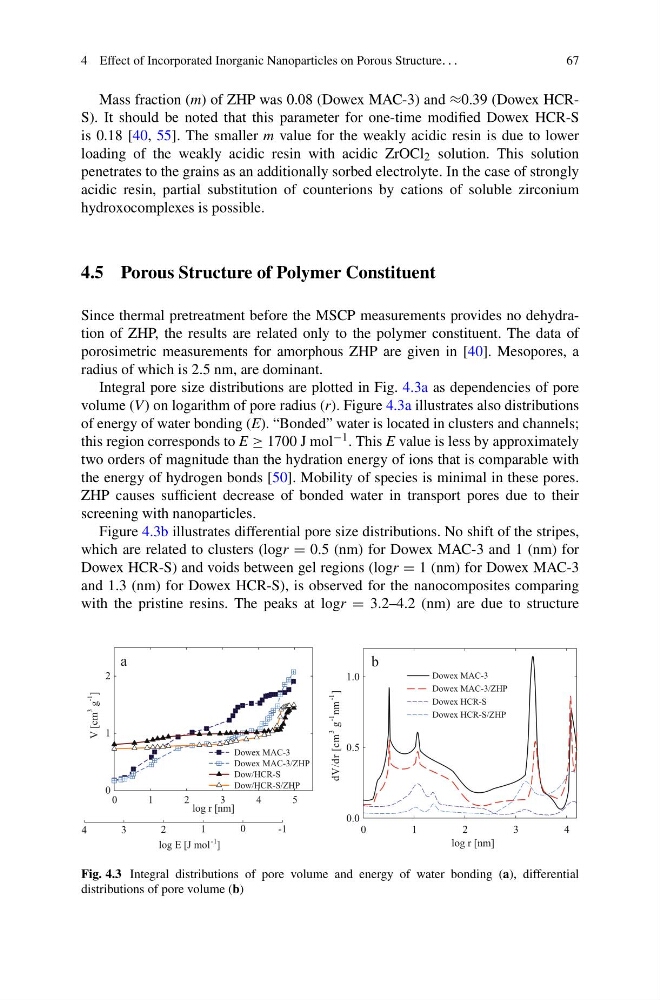
Integral pore size distributions are plotted in Fig. 4.3a as dependencies of pore
volume (V) on logarithm of pore radius (r). Figure 4.3a illustrates also distributions
of energy of water bonding (E). “Bonded” water is located in clusters and channels;
this region corresponds to E ≥ 1700 J mol −1 . This E value is less by approximately
two orders of magnitude than the hydration energy of ions that is comparable with
the energy of hydrogen bonds [50]. Mobility of species is minimal in these pores.
ZHP causes sufficient decrease of bonded water in transport pores due to their
screening with nanoparticles.
Figure 4.3b illustrates differential pore size distributions. No shift of the stripes,
which are related to clusters (logr = 0.5 (nm) for Dowex MAC-3 and 1 (nm) for
Dowex HCR-S) and voids between gel regions (logr = 1 (nm) for Dowex MAC-3
and 1.3 (nm) for Dowex HCR-S), is observed for the nanocomposites comparing
with the pristine resins. The peaks at logr = 3.2–4.2 (nm) are due to structure
log E [J mol
-1
]
log r [nm]
0
1
2
3
4
5
V [cm
3
g
-1
]
0
1
2
Dowex MAC-3
Dowex MAC-3/ZHP
Dow/HCR-S
Dow/HCR-S/ZHP
4
3
2
1
0
-1
a
log r [nm]
0
1
2
3
4
m
c
[
r
d
/
V
d
3
g
-1
nm
-1
]
0.0
0.5
1.0
Dowex MAC-3
Dowex MAC-3/ZHP
Dowex HCR-S
Dowex HCR-S/ZHP
b
Fig. 4.3 Integral distributions of pore volume and energy of water bonding (a), differential
distributions of pore volume (b)
67
Mass fraction (m) of ZHP was 0.08 (Dowex MAC-3) and ≈0.39 (Dowex HCRS). It should be noted that this parameter for one-time modified Dowex HCR-S
is 0.18 [40, 55]. The smaller m value for the weakly acidic resin is due to lower
loading of the weakly acidic resin with acidic ZrOCl 2 solution. This solution
penetrates to the grains as an additionally sorbed electrolyte. In the case of strongly
acidic resin, partial substitution of counterions by cations of soluble zirconium
hydroxocomplexes is possible.
4.5 Porous Structure of Polymer Constituent
Since thermal pretreatment before the MSCP measurements provides no dehydration of ZHP, the results are related only to the polymer constituent. The data of
porosimetric measurements for amorphous ZHP are given in [40]. Mesopores, a
radius of which is 2.5 nm, are dominant.
Integral pore size distributions are plotted in Fig. 4.3a as dependencies of pore
volume (V) on logarithm of pore radius (r). Figure 4.3a illustrates also distributions
of energy of water bonding (E). “Bonded” water is located in clusters and channels;
this region corresponds to E ≥ 1700 J mol −1 . This E value is less by approximately
two orders of magnitude than the hydration energy of ions that is comparable with
the energy of hydrogen bonds [50]. Mobility of species is minimal in these pores.
ZHP causes sufficient decrease of bonded water in transport pores due to their
screening with nanoparticles.
Figure 4.3b illustrates differential pore size distributions. No shift of the stripes,
which are related to clusters (logr = 0.5 (nm) for Dowex MAC-3 and 1 (nm) for
Dowex HCR-S) and voids between gel regions (logr = 1 (nm) for Dowex MAC-3
and 1.3 (nm) for Dowex HCR-S), is observed for the nanocomposites comparing
with the pristine resins. The peaks at logr = 3.2–4.2 (nm) are due to structure
log E [J mol
-1
]
log r [nm]
0
1
2
3
4
5
V [cm
3
g
-1
]
0
1
2
Dowex MAC-3
Dowex MAC-3/ZHP
Dow/HCR-S
Dow/HCR-S/ZHP
4
3
2
1
0
-1
a
log r [nm]
0
1
2
3
4
m
c
[
r
d
/
V
d
3
g
-1
nm
-1
]
0.0
0.5
1.0
Dowex MAC-3
Dowex MAC-3/ZHP
Dowex HCR-S
Dowex HCR-S/ZHP
b
Fig. 4.3 Integral distributions of pore volume and energy of water bonding (a), differential
distributions of pore volume (b)