

66
L. Ponomarova et al.
Ni 2+ ions were removed from tap water under dynamic conditions. Initial
concentration of the solution was (mmol dm −3 ) Ni 2+ − 0.1, Ca 2+ − 1.3, and
Mg 2+ − 0.4.
All experiments were carried out at 25 ◦ C.
4.4 Visualization of Embedded Particles
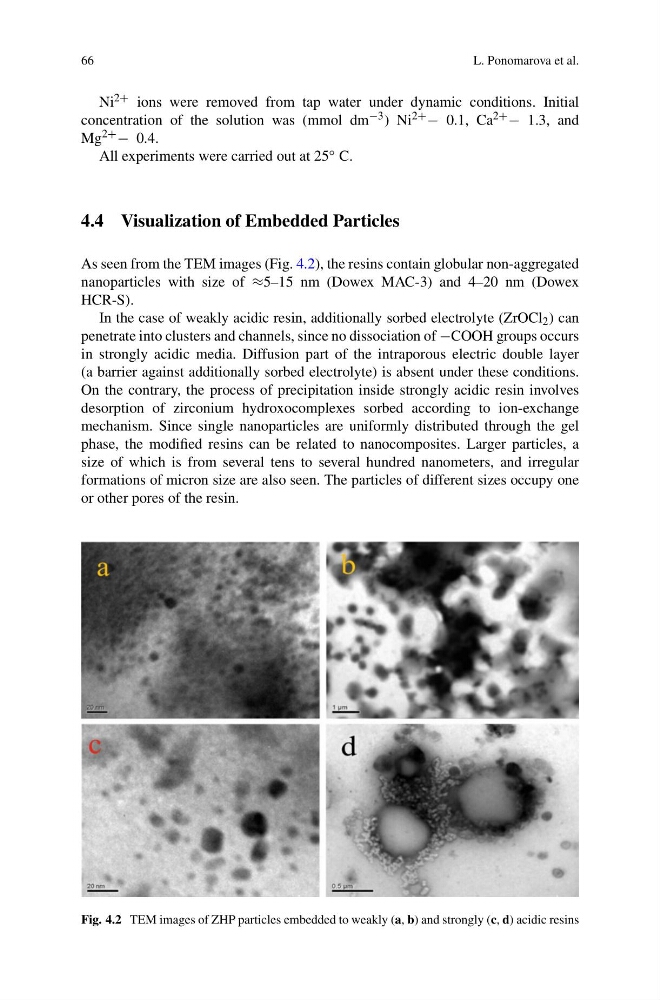
As seen from the TEM images (Fig. 4.2), the resins contain globular non-aggregated
nanoparticles with size of ≈5–15 nm (Dowex MAC-3) and 4–20 nm (Dowex
HCR-S).
In the case of weakly acidic resin, additionally sorbed electrolyte (ZrOCl 2 ) can
penetrate into clusters and channels, since no dissociation of −COOH groups occurs
in strongly acidic media. Diffusion part of the intraporous electric double layer
(a barrier against additionally sorbed electrolyte) is absent under these conditions.
On the contrary, the process of precipitation inside strongly acidic resin involves
desorption of zirconium hydroxocomplexes sorbed according to ion-exchange
mechanism. Since single nanoparticles are uniformly distributed through the gel
phase, the modified resins can be related to nanocomposites. Larger particles, a
size of which is from several tens to several hundred nanometers, and irregular
formations of micron size are also seen. The particles of different sizes occupy one
or other pores of the resin.
Fig. 4.2 TEM images of ZHP particles embedded to weakly (a, b) and strongly (c, d) acidic resins
L. Ponomarova et al.
Ni 2+ ions were removed from tap water under dynamic conditions. Initial
concentration of the solution was (mmol dm −3 ) Ni 2+ − 0.1, Ca 2+ − 1.3, and
Mg 2+ − 0.4.
All experiments were carried out at 25 ◦ C.
4.4 Visualization of Embedded Particles
As seen from the TEM images (Fig. 4.2), the resins contain globular non-aggregated
nanoparticles with size of ≈5–15 nm (Dowex MAC-3) and 4–20 nm (Dowex
HCR-S).
In the case of weakly acidic resin, additionally sorbed electrolyte (ZrOCl 2 ) can
penetrate into clusters and channels, since no dissociation of −COOH groups occurs
in strongly acidic media. Diffusion part of the intraporous electric double layer
(a barrier against additionally sorbed electrolyte) is absent under these conditions.
On the contrary, the process of precipitation inside strongly acidic resin involves
desorption of zirconium hydroxocomplexes sorbed according to ion-exchange
mechanism. Since single nanoparticles are uniformly distributed through the gel
phase, the modified resins can be related to nanocomposites. Larger particles, a
size of which is from several tens to several hundred nanometers, and irregular
formations of micron size are also seen. The particles of different sizes occupy one
or other pores of the resin.
Fig. 4.2 TEM images of ZHP particles embedded to weakly (a, b) and strongly (c, d) acidic resins