

4 Effect of Incorporated Inorganic Nanoparticles on Porous Structure. . .
65
drying at room temperature, and treatment with ultrasound to remove the precipitate
from the outer surface of the grains. ZHP powder, which was obtained by this
manner, was investigated further for comparison. Synthesis of ZHP inside polymers
was carried out one (weakly acidic resin) or eight times (strongly acidic resin). In
the last case, the nanocomposite containing large amount of ZHP shows much faster
proton transport than the pristine resin [55].
TEM images were obtained with a JEOL JEM 1230 transmission electron
microscope (Jeol, Japan). Preliminarily the ion-exchangers were milled and treated
with ultrasound.
A method of standard contact porosimetry (MSCP) [58, 59], which had been
accepted by the IUPAC [60], was applied to study porous structure of the polymers.
Preliminarily the tested samples were dried at 80 ◦ ´ under vacuum. Water was used
as a working liquid.
4.3 Sorption of Ni 2+ Ions and Cationic Dye
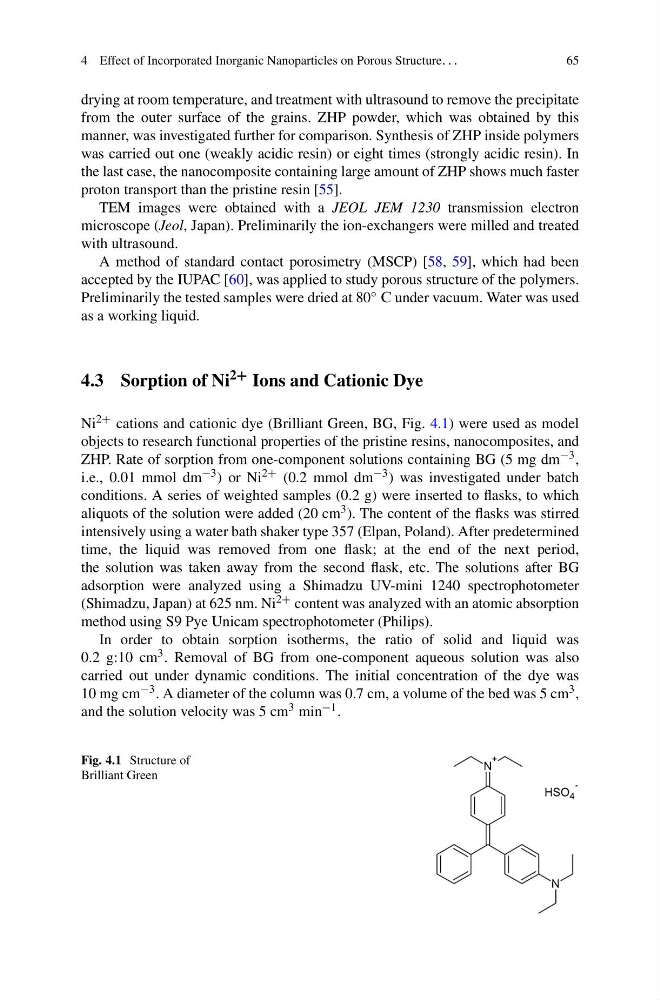
Ni 2+ cations and cationic dye (Brilliant Green, BG, Fig. 4.1) were used as model
objects to research functional properties of the pristine resins, nanocomposites, and
ZHP. Rate of sorption from one-component solutions containing BG (5 mg dm −3 ,
i.e., 0.01 mmol dm −3 ) or Ni 2+ (0.2 mmol dm −3 ) was investigated under batch
conditions. A series of weighted samples (0.2 g) were inserted to flasks, to which
aliquots of the solution were added (20 cm 3 ). The content of the flasks was stirred
intensively using a water bath shaker type 357 (Elpan, Poland). After predetermined
time, the liquid was removed from one flask; at the end of the next period,
the solution was taken away from the second flask, etc. The solutions after BG
adsorption were analyzed using a Shimadzu UV-mini 1240 spectrophotometer
(Shimadzu, Japan) at 625 nm. Ni 2+ content was analyzed with an atomic absorption
method using S9 Pye Unicam spectrophotometer (Philips).
In order to obtain sorption isotherms, the ratio of solid and liquid was
0.2 g:10 cm 3 . Removal of BG from one-component aqueous solution was also
carried out under dynamic conditions. The initial concentration of the dye was
10 mg cm −3 . A diameter of the column was 0.7 cm, a volume of the bed was 5 cm 3 ,
and the solution velocity was 5 cm 3 min −1 .
Fig. 4.1 Structure of
Brilliant Green
65
drying at room temperature, and treatment with ultrasound to remove the precipitate
from the outer surface of the grains. ZHP powder, which was obtained by this
manner, was investigated further for comparison. Synthesis of ZHP inside polymers
was carried out one (weakly acidic resin) or eight times (strongly acidic resin). In
the last case, the nanocomposite containing large amount of ZHP shows much faster
proton transport than the pristine resin [55].
TEM images were obtained with a JEOL JEM 1230 transmission electron
microscope (Jeol, Japan). Preliminarily the ion-exchangers were milled and treated
with ultrasound.
A method of standard contact porosimetry (MSCP) [58, 59], which had been
accepted by the IUPAC [60], was applied to study porous structure of the polymers.
Preliminarily the tested samples were dried at 80 ◦ ´ under vacuum. Water was used
as a working liquid.
4.3 Sorption of Ni 2+ Ions and Cationic Dye
Ni 2+ cations and cationic dye (Brilliant Green, BG, Fig. 4.1) were used as model
objects to research functional properties of the pristine resins, nanocomposites, and
ZHP. Rate of sorption from one-component solutions containing BG (5 mg dm −3 ,
i.e., 0.01 mmol dm −3 ) or Ni 2+ (0.2 mmol dm −3 ) was investigated under batch
conditions. A series of weighted samples (0.2 g) were inserted to flasks, to which
aliquots of the solution were added (20 cm 3 ). The content of the flasks was stirred
intensively using a water bath shaker type 357 (Elpan, Poland). After predetermined
time, the liquid was removed from one flask; at the end of the next period,
the solution was taken away from the second flask, etc. The solutions after BG
adsorption were analyzed using a Shimadzu UV-mini 1240 spectrophotometer
(Shimadzu, Japan) at 625 nm. Ni 2+ content was analyzed with an atomic absorption
method using S9 Pye Unicam spectrophotometer (Philips).
In order to obtain sorption isotherms, the ratio of solid and liquid was
0.2 g:10 cm 3 . Removal of BG from one-component aqueous solution was also
carried out under dynamic conditions. The initial concentration of the dye was
10 mg cm −3 . A diameter of the column was 0.7 cm, a volume of the bed was 5 cm 3 ,
and the solution velocity was 5 cm 3 min −1 .
Fig. 4.1 Structure of
Brilliant Green