

2 Multifunctional Magnetic Nanocomposites on the Base of Magnetite. . .
43
because they can serve as a basis for creation of new types of low-toxic selective
drugs with added functions of magneto-controlled targeted delivery to target organs
or cells and deposit, of hyperthermia and combined µ 1 - and µ 2 -MRI real-time
diagnostics [4, 5, 8, 10, 14, 21, 27–30, 40].
With the aim of synthesizing magnetosensitive NCs of a high biocompatibility
with bone tissues which are promising for the use in NCT, a new methodology [33]
of immobilization of a DTPA-Gd complex on the surface of Fe 3 O 4 /H£ NCs was
developed.
It is known that amino bisphosphonates are used for prevention and treatment of
osteoporosis because they inhibit resorption of bone tissue. Thanks for the presence
of phosphonic groups, the drugs of this class bind to HA tightly and cause a
therapeutic effect. For research one of the simplest and commercially available
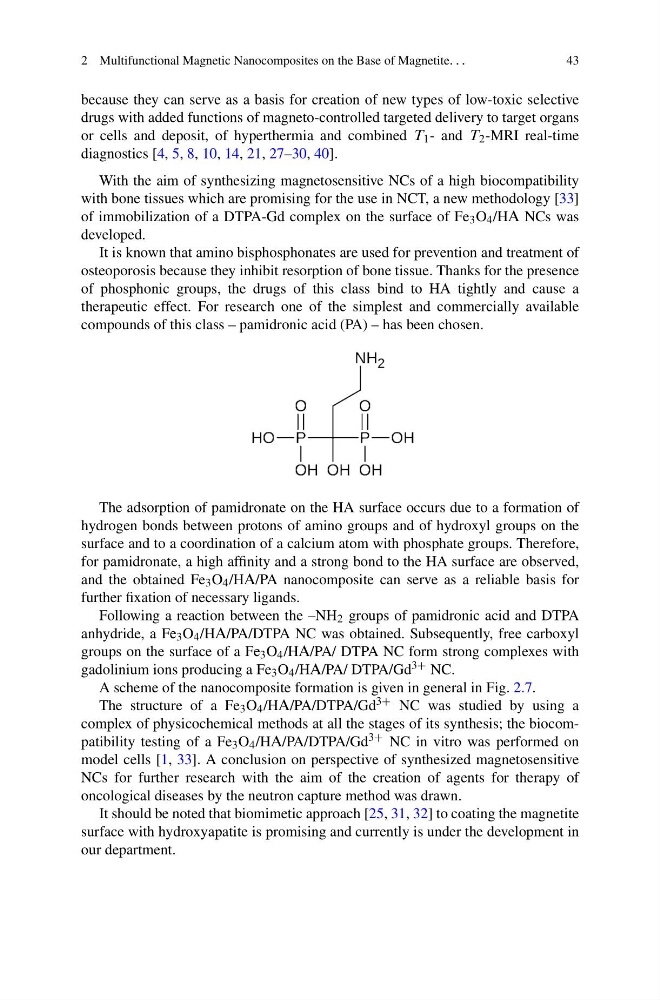
compounds of this class – pamidronic acid (PA) – has been chosen.
The adsorption of pamidronate on the HA surface occurs due to a formation of
hydrogen bonds between protons of amino groups and of hydroxyl groups on the
surface and to a coordination of a calcium atom with phosphate groups. Therefore,
for pamidronate, a high affinity and a strong bond to the HA surface are observed,
and the obtained Fe 3 O 4 /H£/PA nanocomposite can serve as a reliable basis for
further fixation of necessary ligands.
Following a reaction between the –NH 2 groups of pamidronic acid and DTPA
anhydride, a FÈ 3 O 4 /H£/PA/DTPA NC was obtained. Subsequently, free carboxyl
groups on the surface of a FÈ 3 O 4 /H£/PA/ DTPA NC form strong complexes with
gadolinium ions producing a Fe 3 O 4 /H£/PA/ DTPA/Gd 3+ NC.
A scheme of the nanocomposite formation is given in general in Fig. 2.7.
The structure of a Fe 3 O 4 /H£/PA/DTPA/Gd 3+ NC was studied by using a
complex of physicochemical methods at all the stages of its synthesis; the biocompatibility testing of a Fe 3 O 4 /H£/PA/DTPA/Gd 3+ NC in vitro was performed on
model cells [1, 33]. A conclusion on perspective of synthesized magnetosensitive
NCs for further research with the aim of the creation of agents for therapy of
oncological diseases by the neutron capture method was drawn.
It should be noted that biomimetic approach [25, 31, 32] to coating the magnetite
surface with hydroxyapatite is promising and currently is under the development in
our department.
43
because they can serve as a basis for creation of new types of low-toxic selective
drugs with added functions of magneto-controlled targeted delivery to target organs
or cells and deposit, of hyperthermia and combined µ 1 - and µ 2 -MRI real-time
diagnostics [4, 5, 8, 10, 14, 21, 27–30, 40].
With the aim of synthesizing magnetosensitive NCs of a high biocompatibility
with bone tissues which are promising for the use in NCT, a new methodology [33]
of immobilization of a DTPA-Gd complex on the surface of Fe 3 O 4 /H£ NCs was
developed.
It is known that amino bisphosphonates are used for prevention and treatment of
osteoporosis because they inhibit resorption of bone tissue. Thanks for the presence
of phosphonic groups, the drugs of this class bind to HA tightly and cause a
therapeutic effect. For research one of the simplest and commercially available
compounds of this class – pamidronic acid (PA) – has been chosen.
The adsorption of pamidronate on the HA surface occurs due to a formation of
hydrogen bonds between protons of amino groups and of hydroxyl groups on the
surface and to a coordination of a calcium atom with phosphate groups. Therefore,
for pamidronate, a high affinity and a strong bond to the HA surface are observed,
and the obtained Fe 3 O 4 /H£/PA nanocomposite can serve as a reliable basis for
further fixation of necessary ligands.
Following a reaction between the –NH 2 groups of pamidronic acid and DTPA
anhydride, a FÈ 3 O 4 /H£/PA/DTPA NC was obtained. Subsequently, free carboxyl
groups on the surface of a FÈ 3 O 4 /H£/PA/ DTPA NC form strong complexes with
gadolinium ions producing a Fe 3 O 4 /H£/PA/ DTPA/Gd 3+ NC.
A scheme of the nanocomposite formation is given in general in Fig. 2.7.
The structure of a Fe 3 O 4 /H£/PA/DTPA/Gd 3+ NC was studied by using a
complex of physicochemical methods at all the stages of its synthesis; the biocompatibility testing of a Fe 3 O 4 /H£/PA/DTPA/Gd 3+ NC in vitro was performed on
model cells [1, 33]. A conclusion on perspective of synthesized magnetosensitive
NCs for further research with the aim of the creation of agents for therapy of
oncological diseases by the neutron capture method was drawn.
It should be noted that biomimetic approach [25, 31, 32] to coating the magnetite
surface with hydroxyapatite is promising and currently is under the development in
our department.