

32 Grain Porous Structure and Exploitation Properties of Humidity-Sensitive. . .
513
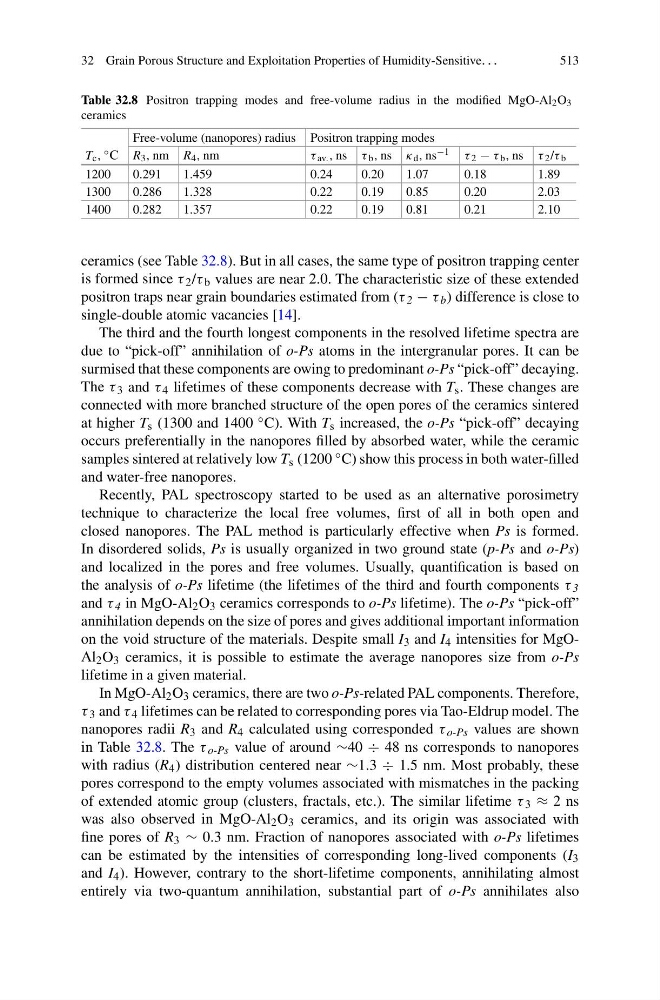
Table 32.8 Positron trapping modes and free-volume radius in the modified MgO-Al 2 O 3
ceramics
Free-volume (nanopores) radius Positron trapping modes
T c , ◦ ´ R 3 , nm R 4 , nm
τ av. , ns τ b , ns κ d , ns −1 τ 2 − τ b , ns τ 2 /τ b
1200
0.291
1.459
0.24
0.20
1.07
0.18
1.89
1300
0.286
1.328
0.22
0.19
0.85
0.20
2.03
1400
0.282
1.357
0.22
0.19
0.81
0.21
2.10
ceramics (see Table 32.8). But in all cases, the same type of positron trapping center
is formed since τ 2 /τ b values are near 2.0. The characteristic size of these extended
positron traps near grain boundaries estimated from (τ 2 − τ b ) difference is close to
single-double atomic vacancies [14].
The third and the fourth longest components in the resolved lifetime spectra are
due to “pick-off” annihilation of o-Ps atoms in the intergranular pores. It can be
surmised that these components are owing to predominant o-Ps “pick-off” decaying.
The τ 3 and τ 4 lifetimes of these components decrease with T s . These changes are
connected with more branched structure of the open pores of the ceramics sintered
at higher T s (1300 and 1400 ◦ C). With T s increased, the o-Ps “pick-off” decaying
occurs preferentially in the nanopores filled by absorbed water, while the ceramic
samples sintered at relatively low T s (1200 ◦ C) show this process in both water-filled
and water-free nanopores.
Recently, PAL spectroscopy started to be used as an alternative porosimetry
technique to characterize the local free volumes, first of all in both open and
closed nanopores. The PAL method is particularly effective when Ps is formed.
In disordered solids, Ps is usually organized in two ground state (p-Ps and o-Ps)
and localized in the pores and free volumes. Usually, quantification is based on
the analysis of o-Ps lifetime (the lifetimes of the third and fourth components τ 3
and τ 4 in MgO-Al 2 O 3 ceramics corresponds to o-Ps lifetime). The o-Ps “pick-off”
annihilation depends on the size of pores and gives additional important information
on the void structure of the materials. Despite small I 3 and I 4 intensities for MgOAl 2 O 3 ceramics, it is possible to estimate the average nanopores size from o-Ps
lifetime in a given material.
In MgO-Al 2 O 3 ceramics, there are two o-Ps-related PAL components. Therefore,
τ 3 and τ 4 lifetimes can be related to corresponding pores via Tao-Eldrup model. The
nanopores radii R 3 and R 4 calculated using corresponded τ o-Ps values are shown
in Table 32.8. The τ o-Ps value of around ∼40 ÷ 48 ns corresponds to nanopores
with radius (R 4 ) distribution centered near ∼1.3 ÷ 1.5 nm. Most probably, these
pores correspond to the empty volumes associated with mismatches in the packing
of extended atomic group (clusters, fractals, etc.). The similar lifetime τ 3 ≈ 2 ns
was also observed in MgO-Al 2 O 3 ceramics, and its origin was associated with
fine pores of R 3 ∼ 0.3 nm. Fraction of nanopores associated with o-Ps lifetimes
can be estimated by the intensities of corresponding long-lived components (I 3
and I 4 ). However, contrary to the short-lifetime components, annihilating almost
entirely via two-quantum annihilation, substantial part of o-Ps annihilates also
513
Table 32.8 Positron trapping modes and free-volume radius in the modified MgO-Al 2 O 3
ceramics
Free-volume (nanopores) radius Positron trapping modes
T c , ◦ ´ R 3 , nm R 4 , nm
τ av. , ns τ b , ns κ d , ns −1 τ 2 − τ b , ns τ 2 /τ b
1200
0.291
1.459
0.24
0.20
1.07
0.18
1.89
1300
0.286
1.328
0.22
0.19
0.85
0.20
2.03
1400
0.282
1.357
0.22
0.19
0.81
0.21
2.10
ceramics (see Table 32.8). But in all cases, the same type of positron trapping center
is formed since τ 2 /τ b values are near 2.0. The characteristic size of these extended
positron traps near grain boundaries estimated from (τ 2 − τ b ) difference is close to
single-double atomic vacancies [14].
The third and the fourth longest components in the resolved lifetime spectra are
due to “pick-off” annihilation of o-Ps atoms in the intergranular pores. It can be
surmised that these components are owing to predominant o-Ps “pick-off” decaying.
The τ 3 and τ 4 lifetimes of these components decrease with T s . These changes are
connected with more branched structure of the open pores of the ceramics sintered
at higher T s (1300 and 1400 ◦ C). With T s increased, the o-Ps “pick-off” decaying
occurs preferentially in the nanopores filled by absorbed water, while the ceramic
samples sintered at relatively low T s (1200 ◦ C) show this process in both water-filled
and water-free nanopores.
Recently, PAL spectroscopy started to be used as an alternative porosimetry
technique to characterize the local free volumes, first of all in both open and
closed nanopores. The PAL method is particularly effective when Ps is formed.
In disordered solids, Ps is usually organized in two ground state (p-Ps and o-Ps)
and localized in the pores and free volumes. Usually, quantification is based on
the analysis of o-Ps lifetime (the lifetimes of the third and fourth components τ 3
and τ 4 in MgO-Al 2 O 3 ceramics corresponds to o-Ps lifetime). The o-Ps “pick-off”
annihilation depends on the size of pores and gives additional important information
on the void structure of the materials. Despite small I 3 and I 4 intensities for MgOAl 2 O 3 ceramics, it is possible to estimate the average nanopores size from o-Ps
lifetime in a given material.
In MgO-Al 2 O 3 ceramics, there are two o-Ps-related PAL components. Therefore,
τ 3 and τ 4 lifetimes can be related to corresponding pores via Tao-Eldrup model. The
nanopores radii R 3 and R 4 calculated using corresponded τ o-Ps values are shown
in Table 32.8. The τ o-Ps value of around ∼40 ÷ 48 ns corresponds to nanopores
with radius (R 4 ) distribution centered near ∼1.3 ÷ 1.5 nm. Most probably, these
pores correspond to the empty volumes associated with mismatches in the packing
of extended atomic group (clusters, fractals, etc.). The similar lifetime τ 3 ≈ 2 ns
was also observed in MgO-Al 2 O 3 ceramics, and its origin was associated with
fine pores of R 3 ∼ 0.3 nm. Fraction of nanopores associated with o-Ps lifetimes
can be estimated by the intensities of corresponding long-lived components (I 3
and I 4 ). However, contrary to the short-lifetime components, annihilating almost
entirely via two-quantum annihilation, substantial part of o-Ps annihilates also