

514
H. Klym et al.
via three-quantum process, which is completed by the “pick-off” annihilation
process [49–51]. Different efficiency of the registration for two- and three-quantum
processes can distort the proportion between observed o-Ps annihilation intensities
(I 3 and I 4 ) introducing uncertainty into the estimation of the number of pores. In
addition, it should be noted that porosimetry methods are limited to open pores,
which should have an access to the environment to be determined. These PAL results
are complementary data to Hg-porosimetry measurements. On the other hand, PAL
spectroscopy can probe both open and closed pores in functional humidity-sensitive
ceramics of sizes ranging from atomic scale to several tens of nanometers.
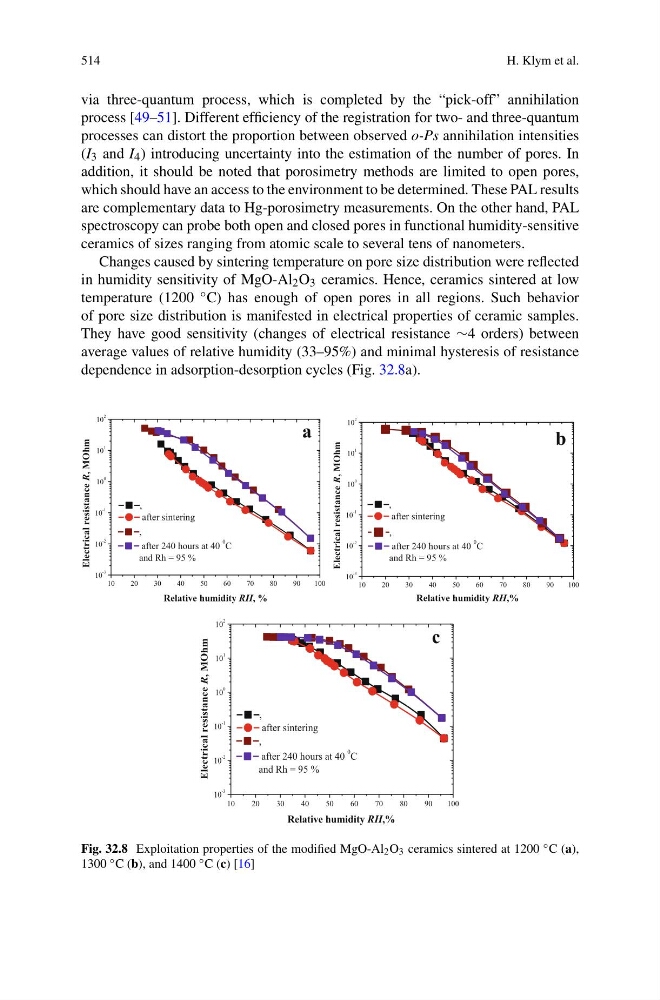
Changes caused by sintering temperature on pore size distribution were reflected
in humidity sensitivity of MgO-Al 2 O 3 ceramics. Hence, ceramics sintered at low
temperature (1200 ◦ C) has enough of open pores in all regions. Such behavior
of pore size distribution is manifested in electrical properties of ceramic samples.
They have good sensitivity (changes of electrical resistance ∼4 orders) between
average values of relative humidity (33–95%) and minimal hysteresis of resistance
dependence in adsorption-desorption cycles (Fig. 32.8a).
10
20
30
40
50
60
70
80
90
100
10 -3
10 -2
10 -1
10
0
10
1
10
2
a
,
after sintering
,
after 240 hours at 40
0 C
and Rh = 95 %
e
c
n
a
t
s
i
s
e
r
l
a
c
i
r
t
c
e
l
E
R, MOhm
Relative humidity RH, %
10
20
30
40
50
60
70
80
90
100
10
-3
10
-2
10
-1
10
0
10
1
10
2
b
Relative humidity RH,%
e
c
n
a
t
s
i
s
e
r
l
a
c
i
r
t
c
e
l
E
R, MOhm
,
after sintering
,
after 240 hours at 40
0 C
and Rh = 95 %
10
20
30
40
50
60
70
80
90
100
10
-3
10
-2
10
-1
10
0
10
1
10
2
c
Relative humidity RH,%
e
c
n
a
t
s
i
s
e
r
l
a
c
i
r
t
c
e
l
E
R, MOhm
,
after sintering
,
after 240 hours at 40
0 C
and Rh = 95 %
Fig. 32.8 Exploitation properties of the modified MgO-Al 2 O 3 ceramics sintered at 1200 ◦ C (a),
1300 ◦ C (b), and 1400 ◦ C (c) [16]
H. Klym et al.
via three-quantum process, which is completed by the “pick-off” annihilation
process [49–51]. Different efficiency of the registration for two- and three-quantum
processes can distort the proportion between observed o-Ps annihilation intensities
(I 3 and I 4 ) introducing uncertainty into the estimation of the number of pores. In
addition, it should be noted that porosimetry methods are limited to open pores,
which should have an access to the environment to be determined. These PAL results
are complementary data to Hg-porosimetry measurements. On the other hand, PAL
spectroscopy can probe both open and closed pores in functional humidity-sensitive
ceramics of sizes ranging from atomic scale to several tens of nanometers.
Changes caused by sintering temperature on pore size distribution were reflected
in humidity sensitivity of MgO-Al 2 O 3 ceramics. Hence, ceramics sintered at low
temperature (1200 ◦ C) has enough of open pores in all regions. Such behavior
of pore size distribution is manifested in electrical properties of ceramic samples.
They have good sensitivity (changes of electrical resistance ∼4 orders) between
average values of relative humidity (33–95%) and minimal hysteresis of resistance
dependence in adsorption-desorption cycles (Fig. 32.8a).
10
20
30
40
50
60
70
80
90
100
10 -3
10 -2
10 -1
10
0
10
1
10
2
a
,
after sintering
,
after 240 hours at 40
0 C
and Rh = 95 %
e
c
n
a
t
s
i
s
e
r
l
a
c
i
r
t
c
e
l
E
R, MOhm
Relative humidity RH, %
10
20
30
40
50
60
70
80
90
100
10
-3
10
-2
10
-1
10
0
10
1
10
2
b
Relative humidity RH,%
e
c
n
a
t
s
i
s
e
r
l
a
c
i
r
t
c
e
l
E
R, MOhm
,
after sintering
,
after 240 hours at 40
0 C
and Rh = 95 %
10
20
30
40
50
60
70
80
90
100
10
-3
10
-2
10
-1
10
0
10
1
10
2
c
Relative humidity RH,%
e
c
n
a
t
s
i
s
e
r
l
a
c
i
r
t
c
e
l
E
R, MOhm
,
after sintering
,
after 240 hours at 40
0 C
and Rh = 95 %
Fig. 32.8 Exploitation properties of the modified MgO-Al 2 O 3 ceramics sintered at 1200 ◦ C (a),
1300 ◦ C (b), and 1400 ◦ C (c) [16]