

512
H. Klym et al.
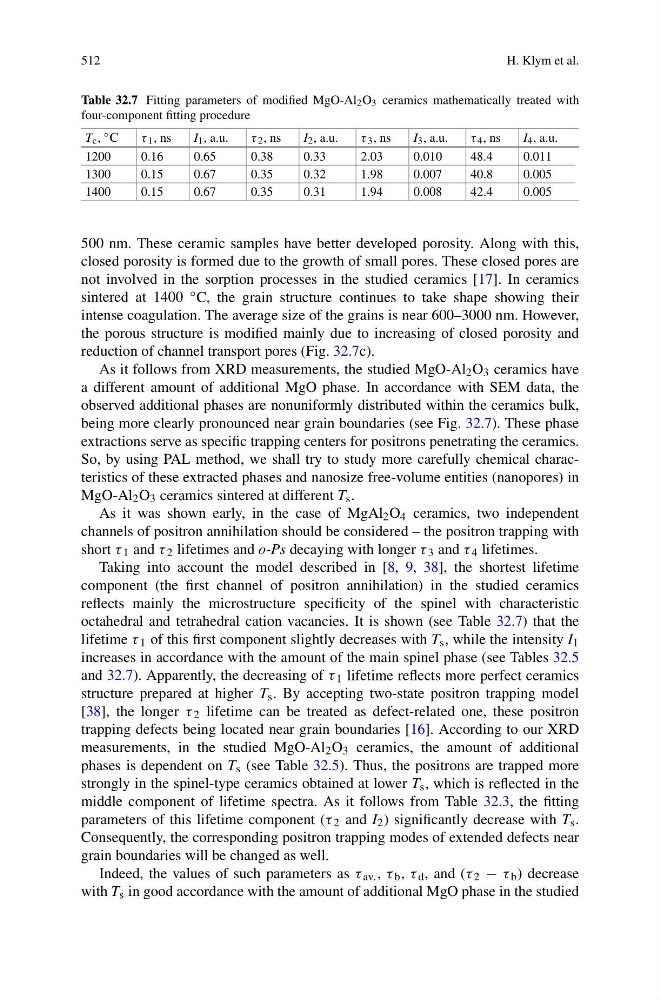
Table 32.7 Fitting parameters of modified MgO-Al 2 O 3 ceramics mathematically treated with
four-component fitting procedure
T c , ◦ ´
τ 1 , ns
I 1 , a.u.
τ 2 , ns
I 2 , a.u.
τ 3 , ns
I 3 , a.u.
τ 4 , ns
I 4 , a.u.
1200
0.16
0.65
0.38
0.33
2.03
0.010
48.4
0.011
1300
0.15
0.67
0.35
0.32
1.98
0.007
40.8
0.005
1400
0.15
0.67
0.35
0.31
1.94
0.008
42.4
0.005
500 nm. These ceramic samples have better developed porosity. Along with this,
closed porosity is formed due to the growth of small pores. These closed pores are
not involved in the sorption processes in the studied ceramics [17]. In ceramics
sintered at 1400 ◦ C, the grain structure continues to take shape showing their
intense coagulation. The average size of the grains is near 600–3000 nm. However,
the porous structure is modified mainly due to increasing of closed porosity and
reduction of channel transport pores (Fig. 32.7c).
As it follows from XRD measurements, the studied MgO-Al 2 O 3 ceramics have
a different amount of additional MgO phase. In accordance with SEM data, the
observed additional phases are nonuniformly distributed within the ceramics bulk,
being more clearly pronounced near grain boundaries (see Fig. 32.7). These phase
extractions serve as specific trapping centers for positrons penetrating the ceramics.
So, by using PAL method, we shall try to study more carefully chemical characteristics of these extracted phases and nanosize free-volume entities (nanopores) in
MgO-Al 2 O 3 ceramics sintered at different T s .
As it was shown early, in the case of MgAl 2 O 4 ceramics, two independent
channels of positron annihilation should be considered – the positron trapping with
short τ 1 and τ 2 lifetimes and o-Ps decaying with longer τ 3 and τ 4 lifetimes.
Taking into account the model described in [8, 9, 38], the shortest lifetime
component (the first channel of positron annihilation) in the studied ceramics
reflects mainly the microstructure specificity of the spinel with characteristic
octahedral and tetrahedral cation vacancies. It is shown (see Table 32.7) that the
lifetime τ 1 of this first component slightly decreases with T s , while the intensity I 1
increases in accordance with the amount of the main spinel phase (see Tables 32.5
and 32.7). Apparently, the decreasing of τ 1 lifetime reflects more perfect ceramics
structure prepared at higher T s . By accepting two-state positron trapping model
[38], the longer τ 2 lifetime can be treated as defect-related one, these positron
trapping defects being located near grain boundaries [16]. According to our XRD
measurements, in the studied MgO-Al 2 O 3 ceramics, the amount of additional
phases is dependent on T s (see Table 32.5). Thus, the positrons are trapped more
strongly in the spinel-type ceramics obtained at lower T s , which is reflected in the
middle component of lifetime spectra. As it follows from Table 32.3, the fitting
parameters of this lifetime component (τ 2 and I 2 ) significantly decrease with T s .
Consequently, the corresponding positron trapping modes of extended defects near
grain boundaries will be changed as well.
Indeed, the values of such parameters as τ av. , τ b , τ d , and (τ 2 − τ b ) decrease
with T s in good accordance with the amount of additional MgO phase in the studied
H. Klym et al.
Table 32.7 Fitting parameters of modified MgO-Al 2 O 3 ceramics mathematically treated with
four-component fitting procedure
T c , ◦ ´
τ 1 , ns
I 1 , a.u.
τ 2 , ns
I 2 , a.u.
τ 3 , ns
I 3 , a.u.
τ 4 , ns
I 4 , a.u.
1200
0.16
0.65
0.38
0.33
2.03
0.010
48.4
0.011
1300
0.15
0.67
0.35
0.32
1.98
0.007
40.8
0.005
1400
0.15
0.67
0.35
0.31
1.94
0.008
42.4
0.005
500 nm. These ceramic samples have better developed porosity. Along with this,
closed porosity is formed due to the growth of small pores. These closed pores are
not involved in the sorption processes in the studied ceramics [17]. In ceramics
sintered at 1400 ◦ C, the grain structure continues to take shape showing their
intense coagulation. The average size of the grains is near 600–3000 nm. However,
the porous structure is modified mainly due to increasing of closed porosity and
reduction of channel transport pores (Fig. 32.7c).
As it follows from XRD measurements, the studied MgO-Al 2 O 3 ceramics have
a different amount of additional MgO phase. In accordance with SEM data, the
observed additional phases are nonuniformly distributed within the ceramics bulk,
being more clearly pronounced near grain boundaries (see Fig. 32.7). These phase
extractions serve as specific trapping centers for positrons penetrating the ceramics.
So, by using PAL method, we shall try to study more carefully chemical characteristics of these extracted phases and nanosize free-volume entities (nanopores) in
MgO-Al 2 O 3 ceramics sintered at different T s .
As it was shown early, in the case of MgAl 2 O 4 ceramics, two independent
channels of positron annihilation should be considered – the positron trapping with
short τ 1 and τ 2 lifetimes and o-Ps decaying with longer τ 3 and τ 4 lifetimes.
Taking into account the model described in [8, 9, 38], the shortest lifetime
component (the first channel of positron annihilation) in the studied ceramics
reflects mainly the microstructure specificity of the spinel with characteristic
octahedral and tetrahedral cation vacancies. It is shown (see Table 32.7) that the
lifetime τ 1 of this first component slightly decreases with T s , while the intensity I 1
increases in accordance with the amount of the main spinel phase (see Tables 32.5
and 32.7). Apparently, the decreasing of τ 1 lifetime reflects more perfect ceramics
structure prepared at higher T s . By accepting two-state positron trapping model
[38], the longer τ 2 lifetime can be treated as defect-related one, these positron
trapping defects being located near grain boundaries [16]. According to our XRD
measurements, in the studied MgO-Al 2 O 3 ceramics, the amount of additional
phases is dependent on T s (see Table 32.5). Thus, the positrons are trapped more
strongly in the spinel-type ceramics obtained at lower T s , which is reflected in the
middle component of lifetime spectra. As it follows from Table 32.3, the fitting
parameters of this lifetime component (τ 2 and I 2 ) significantly decrease with T s .
Consequently, the corresponding positron trapping modes of extended defects near
grain boundaries will be changed as well.
Indeed, the values of such parameters as τ av. , τ b , τ d , and (τ 2 − τ b ) decrease
with T s in good accordance with the amount of additional MgO phase in the studied