

32 Grain Porous Structure and Exploitation Properties of Humidity-Sensitive. . .
511
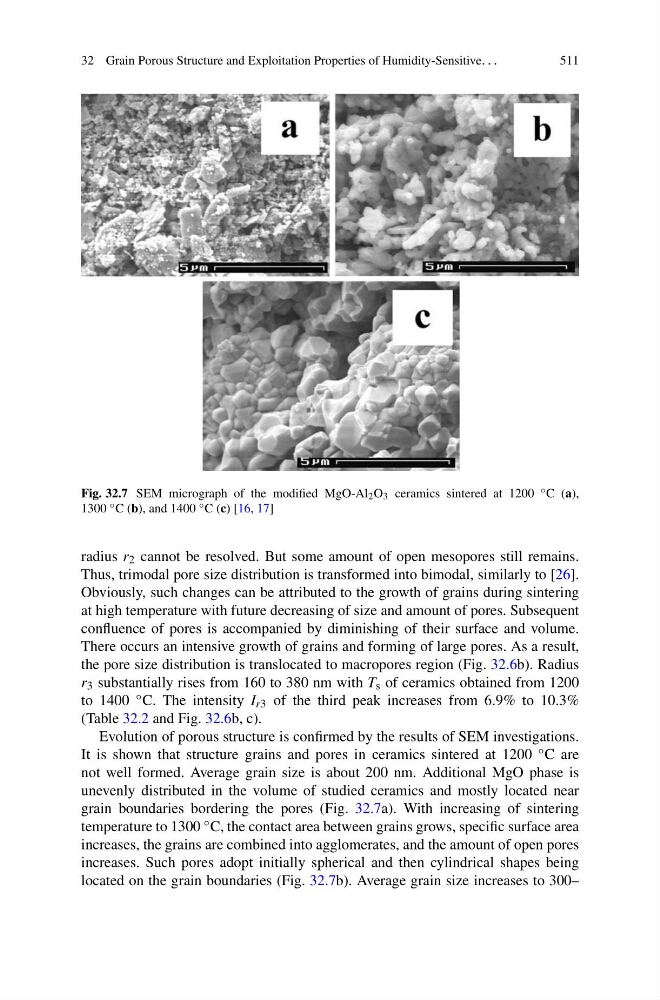
Fig. 32.7 SEM micrograph of the modified MgO-Al 2 O 3 ceramics sintered at 1200 ◦ C (a),
1300 ◦ C (b), and 1400 ◦ C (c) [16, 17]
radius r 2 cannot be resolved. But some amount of open mesopores still remains.
Thus, trimodal pore size distribution is transformed into bimodal, similarly to [26].
Obviously, such changes can be attributed to the growth of grains during sintering
at high temperature with future decreasing of size and amount of pores. Subsequent
confluence of pores is accompanied by diminishing of their surface and volume.
There occurs an intensive growth of grains and forming of large pores. As a result,
the pore size distribution is translocated to macropores region (Fig. 32.6b). Radius
r 3 substantially rises from 160 to 380 nm with T s of ceramics obtained from 1200
to 1400 ◦ C. The intensity I r3 of the third peak increases from 6.9% to 10.3%
(Table 32.2 and Fig. 32.6b, c).
Evolution of porous structure is confirmed by the results of SEM investigations.
It is shown that structure grains and pores in ceramics sintered at 1200 ◦ C are
not well formed. Average grain size is about 200 nm. Additional MgO phase is
unevenly distributed in the volume of studied ceramics and mostly located near
grain boundaries bordering the pores (Fig. 32.7a). With increasing of sintering
temperature to 1300 ◦ C, the contact area between grains grows, specific surface area
increases, the grains are combined into agglomerates, and the amount of open pores
increases. Such pores adopt initially spherical and then cylindrical shapes being
located on the grain boundaries (Fig. 32.7b). Average grain size increases to 300–
511
Fig. 32.7 SEM micrograph of the modified MgO-Al 2 O 3 ceramics sintered at 1200 ◦ C (a),
1300 ◦ C (b), and 1400 ◦ C (c) [16, 17]
radius r 2 cannot be resolved. But some amount of open mesopores still remains.
Thus, trimodal pore size distribution is transformed into bimodal, similarly to [26].
Obviously, such changes can be attributed to the growth of grains during sintering
at high temperature with future decreasing of size and amount of pores. Subsequent
confluence of pores is accompanied by diminishing of their surface and volume.
There occurs an intensive growth of grains and forming of large pores. As a result,
the pore size distribution is translocated to macropores region (Fig. 32.6b). Radius
r 3 substantially rises from 160 to 380 nm with T s of ceramics obtained from 1200
to 1400 ◦ C. The intensity I r3 of the third peak increases from 6.9% to 10.3%
(Table 32.2 and Fig. 32.6b, c).
Evolution of porous structure is confirmed by the results of SEM investigations.
It is shown that structure grains and pores in ceramics sintered at 1200 ◦ C are
not well formed. Average grain size is about 200 nm. Additional MgO phase is
unevenly distributed in the volume of studied ceramics and mostly located near
grain boundaries bordering the pores (Fig. 32.7a). With increasing of sintering
temperature to 1300 ◦ C, the contact area between grains grows, specific surface area
increases, the grains are combined into agglomerates, and the amount of open pores
increases. Such pores adopt initially spherical and then cylindrical shapes being
located on the grain boundaries (Fig. 32.7b). Average grain size increases to 300–