

510
H. Klym et al.
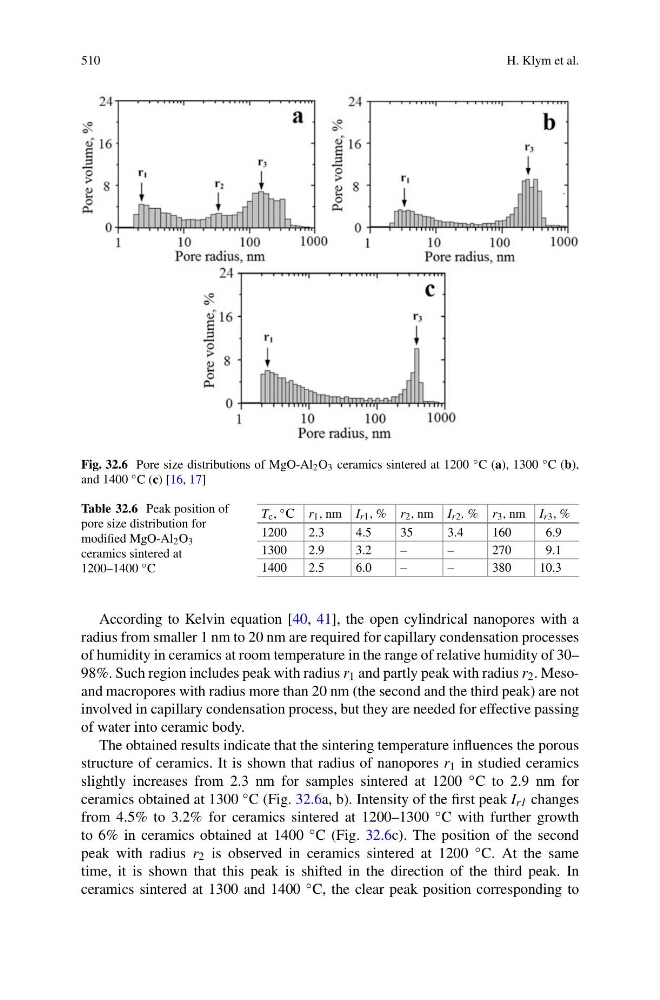
Fig. 32.6 Pore size distributions of MgO-Al 2 O 3 ceramics sintered at 1200 ◦ C (a), 1300 ◦ C (b),
and 1400 ◦ C (c) [16, 17]
Table 32.6 Peak position of
pore size distribution for
modified MgO-Al 2 O 3
ceramics sintered at
1200–1400 ◦ C
T c , ◦ ´ r 1 , nm I r1 , % r 2 , nm I r2 , % r 3 , nm I r3 , %
1200
2.3
4.5
35
3.4
160
6.9
1300
2.9
3.2
–
–
270
9.1
1400
2.5
6.0
–
–
380
10.3
According to Kelvin equation [40, 41], the open cylindrical nanopores with a
radius from smaller 1 nm to 20 nm are required for capillary condensation processes
of humidity in ceramics at room temperature in the range of relative humidity of 30–
98%. Such region includes peak with radius r 1 and partly peak with radius r 2 . Mesoand macropores with radius more than 20 nm (the second and the third peak) are not
involved in capillary condensation process, but they are needed for effective passing
of water into ceramic body.
The obtained results indicate that the sintering temperature influences the porous
structure of ceramics. It is shown that radius of nanopores r 1 in studied ceramics
slightly increases from 2.3 nm for samples sintered at 1200 ◦ C to 2.9 nm for
ceramics obtained at 1300 ◦ C (Fig. 32.6a, b). Intensity of the first peak I r1 changes
from 4.5% to 3.2% for ceramics sintered at 1200–1300 ◦ C with further growth
to 6% in ceramics obtained at 1400 ◦ C (Fig. 32.6c). The position of the second
peak with radius r 2 is observed in ceramics sintered at 1200 ◦ C. At the same
time, it is shown that this peak is shifted in the direction of the third peak. In
ceramics sintered at 1300 and 1400 ◦ C, the clear peak position corresponding to
H. Klym et al.
Fig. 32.6 Pore size distributions of MgO-Al 2 O 3 ceramics sintered at 1200 ◦ C (a), 1300 ◦ C (b),
and 1400 ◦ C (c) [16, 17]
Table 32.6 Peak position of
pore size distribution for
modified MgO-Al 2 O 3
ceramics sintered at
1200–1400 ◦ C
T c , ◦ ´ r 1 , nm I r1 , % r 2 , nm I r2 , % r 3 , nm I r3 , %
1200
2.3
4.5
35
3.4
160
6.9
1300
2.9
3.2
–
–
270
9.1
1400
2.5
6.0
–
–
380
10.3
According to Kelvin equation [40, 41], the open cylindrical nanopores with a
radius from smaller 1 nm to 20 nm are required for capillary condensation processes
of humidity in ceramics at room temperature in the range of relative humidity of 30–
98%. Such region includes peak with radius r 1 and partly peak with radius r 2 . Mesoand macropores with radius more than 20 nm (the second and the third peak) are not
involved in capillary condensation process, but they are needed for effective passing
of water into ceramic body.
The obtained results indicate that the sintering temperature influences the porous
structure of ceramics. It is shown that radius of nanopores r 1 in studied ceramics
slightly increases from 2.3 nm for samples sintered at 1200 ◦ C to 2.9 nm for
ceramics obtained at 1300 ◦ C (Fig. 32.6a, b). Intensity of the first peak I r1 changes
from 4.5% to 3.2% for ceramics sintered at 1200–1300 ◦ C with further growth
to 6% in ceramics obtained at 1400 ◦ C (Fig. 32.6c). The position of the second
peak with radius r 2 is observed in ceramics sintered at 1200 ◦ C. At the same
time, it is shown that this peak is shifted in the direction of the third peak. In
ceramics sintered at 1300 and 1400 ◦ C, the clear peak position corresponding to