

32 Grain Porous Structure and Exploitation Properties of Humidity-Sensitive. . .
507
Table 32.4 Positron trapping modes and calculated free volume for MgAl 2 O 4 ceramics
Positron trapping modes
Free-volume (nanopores) radius
T s , ◦ C
τ av. , ns
τ b , ns
κ d , ns −1
R 3 ,
Å
R 4 ,
Å
1200
0.232
0.19
0.94
3.19
18.52
1300
0.197
0.17
0.66
3.25
18.18
1400
0.178
0.16
0.44
3.31
17.01
ceramics. Thus, the size and the number of free-volume entity and extended defects
near grain boundaries in MgAl 2 O 4 ceramics decrease with sintering temperature.
The characteristic size of these extended positron traps is close to that of singledouble atomic vacancies. Hence, the obtained PAL results agree well with phase
composition study of MgAl 2 O 4 ceramics by XRD method.
The third and the fourth longest components in lifetime spectra are due to the
“pick-off” annihilation of o-Ps atoms in nanopores. Despite small I 3 intensity, these
components cannot be eliminated without significant losses in the quality of the
fitting procedure. Similar components were detected in different porous substances
with different structural type [39, 48]. It can be surmised that these components are
related to predominant o-Ps “pick-off” decay in nanopores. The τ 3 lifetime of the
third component increases with T s . At the same time its intensity I 3 decreases. These
changes correspond to increased nanopore size and smaller amount of nanopores.
But size and amount of smaller nanopores in ceramics bulk decrease with T s which
is manifested in changes of τ 4 lifetime and I 4 intensity.
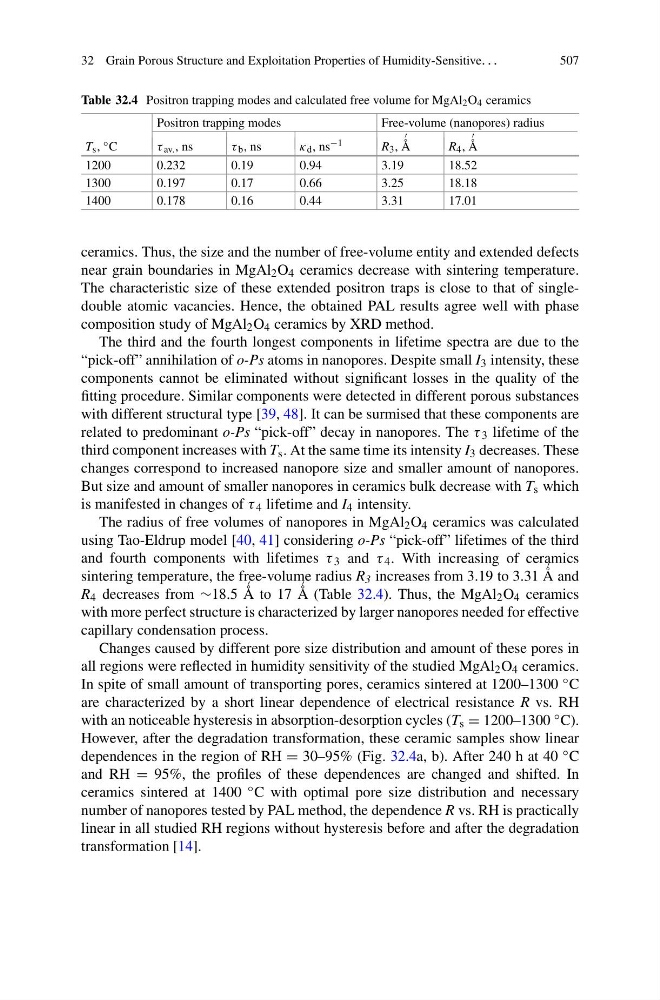
The radius of free volumes of nanopores in MgAl 2 O 4 ceramics was calculated
using Tao-Eldrup model [40, 41] considering o-Ps “pick-off” lifetimes of the third
and fourth components with lifetimes τ 3 and τ 4 . With increasing of ceramics
sintering temperature, the free-volume radius R 3 increases from 3.19 to 3.31
Å and
R 4 decreases from ∼18.5
Å to 17
Å (Table 32.4). Thus, the MgAl 2 O 4 ceramics
with more perfect structure is characterized by larger nanopores needed for effective
capillary condensation process.
Changes caused by different pore size distribution and amount of these pores in
all regions were reflected in humidity sensitivity of the studied MgAl 2 O 4 ceramics.
In spite of small amount of transporting pores, ceramics sintered at 1200–1300 ◦ C
are characterized by a short linear dependence of electrical resistance R vs. RH
with an noticeable hysteresis in absorption-desorption cycles (T s = 1200–1300 ◦ C).
However, after the degradation transformation, these ceramic samples show linear
dependences in the region of RH = 30–95% (Fig. 32.4a, b). After 240 h at 40 ◦ C
and RH = 95%, the profiles of these dependences are changed and shifted. In
ceramics sintered at 1400 ◦ C with optimal pore size distribution and necessary
number of nanopores tested by PAL method, the dependence R vs. RH is practically
linear in all studied RH regions without hysteresis before and after the degradation
transformation [14].
507
Table 32.4 Positron trapping modes and calculated free volume for MgAl 2 O 4 ceramics
Positron trapping modes
Free-volume (nanopores) radius
T s , ◦ C
τ av. , ns
τ b , ns
κ d , ns −1
R 3 ,
Å
R 4 ,
Å
1200
0.232
0.19
0.94
3.19
18.52
1300
0.197
0.17
0.66
3.25
18.18
1400
0.178
0.16
0.44
3.31
17.01
ceramics. Thus, the size and the number of free-volume entity and extended defects
near grain boundaries in MgAl 2 O 4 ceramics decrease with sintering temperature.
The characteristic size of these extended positron traps is close to that of singledouble atomic vacancies. Hence, the obtained PAL results agree well with phase
composition study of MgAl 2 O 4 ceramics by XRD method.
The third and the fourth longest components in lifetime spectra are due to the
“pick-off” annihilation of o-Ps atoms in nanopores. Despite small I 3 intensity, these
components cannot be eliminated without significant losses in the quality of the
fitting procedure. Similar components were detected in different porous substances
with different structural type [39, 48]. It can be surmised that these components are
related to predominant o-Ps “pick-off” decay in nanopores. The τ 3 lifetime of the
third component increases with T s . At the same time its intensity I 3 decreases. These
changes correspond to increased nanopore size and smaller amount of nanopores.
But size and amount of smaller nanopores in ceramics bulk decrease with T s which
is manifested in changes of τ 4 lifetime and I 4 intensity.
The radius of free volumes of nanopores in MgAl 2 O 4 ceramics was calculated
using Tao-Eldrup model [40, 41] considering o-Ps “pick-off” lifetimes of the third
and fourth components with lifetimes τ 3 and τ 4 . With increasing of ceramics
sintering temperature, the free-volume radius R 3 increases from 3.19 to 3.31
Å and
R 4 decreases from ∼18.5
Å to 17
Å (Table 32.4). Thus, the MgAl 2 O 4 ceramics
with more perfect structure is characterized by larger nanopores needed for effective
capillary condensation process.
Changes caused by different pore size distribution and amount of these pores in
all regions were reflected in humidity sensitivity of the studied MgAl 2 O 4 ceramics.
In spite of small amount of transporting pores, ceramics sintered at 1200–1300 ◦ C
are characterized by a short linear dependence of electrical resistance R vs. RH
with an noticeable hysteresis in absorption-desorption cycles (T s = 1200–1300 ◦ C).
However, after the degradation transformation, these ceramic samples show linear
dependences in the region of RH = 30–95% (Fig. 32.4a, b). After 240 h at 40 ◦ C
and RH = 95%, the profiles of these dependences are changed and shifted. In
ceramics sintered at 1400 ◦ C with optimal pore size distribution and necessary
number of nanopores tested by PAL method, the dependence R vs. RH is practically
linear in all studied RH regions without hysteresis before and after the degradation
transformation [14].