

508
H. Klym et al.
10 20 30 40 50 60 70 80 90 100
1E-3
0.01
0.1
1
10
100
,
after sintering
,
after 240 hours at 40
0
C
and Rh = 95 %
e
c
n
a
t
s
i
s
e
r
l
a
c
i
r
t
c
e
l
E
R, MOhm
Relative humidity RH,%
a
10 20 30 40 50 60 70 80 90 100
1E-3
0.01
0.1
1
10
100
b
Relative humidity RH,%
e
c
n
a
t
s
i
s
e
r
l
a
c
i
r
t
c
e
l
E
R, MOhm
,
after sintering
,
after 240 hours at 40
0 C
and Rh = 95 %
10 20 30 40 50 60 70 80 90 100
1E-3
0.01
0.1
1
10
100
c
Relative humidity RH,%
e
c
n
a
t
s
i
s
e
r
l
a
c
i
r
t
c
e
l
E
R, MOhm
,
after sintering
,
after 240 hours at 40
0 C
and Rh = 95 %
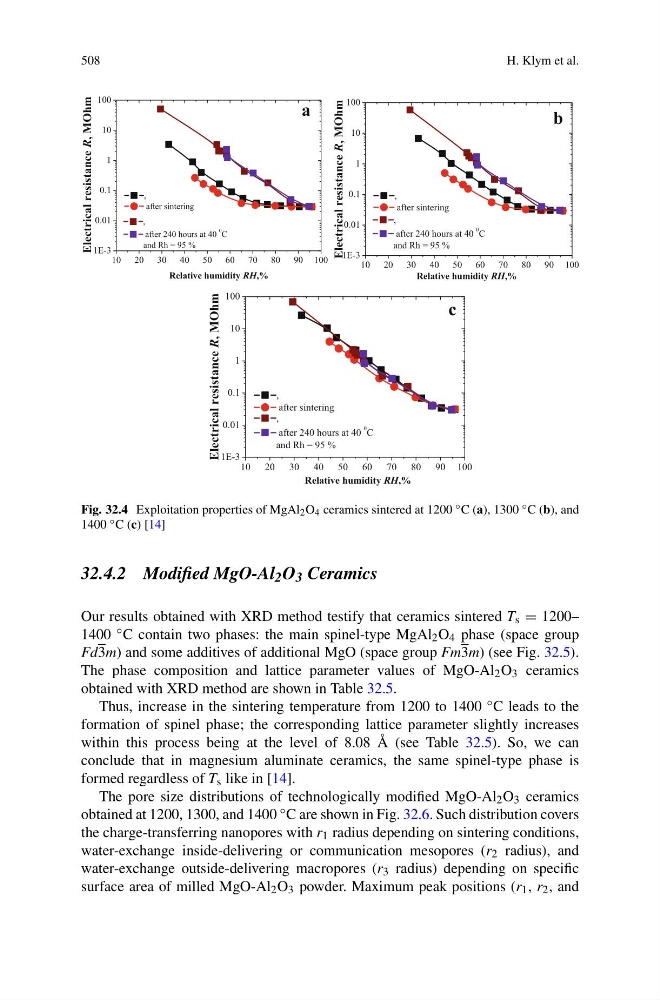
Fig. 32.4 Exploitation properties of MgAl 2 O 4 ceramics sintered at 1200 ◦ C (a), 1300 ◦ C (b), and
1400 ◦ C (c) [14]
32.4.2 Modified MgO-Al 2 O 3 Ceramics
Our results obtained with XRD method testify that ceramics sintered T s = 1200–
1400 ◦ C contain two phases: the main spinel-type MgAl 2 O 4 phase (space group
Fd3m) and some additives of additional MgO (space group Fm3m) (see Fig. 32.5).
The phase composition and lattice parameter values of MgO-Al 2 O 3 ceramics
obtained with XRD method are shown in Table 32.5.
Thus, increase in the sintering temperature from 1200 to 1400 ◦ C leads to the
formation of spinel phase; the corresponding lattice parameter slightly increases
within this process being at the level of 8.08 Å (see Table 32.5). So, we can
conclude that in magnesium aluminate ceramics, the same spinel-type phase is
formed regardless of T s like in [14].
The pore size distributions of technologically modified MgO-Al 2 O 3 ceramics
obtained at 1200, 1300, and 1400 ◦ C are shown in Fig. 32.6. Such distribution covers
the charge-transferring nanopores with r 1 radius depending on sintering conditions,
water-exchange inside-delivering or communication mesopores (r 2 radius), and
water-exchange outside-delivering macropores (r 3 radius) depending on specific
surface area of milled MgO-Al 2 O 3 powder. Maximum peak positions (r 1 , r 2 , and
H. Klym et al.
10 20 30 40 50 60 70 80 90 100
1E-3
0.01
0.1
1
10
100
,
after sintering
,
after 240 hours at 40
0
C
and Rh = 95 %
e
c
n
a
t
s
i
s
e
r
l
a
c
i
r
t
c
e
l
E
R, MOhm
Relative humidity RH,%
a
10 20 30 40 50 60 70 80 90 100
1E-3
0.01
0.1
1
10
100
b
Relative humidity RH,%
e
c
n
a
t
s
i
s
e
r
l
a
c
i
r
t
c
e
l
E
R, MOhm
,
after sintering
,
after 240 hours at 40
0 C
and Rh = 95 %
10 20 30 40 50 60 70 80 90 100
1E-3
0.01
0.1
1
10
100
c
Relative humidity RH,%
e
c
n
a
t
s
i
s
e
r
l
a
c
i
r
t
c
e
l
E
R, MOhm
,
after sintering
,
after 240 hours at 40
0 C
and Rh = 95 %
Fig. 32.4 Exploitation properties of MgAl 2 O 4 ceramics sintered at 1200 ◦ C (a), 1300 ◦ C (b), and
1400 ◦ C (c) [14]
32.4.2 Modified MgO-Al 2 O 3 Ceramics
Our results obtained with XRD method testify that ceramics sintered T s = 1200–
1400 ◦ C contain two phases: the main spinel-type MgAl 2 O 4 phase (space group
Fd3m) and some additives of additional MgO (space group Fm3m) (see Fig. 32.5).
The phase composition and lattice parameter values of MgO-Al 2 O 3 ceramics
obtained with XRD method are shown in Table 32.5.
Thus, increase in the sintering temperature from 1200 to 1400 ◦ C leads to the
formation of spinel phase; the corresponding lattice parameter slightly increases
within this process being at the level of 8.08 Å (see Table 32.5). So, we can
conclude that in magnesium aluminate ceramics, the same spinel-type phase is
formed regardless of T s like in [14].
The pore size distributions of technologically modified MgO-Al 2 O 3 ceramics
obtained at 1200, 1300, and 1400 ◦ C are shown in Fig. 32.6. Such distribution covers
the charge-transferring nanopores with r 1 radius depending on sintering conditions,
water-exchange inside-delivering or communication mesopores (r 2 radius), and
water-exchange outside-delivering macropores (r 3 radius) depending on specific
surface area of milled MgO-Al 2 O 3 powder. Maximum peak positions (r 1 , r 2 , and