

506
H. Klym et al.
Table 32.3 Fitting parameters for MgAl 2 O 4 ceramics obtained according to four-component
fitting procedure [14]
T s , ◦ C
τ 1 , ns
I 1, a.u.
τ 2 , ns
I 2, a.u.
τ 3 , ns
I 3, a.u.
τ 4 , ns
I 4, a.u.
1200
0.164
0.73
0.443
0.24
2.347
0.011
70.51
0.020
1300
0.155
0.82
0.414
0.16
2.426
0.008
68.74
0.014
1400
0.152
0.88
0.388
0.11
2.504
0.007
62.32
0.008
According to SEM data, the observed phases are nonuniformly distributed within
ceramics bulk, being more clearly pronounced near grain boundaries (see Fig. 32.3).
These phase extractions serve as specific trapping centers for positrons penetrating
ceramics. By using PAL technique in addition to XRD and porosimetry methods,
we have made an attempt to study more carefully the chemical characteristics of
these extracted phases in MgAl 2 O 4 ceramics sintered at different T s . We aim also
to estimate the size of nanopores in ceramics bulk, where capillary condensation
processes occur.
It has been shown already that for MgAl 2 O 4 ceramics two of positron annihilation channels should be considered – the positron trapping with shortest τ 1 and
middle τ 2 lifetimes and o-Ps decaying (“pick-off” annihilation) with the longest τ 3
and τ 4 lifetimes [14, 16].
Assuming the two-state positron trapping model for spinel ceramics [8, 9, 38],
four components in the fit of the experimental PAL spectra can be associated
with the microstructure peculiarities of the spinel. This microstructure exhibits
characteristic octahedral and tetrahedral cation vacancies (τ 1 , I 1 ), positron trapping
extended defects located near grain boundaries, and positron traps in the freevolume entities (τ 2 , I 2 ). O-Ps decay in the water-filled nanopores of ceramics is
described by τ 3 , I 3 and τ 4 , I 4 . Within the formalism of this model, the open volume
entities free of the electron density are treated as “defects,” while hypothetical
structure without these entities is treated as the “defect-free” bulk (represented by
τ b value).
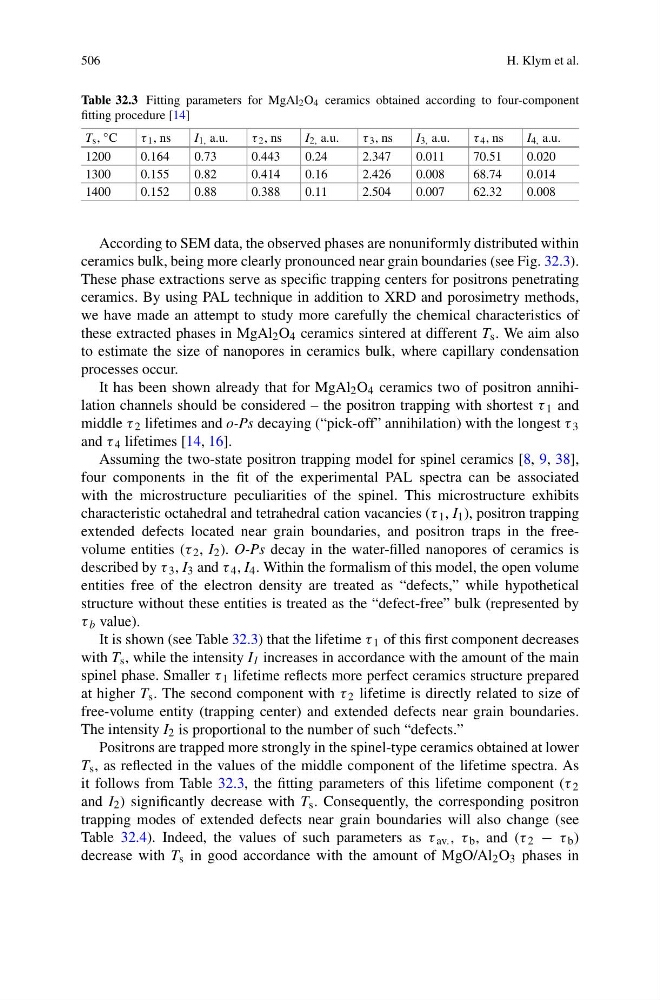
It is shown (see Table 32.3) that the lifetime τ 1 of this first component decreases
with T s , while the intensity I 1 increases in accordance with the amount of the main
spinel phase. Smaller τ 1 lifetime reflects more perfect ceramics structure prepared
at higher T s . The second component with τ 2 lifetime is directly related to size of
free-volume entity (trapping center) and extended defects near grain boundaries.
The intensity I 2 is proportional to the number of such “defects.”
Positrons are trapped more strongly in the spinel-type ceramics obtained at lower
T s , as reflected in the values of the middle component of the lifetime spectra. As
it follows from Table 32.3, the fitting parameters of this lifetime component (τ 2
and I 2 ) significantly decrease with T s . Consequently, the corresponding positron
trapping modes of extended defects near grain boundaries will also change (see
Table 32.4). Indeed, the values of such parameters as τ av. , τ b , and (τ 2 − τ b )
decrease with T s in good accordance with the amount of MgO/Al 2 O 3 phases in
H. Klym et al.
Table 32.3 Fitting parameters for MgAl 2 O 4 ceramics obtained according to four-component
fitting procedure [14]
T s , ◦ C
τ 1 , ns
I 1, a.u.
τ 2 , ns
I 2, a.u.
τ 3 , ns
I 3, a.u.
τ 4 , ns
I 4, a.u.
1200
0.164
0.73
0.443
0.24
2.347
0.011
70.51
0.020
1300
0.155
0.82
0.414
0.16
2.426
0.008
68.74
0.014
1400
0.152
0.88
0.388
0.11
2.504
0.007
62.32
0.008
According to SEM data, the observed phases are nonuniformly distributed within
ceramics bulk, being more clearly pronounced near grain boundaries (see Fig. 32.3).
These phase extractions serve as specific trapping centers for positrons penetrating
ceramics. By using PAL technique in addition to XRD and porosimetry methods,
we have made an attempt to study more carefully the chemical characteristics of
these extracted phases in MgAl 2 O 4 ceramics sintered at different T s . We aim also
to estimate the size of nanopores in ceramics bulk, where capillary condensation
processes occur.
It has been shown already that for MgAl 2 O 4 ceramics two of positron annihilation channels should be considered – the positron trapping with shortest τ 1 and
middle τ 2 lifetimes and o-Ps decaying (“pick-off” annihilation) with the longest τ 3
and τ 4 lifetimes [14, 16].
Assuming the two-state positron trapping model for spinel ceramics [8, 9, 38],
four components in the fit of the experimental PAL spectra can be associated
with the microstructure peculiarities of the spinel. This microstructure exhibits
characteristic octahedral and tetrahedral cation vacancies (τ 1 , I 1 ), positron trapping
extended defects located near grain boundaries, and positron traps in the freevolume entities (τ 2 , I 2 ). O-Ps decay in the water-filled nanopores of ceramics is
described by τ 3 , I 3 and τ 4 , I 4 . Within the formalism of this model, the open volume
entities free of the electron density are treated as “defects,” while hypothetical
structure without these entities is treated as the “defect-free” bulk (represented by
τ b value).
It is shown (see Table 32.3) that the lifetime τ 1 of this first component decreases
with T s , while the intensity I 1 increases in accordance with the amount of the main
spinel phase. Smaller τ 1 lifetime reflects more perfect ceramics structure prepared
at higher T s . The second component with τ 2 lifetime is directly related to size of
free-volume entity (trapping center) and extended defects near grain boundaries.
The intensity I 2 is proportional to the number of such “defects.”
Positrons are trapped more strongly in the spinel-type ceramics obtained at lower
T s , as reflected in the values of the middle component of the lifetime spectra. As
it follows from Table 32.3, the fitting parameters of this lifetime component (τ 2
and I 2 ) significantly decrease with T s . Consequently, the corresponding positron
trapping modes of extended defects near grain boundaries will also change (see
Table 32.4). Indeed, the values of such parameters as τ av. , τ b , and (τ 2 − τ b )
decrease with T s in good accordance with the amount of MgO/Al 2 O 3 phases in