

32 Grain Porous Structure and Exploitation Properties of Humidity-Sensitive. . .
505
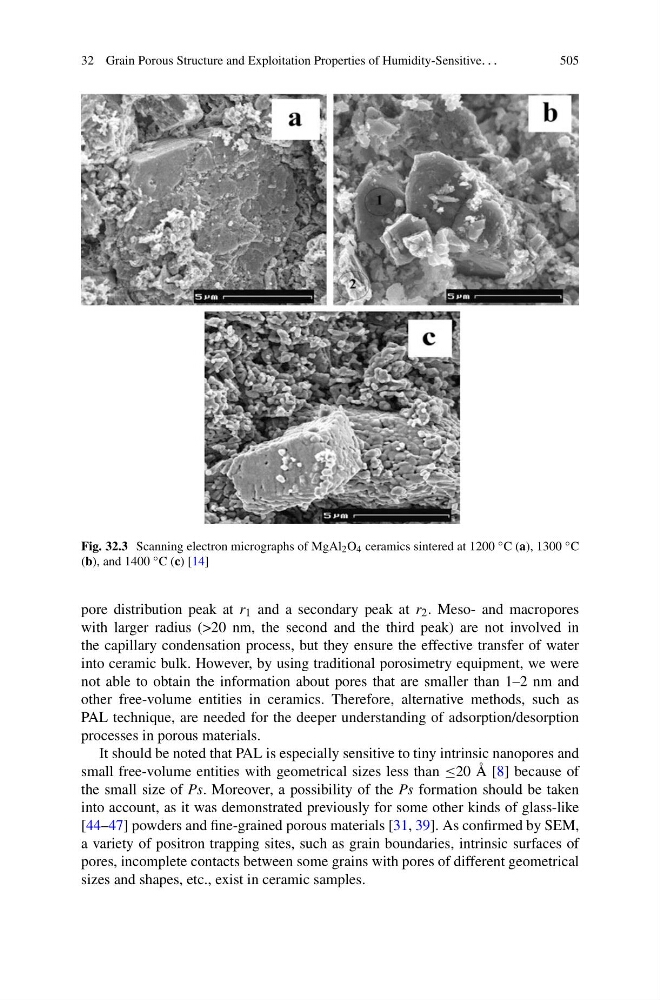
Fig. 32.3 Scanning electron micrographs of MgAl 2 O 4 ceramics sintered at 1200 ◦ C (a), 1300 ◦ C
(b), and 1400 ◦ C (c) [14]
pore distribution peak at r 1 and a secondary peak at r 2 . Meso- and macropores
with larger radius (>20 nm, the second and the third peak) are not involved in
the capillary condensation process, but they ensure the effective transfer of water
into ceramic bulk. However, by using traditional porosimetry equipment, we were
not able to obtain the information about pores that are smaller than 1–2 nm and
other free-volume entities in ceramics. Therefore, alternative methods, such as
PAL technique, are needed for the deeper understanding of adsorption/desorption
processes in porous materials.
It should be noted that PAL is especially sensitive to tiny intrinsic nanopores and
small free-volume entities with geometrical sizes less than ≤20 Å [8] because of
the small size of Ps. Moreover, a possibility of the Ps formation should be taken
into account, as it was demonstrated previously for some other kinds of glass-like
[44–47] powders and fine-grained porous materials [31, 39]. As confirmed by SEM,
a variety of positron trapping sites, such as grain boundaries, intrinsic surfaces of
pores, incomplete contacts between some grains with pores of different geometrical
sizes and shapes, etc., exist in ceramic samples.
505
Fig. 32.3 Scanning electron micrographs of MgAl 2 O 4 ceramics sintered at 1200 ◦ C (a), 1300 ◦ C
(b), and 1400 ◦ C (c) [14]
pore distribution peak at r 1 and a secondary peak at r 2 . Meso- and macropores
with larger radius (>20 nm, the second and the third peak) are not involved in
the capillary condensation process, but they ensure the effective transfer of water
into ceramic bulk. However, by using traditional porosimetry equipment, we were
not able to obtain the information about pores that are smaller than 1–2 nm and
other free-volume entities in ceramics. Therefore, alternative methods, such as
PAL technique, are needed for the deeper understanding of adsorption/desorption
processes in porous materials.
It should be noted that PAL is especially sensitive to tiny intrinsic nanopores and
small free-volume entities with geometrical sizes less than ≤20 Å [8] because of
the small size of Ps. Moreover, a possibility of the Ps formation should be taken
into account, as it was demonstrated previously for some other kinds of glass-like
[44–47] powders and fine-grained porous materials [31, 39]. As confirmed by SEM,
a variety of positron trapping sites, such as grain boundaries, intrinsic surfaces of
pores, incomplete contacts between some grains with pores of different geometrical
sizes and shapes, etc., exist in ceramic samples.