

504
H. Klym et al.
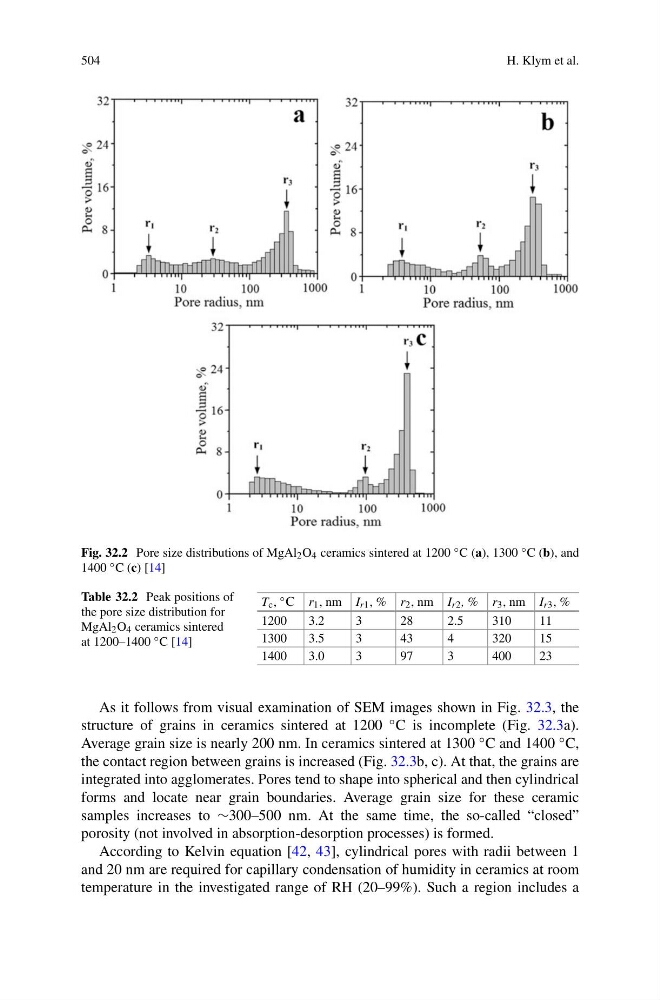
Fig. 32.2 Pore size distributions of MgAl 2 O 4 ceramics sintered at 1200 ◦ C (a), 1300 ◦ C (b), and
1400 ◦ C (c) [14]
Table 32.2 Peak positions of
the pore size distribution for
MgAl 2 O 4 ceramics sintered
at 1200–1400 ◦ C [14]
T c , ◦ ´ r 1 , nm I r1 , % r 2 , nm I r2 , % r 3 , nm I r3 , %
1200
3.2
3
28
2.5
310
11
1300
3.5
3
43
4
320
15
1400
3.0
3
97
3
400
23
As it follows from visual examination of SEM images shown in Fig. 32.3, the
structure of grains in ceramics sintered at 1200 ◦ C is incomplete (Fig. 32.3a).
Average grain size is nearly 200 nm. In ceramics sintered at 1300 ◦ C and 1400 ◦ C,
the contact region between grains is increased (Fig. 32.3b, c). At that, the grains are
integrated into agglomerates. Pores tend to shape into spherical and then cylindrical
forms and locate near grain boundaries. Average grain size for these ceramic
samples increases to ∼300–500 nm. At the same time, the so-called “closed”
porosity (not involved in absorption-desorption processes) is formed.
According to Kelvin equation [42, 43], cylindrical pores with radii between 1
and 20 nm are required for capillary condensation of humidity in ceramics at room
temperature in the investigated range of RH (20–99%). Such a region includes a
H. Klym et al.
Fig. 32.2 Pore size distributions of MgAl 2 O 4 ceramics sintered at 1200 ◦ C (a), 1300 ◦ C (b), and
1400 ◦ C (c) [14]
Table 32.2 Peak positions of
the pore size distribution for
MgAl 2 O 4 ceramics sintered
at 1200–1400 ◦ C [14]
T c , ◦ ´ r 1 , nm I r1 , % r 2 , nm I r2 , % r 3 , nm I r3 , %
1200
3.2
3
28
2.5
310
11
1300
3.5
3
43
4
320
15
1400
3.0
3
97
3
400
23
As it follows from visual examination of SEM images shown in Fig. 32.3, the
structure of grains in ceramics sintered at 1200 ◦ C is incomplete (Fig. 32.3a).
Average grain size is nearly 200 nm. In ceramics sintered at 1300 ◦ C and 1400 ◦ C,
the contact region between grains is increased (Fig. 32.3b, c). At that, the grains are
integrated into agglomerates. Pores tend to shape into spherical and then cylindrical
forms and locate near grain boundaries. Average grain size for these ceramic
samples increases to ∼300–500 nm. At the same time, the so-called “closed”
porosity (not involved in absorption-desorption processes) is formed.
According to Kelvin equation [42, 43], cylindrical pores with radii between 1
and 20 nm are required for capillary condensation of humidity in ceramics at room
temperature in the investigated range of RH (20–99%). Such a region includes a